
SGD-BA: Bridging Swarm Intelligence and Gradient Descent for Precise Optimization
Sign gradient descent method based bat searching algorithm with application to the economic load dispatch problem
The paper introduces SGD-BA, a hybrid metaheuristic optimization algorithm that integrates the Sign Gradient Descent (SGD) method into the traditional Bat Algorithm (BA). By incorporating first-order gradient information into the bat velocity update equations, the method achieves superior convergence accuracy and stability compared to the original BA and its variants, particularly in complex global optimization tasks.
Executive Summary
TL;DR: This paper presents SGD-BA, a novel hybrid optimization framework that fuses the global exploration capabilities of the Bat Algorithm (BA) with the local exploitation precision of the Sign Gradient Descent (SGD) method. By injecting a sign-based gradient term into the bat's movement dynamics, the researchers have effectively addressed the "precision bottleneck" that plagues many nature-inspired metaheuristics.
Context: In the landscape of optimization, metaheuristics are often viewed as "blind" global searchers. This work acts as a significant "theoretical patch," providing BA with "eyes" (gradients) to navigate complex terrains more effectively. It identifies itself as a high-performance contender for heavy-duty engineering applications, specifically the Economic Load Dispatch (ELD) problem in power systems.
The Motivation: Why Bats Need More Than Echolocation
The original Bat Algorithm (BA) mimics the echolocation behavior of microbats to find global minima. While efficient at covering large search spaces, it relies on random walks and proximity-based updates.
The primary pain point is the lack of a Gradient Term. Without gradients, the bats effectively guess the local slope of the cost function. This leads to:
- Low Local Accuracy: Oscillation around the global optimum without ever truly landing on it.
- Vanishing/Exploding Gradients: Even when gradients are used in some variants, the amplitude variance can destabilize the search.
The authors' insight was to utilize the Sign of the Gradient. By focusing only on the direction ((+1, -1, 0)) rather than the magnitude, they can maintain a stable, tunable step size that ignores the scale of the objective function, thus avoiding numerical instability.
Methodology: Injecting Intelligence into Echolocation
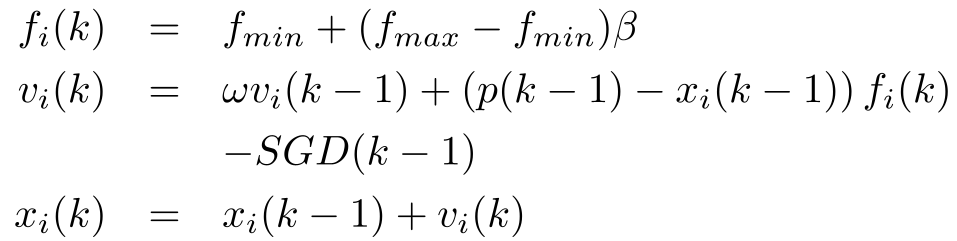
The core innovation lies in the modified Velocity Update Equation. Instead of the traditional update, the researchers introduced an inertia weight (\omega) and a sign-gradient term:
The SGD Term Explained
The term (SGD(k-1) = d(k-1) imes ext{sign}( abla F(x))) ensures that each bat takes a step in the steepest descent direction.
- Modification 1: A precise but computationally expensive partial derivative approximation involving nested function evaluations.
- Modification 2: A faster, heuristic approximation that scales better for high-dimensional problems.
System Dynamics Stability
A significant portion of the paper is dedicated to proving why this works. Using Z-transform analysis, the authors derived the convergence criteria:
- The inertia weight must satisfy (-1 < \omega < 1).
- The frequency and step size must be tuned to keep the system roots within the unit circle of the complex plane.
Experimental Evidence & Results
1. Mathematical Benchmarking
The SGD-BA was tested against 15 functions from the CEC 2018 competition, covering separable, overlapping, and non-separable landscapes.
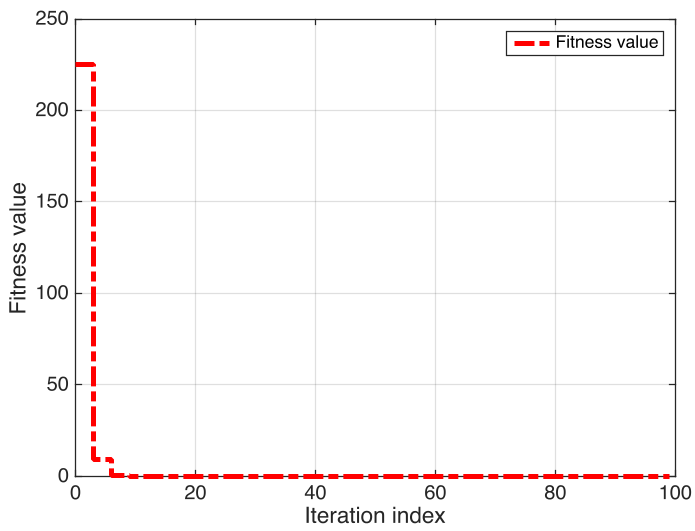 Figure: The fitness value curve shows the rapid descent and elite stability of the SGD-BA compared to standard fluctuations.
2. Engineering Application: Economic Load Dispatch
The ultimate test was the Economic Load Dispatch (ELD) problem—finding the cheapest way to generate power across multiple plants while meeting demand and transmission constraints.
| Method | Min Cost | Mean Cost | Std. Deviation |
|---|---|---|---|
| Traditional BA | 5.9465e+05 | 5.9684e+05 | 83.62 |
| SGD-BA (Proposed) | 4.5695e+05 | 4.5727e+05 | 213.79 |
The results indicate that SGD-BA found significantly cheaper generation configurations than the base BA, proving that gradient-awareness is critical for highly constrained industrial problems.
Critical Analysis & Future Outlook
Takeaways
- Sign Matters More Than Magnitude: This paper reinforces the idea that in stochastic optimization, the direction of the gradient is often more valuable and robust than its exact value.
- Hybridization is Key: Pure metaheuristics are rarely enough for industrial-grade precision; the inclusion of first-order calculus is a necessary evolution.
Limitations
- Computational Overhead: Calculating the gradient approximation (Modification 1) requires multiple function evaluations per iteration, which might be prohibitive for extremely heavy simulation environments.
- Constraint Handling: While it works for ELD, more complex non-convex constraints might require further refinement of the "Local Search" logic in the algorithm.
Future Work
The researchers suggest exploring this hybrid approach for multi-objective optimization and expanding its application into broader energy system management where non-linear cost functions are the norm.
Summary: If you are working on metaheuristics, this paper serves as a roadmap for "professionalizing" your algorithm by integrating classical optimization theory.