
Sig4UDD: Navigating the Uncertainty of Selfishness in Mobile Social Networks
A Signaling Game for Uncertain Data Delivery in Selfish Mobile Social Networks
The paper proposes Sig4UDD, a novel signaling game approach designed to model and manage uncertain data delivery in Mobile Social Networks (MSNs) populated by socially selfish (SS) nodes. By leveraging Bayesian Nash Equilibrium (BNE) and Perfect Bayesian Equilibrium (PBE), the method optimizes message forwarding decisions based on evolved beliefs about node types and social tie strength.
TL;DR
In the chaotic environment of Mobile Social Networks (MSNs), nodes often refuse to cooperate to save their own resources—a phenomenon known as social selfishness. Sig4UDD introduces a signaling game framework that allows nodes to "guess" the trustworthiness and type of their peers using social features. By calculating a Weighted Social Distance (WSD) and reaching a Perfect Bayesian Equilibrium, Sig4UDD dramatically slashes delivery costs while maintaining competitive speeds, proving that we can build efficient networks even when no one wants to help "strangers."
The Motivation: Why Altruism is a Flawed Assumption
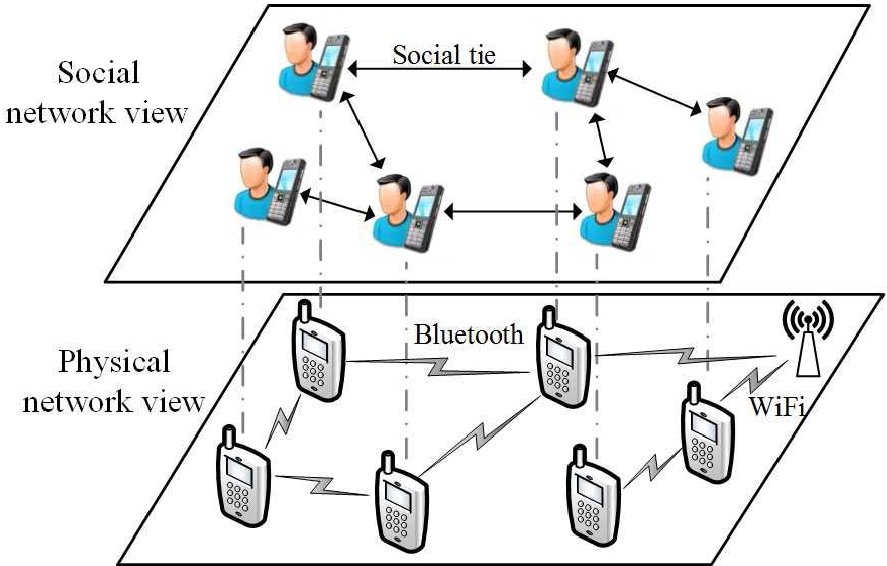
Most routing protocols for intermittently connected networks (like DTNs) operate on a "Utopian" assumption: every node is happy to relay everyone else's data. In reality, users are Socially Selfishly (SS). They might help a friend but ignore a stranger to save battery or memory.
The hardest part? Nodes don't broadcast their selfishness. This creates a state of uncertainty. If a node encounters a peer, it doesn't know if the peer is a "Good Samaritan" (Fully Cooperative) or a "Strategic Player" (Socially Selfish). This paper treats this interaction not just as a routing problem, but as a high-stakes game of incomplete information.
Methodology: The Science of "Beliefs" and "Signals"
1. Modeling Social Ties (WSD)
The authors don't just count contacts. They propose a Weighted Social Distance (WSD). Using Gower coefficients, they integrate diverse features like Bluetooth frequency, interests, and SMS logs, assigning weights to each to reflect their true social significance.
- Intuition: If we share the same music interests and frequently call each other, the "cost" of me helping you is offset by our social tie.
2. The Signaling Game Framework
The interaction is modeled as a two-player game:
- Sender: Chooses to "Forward" or "Hold" a message (Signal).
- Receiver: Chooses to "Accept" or "Drop" based on their Belief of the sender's type.
3. Bayesian Evolution
The "Belief System" is the brain of Sig4UDD. When nodes meet for the first time, they initialize a belief based on social distance. As the game progresses across multiple stages (multistage interactions), they update these beliefs using Bayes' theorem.
- If a node consistently acts like an SS node, its peers will eventually treat it as one, reaching a Perfect Bayesian Equilibrium (PBE).
Experiments: Real-World Proof
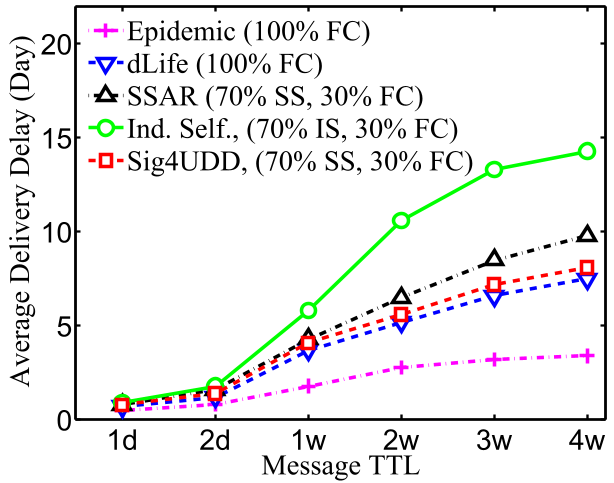
The researchers tested Sig4UDD against heavyweights like Epidemic (flooding) and dLife (social-based) using the Reality Mining (MIT) and Social Evolution datasets.
Key Findings:
- Cost Efficiency: Sig4UDD achieved the lowest delivery cost. Compared to the Ind-Self (purely selfish) protocol, it was 300% more efficient. This is because nodes only transfer data when there is a high "social utility" and belief of acceptance.
- Delay Reduction: By predicting successful relays, it outperformed other selfish protocols (SSAR) by about 18% in delivery speed.
Critical Analysis: The Price of Disbelief
While Sig4UDD is a masterclass in efficiency, it has a trade-off: Delivery Ratio. Because SS nodes are selective and can choose to "Hold" messages if they suspect the receiver won't cooperate, some messages never reach their destination compared to "flood-everything" protocols like Epidemic.
Academic Insight: Sig4UDD effectively converts a "Quantity" problem (delivering everything at any cost) into a "Quality" problem (delivering efficiently through trusted social channels).
Conclusion
Sig4UDD represents a significant step in making Mobile Social Networks more realistic. By treating social data as a "signal" in a game-theoretic architecture, the paper provides a blueprint for future 6G and IoT networks where resource management and user behavior are inextricably linked. The next frontier? Incentivizing these selfish nodes to help even those outside their social circle.
Source: A Signaling Game for Uncertain Data Delivery in Selfish Mobile Social Networks (IEEE Transactions).