
From Dots to Hertz: A Spectral Journey Through Communication History
Signals in Communication Engineering History
This paper provides a comprehensive technical and historical analysis of quintessential signals in communication engineering, tracing the evolution from 19th-century wired telegraphy to the 1930s advent of Frequency Modulation (FM). Using MATLAB-based simulations, the authors provide time and frequency domain representations for landmark signals including Morse code, spark-gap wireless, CW (Continuous Wave), AM, and FM.
TL;DR
Communication engineering didn't start with clean sine waves; it began with the clicking of magnets and the roar of electric sparks. This paper bridges the gap between historical narrative and rigorous signal analysis, using MATLAB to visualize how signals morphed from 19th-century Morse code to the high-fidelity FM signals that defined the 20th century.
Back to the Roots: The Problem of "Dirty" Signals
Before the elegant mathematics of Maxwell were proven, inventors like Morse and Bell were essentially "hacking" electricity. The early telegraph was digital in nature—long and short pulses of current. However, as lines crossed cities, the need for Multiplexing arose. This birthed the Harmonic Telegraph, which used audible tones to carry multiple messages. Yet, the real chaos began with wireless.
The first wireless signals (Hertz's sparks) were exponentially damped sinusoids. In the frequency domain, these were "spectral vandals"—wideband signals that leaked energy everywhere, causing massive electromagnetic interference (EMI).
Methodology: Simulating the Past
The authors use MATLAB to recreate these historical signals, ensuring modern constraints (like the Nyquist-Shannon theorem) are met. They focus on two critical domains:
- Time Domain: Visualizing pulse duration, damping factors, and carrier envelopes.
- Frequency Domain (The Spectrum): Using FFT to show how energy spreads across the spectrum.
The Pulse of the Telegraph
Morse code is often simplified as "on/off" states. But when analyzed, the transitions create a sinc-like spectrum. When modulated onto a carrier (Harmonic Telegraph), this spectrum shifts, allowing multiple "singing tones" to coexist on a single wire—the birth of Frequency Division Multiplexing (FDM).
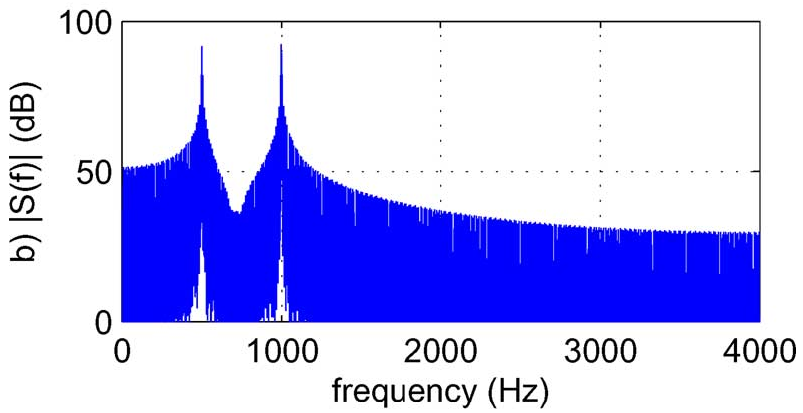 Fig 1. Spectral magnitude of the famous message "What hath God wrought."
The Spark Gap Era: Spectral Chaos
Marconi’s early wireless transmitters used spark gaps. These generated pulses that decayed rapidly. The paper highlights a critical insight: the Damping Factor.
- High Damping: The signal decays quickly, resembling an impulse. Its spectrum is extremely wide, causing interference.
- Low Damping (The Braun/Tesla improvement): Inductive coupling allowed the signal to "ring" longer. This narrowed the bandwidth, a primitive but essential step toward modern tuning.
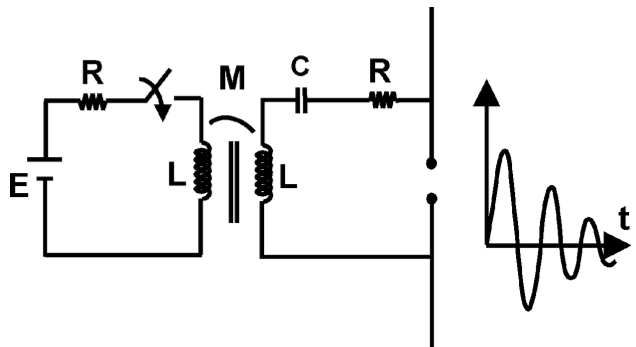 Fig 2. The equivalent RLC circuit of a Hertzian transmitter.
The Continuous Wave (CW) Revolution
Fessenden realized that voice could not be carried by sparks; it required a Continuous Wave (CW). This shifted the paradigm from pulse-based logic to Amplitude Modulation (AM). By translating the baseband audio spectrum to a high-frequency carrier, wireless communication became continuous and "smooth."
The Armstrong Breakthrough: FM
Edwin Armstrong's genius was counter-intuitive. While the industry sought narrow bands to avoid interference, Armstrong proposed Frequency Modulation (FM). By varying the frequency instead of the amplitude, he achieved unprecedented noise immunity. The spectrograms in the paper beautifully show how FM mimics the time-domain shape of speech within the frequency variations themselves.
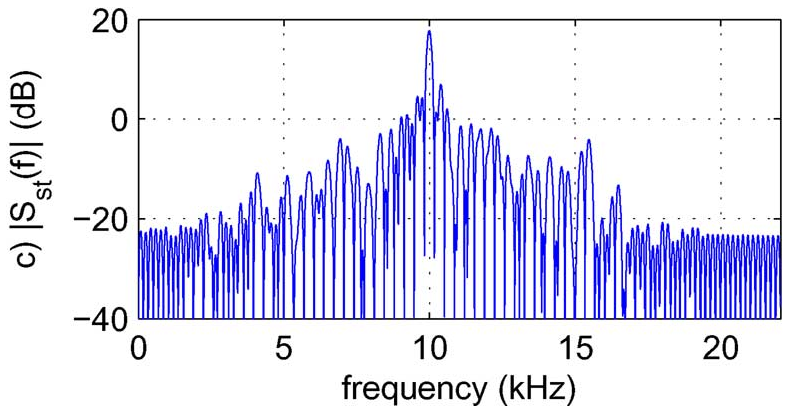 Fig 3. Spectrogram of the speech signal "What hath God wrought" modulated in frequency (FM).
Critical Insight & Conclusion
The evolution of communication engineering is fundamentally a story of control. We moved from uncontrolled, wideband sparks to precisely modulated carriers. This paper serves as a technical bridge: it reminds us that every digital bit we send today is built on a century-old foundation of managing the spectrum.
Takeaway: Understanding the "Why" behind AM/FM and Spark-gap systems isn't just for historians; it provides the physical intuition needed to design the next generation of wireless systems, where spectrum management remains our most precious resource.