
Mapping Conflict: Spectral Embedding for Signed and Directed Social Networks
Signed Directed Social Network Analysis Applied to Group Conflict
The paper introduces a novel spectral embedding technique for social networks that are both signed (positive/negative ties) and directed (asymmetric relationships). By combining two specialized spectral methods, it maps complex interactions into a geometric space where distance reflects dissimilarity, achieving a unified representation suitable for analyzing conflict ecosystems in North-West Africa.
TL;DR
Real-world social networks are messy—relationships are rarely just "friends" or "enemies," and they often flow in one direction (like command-and-control). This paper introduces a robust spectral embedding technique that handles both signs and directions. By transforming a single node into four functional versions, the authors provide a mathematical lens to visualize and quantify the complex "ecosystems" of insurgent groups in North-West Africa.
Problem & Motivation: Beyond "Likes" and "Dislikes"
Traditional Social Network Analysis (SNA) often simplifies relationships into undirected, positive-only edges. However, in intelligence and law enforcement, the "push" and "pull" of a relationship matter:
- Directionality: In a hierarchy, A may influence B, but B does not influence A.
- Sign: Alliances (+) co-exist with conflicts (-).
The technical bottleneck? Spectral graph models—the engines behind graph embeddings—require symmetric matrices. Previous attempts to "symmetrize" directed graphs often introduced noise, made matrices too dense, or misrepresented the importance of isolated nodes. Furthermore, negative weights are notoriously difficult because the "enemy of my enemy" is not always a friend; sometimes, they are just another hazard.
Methodology: The Four-Version Node Replication
The authors’ core insight is to encode relationship semantics into the graph structure itself before performing spectral decomposition. They transform each node into a quartet:
- In-Positive
- Out-Positive
- In-Negative
- Out-Negative
These four versions are connected via a 4-clique, where the edge weights represent the sum of the incident weights of the original node.
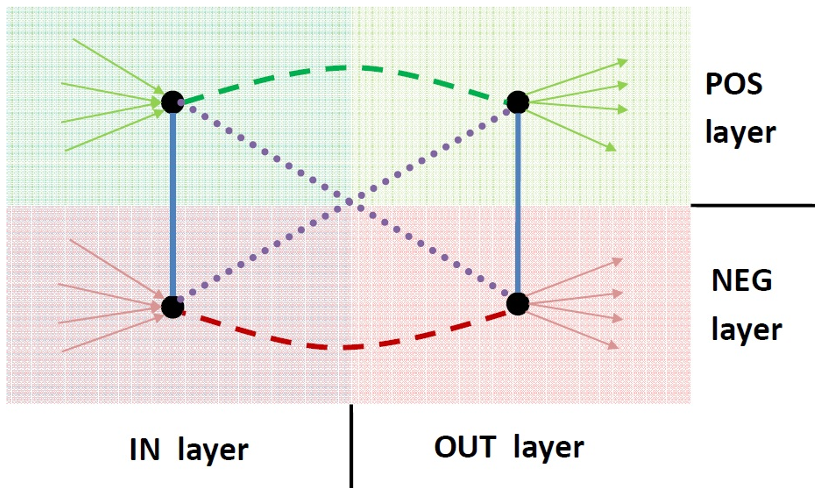
This structure is then represented by a specialized Laplacian matrix, : where is the adjacency matrix of the expanded 4-version graph. This allows the embedding to place "allies" close together and "foes" far apart while accounting for the flow of influence.
Experimental Insights: Radical Groups in Africa
The team tested their approach on the ACLED dataset, covering years of conflict in Algeria, Libya, and Nigeria.
1. Identifying "Net Flow"
The distance between the "In" and "Out" versions of the same node reveals a group's role. A long positive-positive edge suggests a group receives support from one set of actors and passes it to an entirely different set (a "bridge"). Conversely, a short negative-negative edge suggests a group is receiving hostility from all directions—making them a common target of a diverse coalition.
2. The Case of Boko Haram
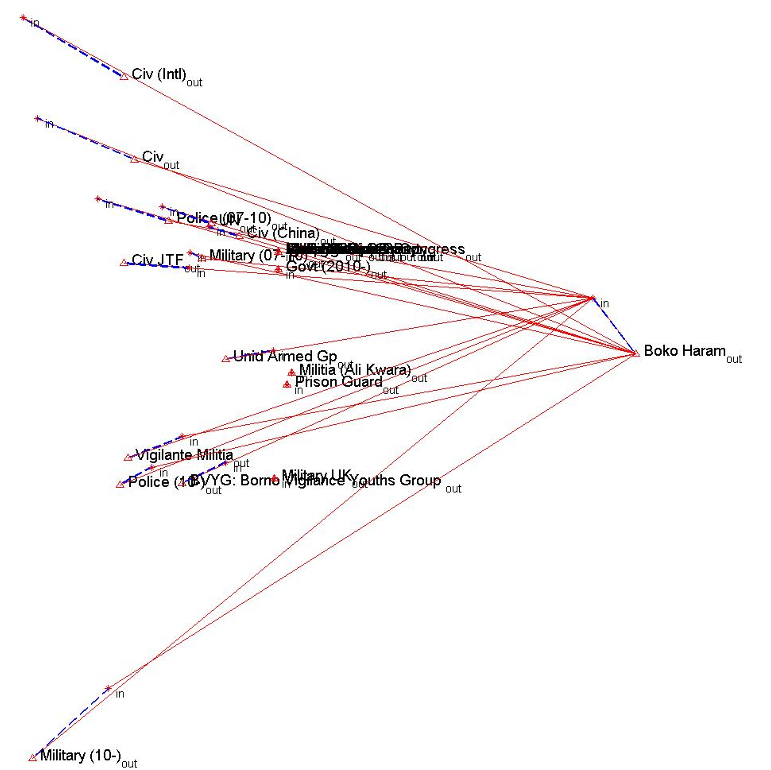
In Nigeria, the embedding clearly isolated Boko Haram. The group exhibits a relatively long "dashed edge" between its in and out versions, signaling its isolated, predatory nature.
3. Quantitative Anomalies
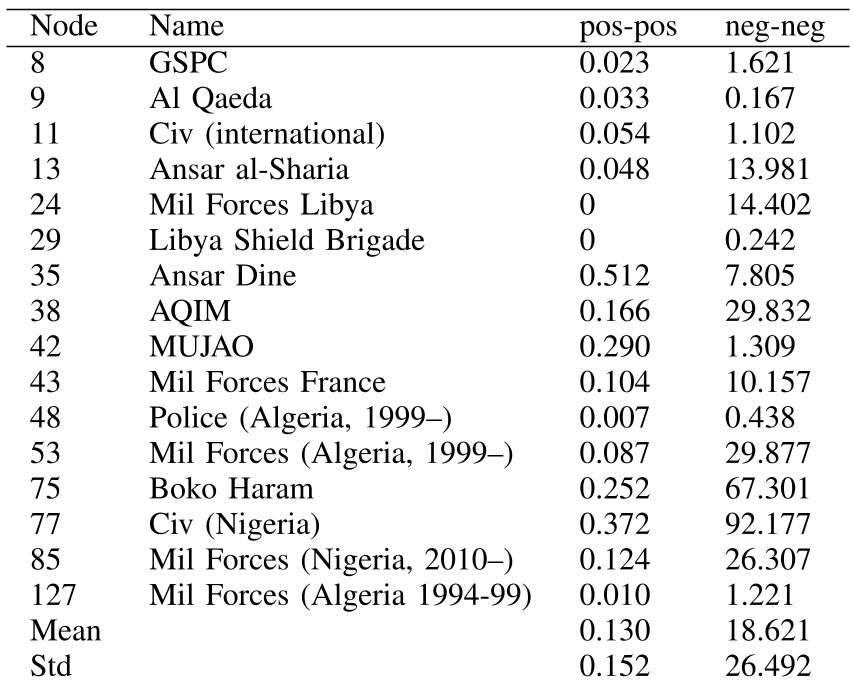
The authors defined Normalized Edge Length to automatically flag "unusual" actors. As seen in the table below, groups like Ansar al-Sharia and Boko Haram have negative-negative lengths far exceeding the mean (13.98 and 67.30 vs a mean of 18.62), statistically highlighting their roles as catalysts of extreme conflict.
Critical Analysis & Conclusion
The value of this work lies in its ability to handle asymmetric hostility. By projecting these dynamics onto a geometric space, it reveals hidden similarities—for instance, identifying that two radical groups (AQIM and GSPC) are nearly identical in their relationship profiles, despite using different names.
Takeaway: Effective SNA for high-stakes environments requires moving beyond simple graph layouts to structured representations that respect the physical intuition of "push/pull" and "flow."
Limitations: While powerful, the "four-version" replication quadruples the number of points in an embedding, making visualizations cluttered for very large networks (e.g., >2,000 nodes). Future work might look into dimensionality reduction techniques that can compress these four versions without losing the directional semantics.