
SLP: Harnessing the Power of Optimism and Pessimism for Signed Link Prediction
Signed Link Prediction with Sparse Data: The Role of Personality Information
2019-05-13
Summary
Problem
Method
Results
Takeaways
Abstract
This paper introduces SLP (Signed Link Prediction), a novel framework that leverages user personality traits—specifically optimism and pessimism—to predict positive and negative links in social networks. By integrating personality information as regularizations within a low-rank matrix factorization model, the authors achieve SOTA performance in sparse signed link environments.
## TL;DR
Predicting who will trust or distrust whom on social media is notoriously difficult due to extreme data sparsity. This paper presents **SLP (Signed Link Prediction)**, a framework that solves this by looking beyond the network graph. By quantifying a user's **optimism and pessimism** through their general rating behavior and opinions, SLP uses psychological insights to "fill in the gaps," outperforming traditional structural models by significant margins.
## The Sparsity Bottleneck
In any social network, explicit negative links are rare. Users are generally more vocal about their friendships than their "foes." This creates a massive imbalance that breaks traditional algorithms:
1. **Topological Methods** (e.g., Balance Theory): If a user has no links yet, there are no "triangles" to complete.
2. **Standard Matrix Factorization**: Without sufficient interactions, the latent vectors remain poorly defined, leading to biased or random predictions.
The authors' core **Insight** is that link formation is not just a structural phenomenon but a psychological one. An optimistic user is fundamentally more likely to overlook a person's flaws and establish a positive link, while a pessimist is predisposed to notice negative traits and signal distrust.
## Methodology: Personality as a Regularizer
The authors propose a multi-step workflow to turn abstract personality traits into mathematical constraints.
### 1. Quantification of Personality
Since users don't label themselves as "optimists," SLP infers it from exogenous data:
- **Scenario 1 (Ratings):** Users who consistently rate "bad" items (items with low average scores) higher than the average are deemed optimistic.
- **Scenario 2 (Opinions):** Users who express positive opinions toward "controversial" or generally disliked users are categorized as optimistic.
### 2. The SLP Framework
The model builds upon the low-rank matrix factorization objective:
$$ \min_{\mathbf{U}, \mathbf {V}} || \mathbf{W} \odot (\mathbf{G} - \mathbf{U V U}^{ op}) ||_F^2 $$
To this, they add **Personality Regularization**. If user $i$ is more optimistic than user $j$ ($o_i - o_j > t_o$), the model penalizes the loss if user $i$'s predicted degree is not higher than user $j$'s. This forces the latent representations $\mathbf{U}$ to respect the psychological propensity of the users.

*The objective function integrates latent factor modeling with personality-driven constraints (Eq. 5).*
## Experimental Results: Dominating the Sparse Regime
The framework was tested on **Epinions** (trust/distrust) and **Slashdot** (friend/foe).
### SOTA Comparison
SLP consistently beat structural methods like **All23** (topological features) and **TDP** (propagation-based). Remarkably, SLP achieved an AUC of **0.8725** on Epinions, whereas standard Matrix Factorization (MF) only reached **0.7265**. This proves that the personality constraints provide essential "anchor points" for the model in sparse regions of the graph.
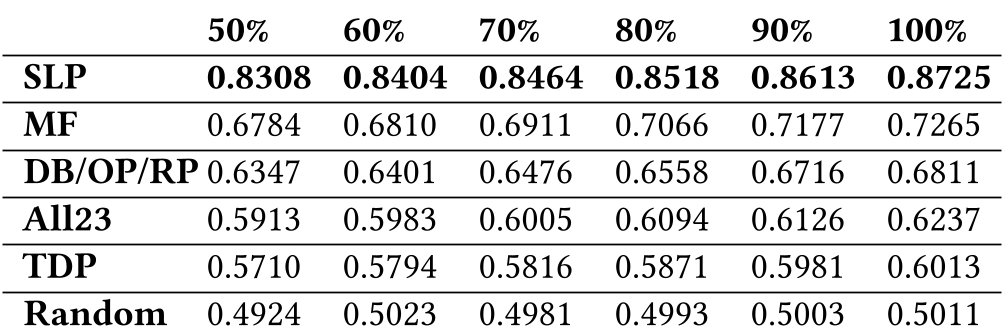
*Results on Epinions: SLP shows a dramatic lead over traditional topological and MF methods.*
### The "Indifferent User" Effect
One of the most interesting findings was the ablation study on personality strength. The authors found that removing personality information for **indifferent users** (those with low scores in both traits) had little impact. However, the performance plummeted when they ignored users with **strong personalities**. This suggests that specific "vocal" personality types are the primary drivers of network growth.
## Critical Analysis & Conclusion
### Takeaway
The integration of psychological theories into graph learning is a highly effective way to mitigate the **Inherent Sparsity** of signed social data. By transforming behavior into a mathematical prior, the SLP framework bridges the gap between social science and machine learning.
### Limitations & Future Work
- **Static Nature**: The current model treats personality as a static attribute. In reality, users adapt based on social context. A **Temporal Personality Model** would be a logical next step.
- **Cold Start**: While personality helps with sparse data, you still need *some* feedback (ratings/opinions) to estimate it. Truly "new" users still pose a challenge.
- **Dimensionality**: Moving beyond Optimism/Pessimism to the **Big Five** traits could offer a more granular view of social dynamics.
Final Verdict: This work is a seminal example of how **Exogenous Side Information** can be formalized into a rigorous factorization framework to solve problems where the primary graph data is simply insufficient.