
DblpNET: Redefining Significance via Multi-Feature Intersection in Social Networks
Significant Node Identification in Social Networks
The paper introduces a general unsupervised node ranking model for social networks, specifically instantiated as the DblpNET system for identifying significant researchers. It employs a multi-feature ranking algorithm, DblpRank, to produce flexible top-k lists based on user-selected criteria from the DBLP co-author network.
TL;DR
Determining who is "important" in a social network is subjective. DblpNET moves away from fixed rankings by introducing an unsupervised algorithm, DblpRank, which identifies top-k nodes based on an intersection of user-selected features (e.g., connectivity, productivity, centrality). It ensures that top-ranked nodes are those that perform well across all chosen dimensions, rather than just excelling in one.
Contextual Positioning
In the landscape of Graph Mining, we often oscillate between simple metrics (Degree Centrality) and complex recursive algorithms (PageRank). This paper sits in the General Node Ranking category, offering a bridge between raw feature extraction and customizable user demand. It is a system-oriented work that prioritizes flexibility and "multi-faceted excellence" over static expertise finding.
Problem & Motivation: The Subjectivity of Significance
Why is ranking hard? Because the definition of a "significant node" changes with the application.
- In a marketing network, "significant" might mean high reach (Degree).
- In a research network, it might mean high citation or collaborative "closeness."
Existing SOTA methods usually apply a weighted sum of these features. However, weighting is arbitrary. Why should "Number of Papers" be twice as important as "Co-author count"? DblpNET avoids this by asking: Which nodes consistently rank near the top across all selected features?
Methodology: The DblpRank Logic
The core innovation is the DblpRank algorithm. Unlike weighted scoring, it treats each feature as a sorted list.
The Intersection Mechanism
The algorithm processes ranks iteratively. A node is added to the topList only if it has appeared in the "top-i" window of every selected feature list. This creates a natural "gatekeeping" effect—to be #1 in the final list, you must be exceptionally strong across all selected metrics.
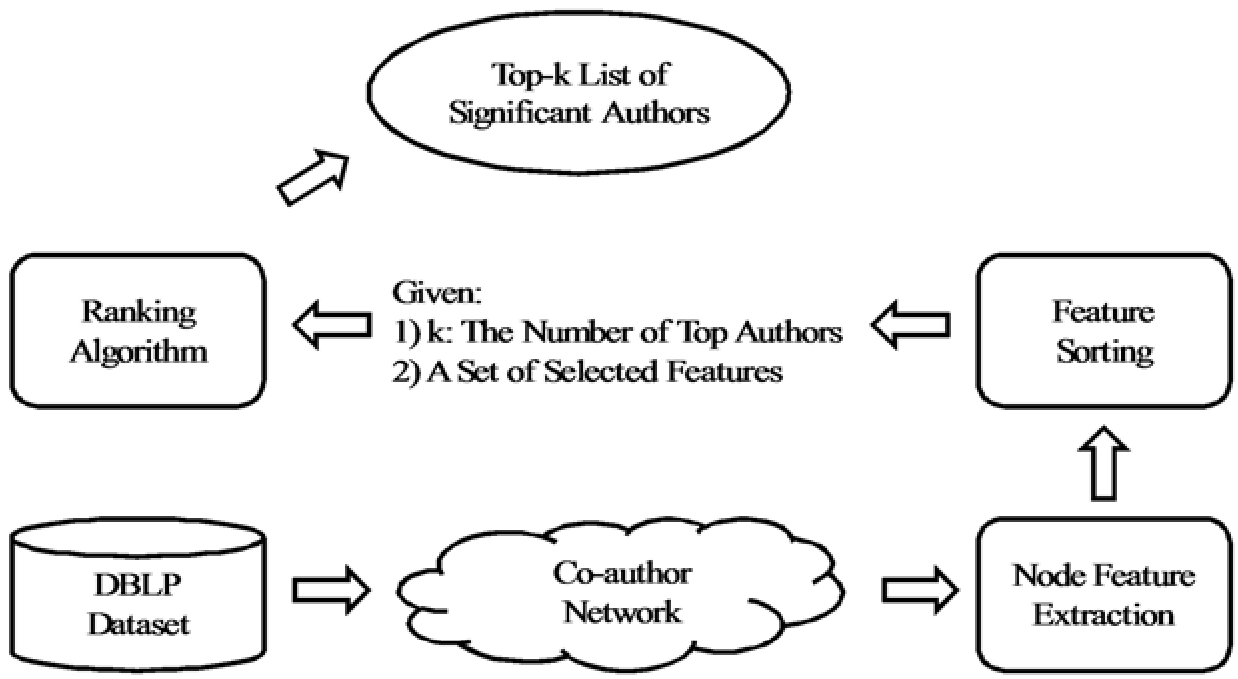 Figure 1: The system architecture, showing the transition from offline feature extraction to online multi-feature ranking.
Feature Extraction
The authors utilize four key indicators from the DBLP co-author network:
- Paper Count: Productivity.
- Co-author Count: Networking degree.
- Closeness Centrality: Proximity to the network center (Equation 1).
- Component Size: Robustness of the author's local network.
Experiments & Results: Real-world Author Ranking
The researchers tested DblpNET on a massive snapshot of the DBLP database (~1.4 million publications).
SOTA Comparison & Stability
The algorithm successfully revealed that different authors emerge as "top" depending on the feature mix. For instance, a highly productive author might not be central to the community's global "small world" structure.
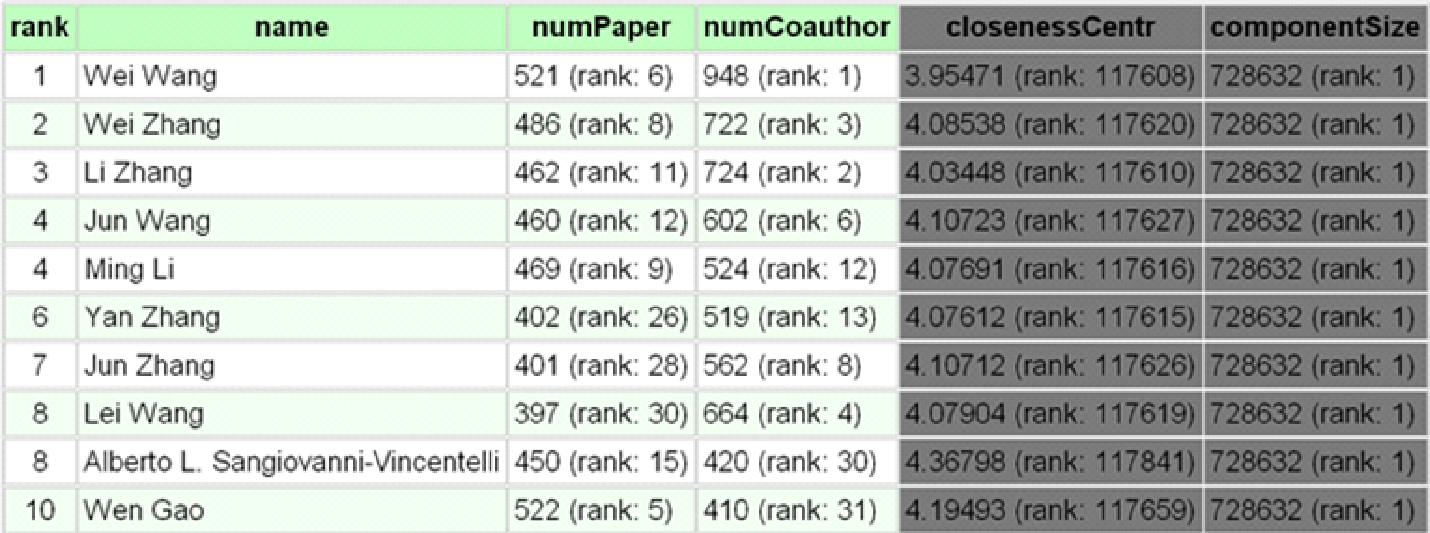 Table 1: Top-10 authors when considering Papers and Co-authors. Note how 'Wei Wang' dominates both, securing the #1 spot.
Efficiency Insights
The complexity of the online ranking is , but the "search depth" (number of iterations) depends on the correlation between selected features. The paper notes that adding Closeness Centrality increases the search depth significantly because many authors are part of small, isolated components, forcing the algorithm to scan deeper to find nodes that are both productive and globally central.
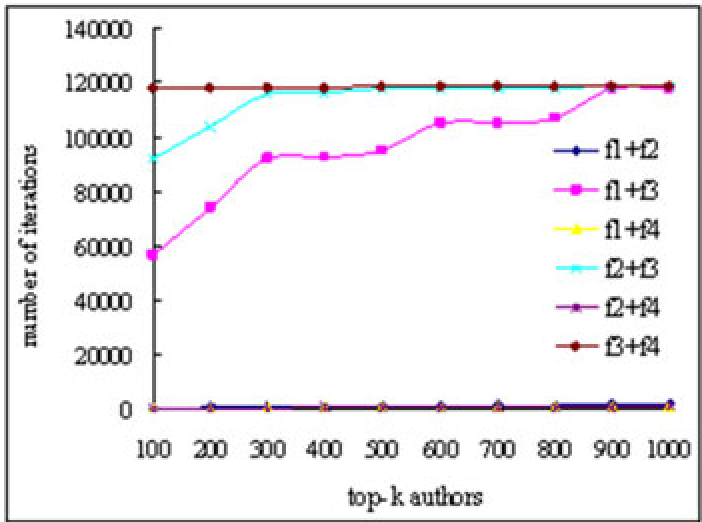 Figure 2: Analysis of iterations vs. Top-K. The inclusion of feature 'f3' (Closeness Centrality) dramatically increases the computational workload.
Critical Analysis & Conclusion
Takeaway
The DblpRank approach is a powerful tool for multi-criteria decision-making (MCDM) in graphs. It bypasses the "weight-tuning" trap by focusing on rank-order intersection, making it highly intuitive for end-users who want to find "all-rounders."
Limitations
- Name Ambiguity: While the DBLP uses numbers to distinguish "Wei Wang (1)" from "Wei Wang (2)", the ranking system is still heavily dependent on the quality of the underlying entity resolution.
- Offline Bottleneck: Calculating Closeness Centrality for all pairs of nodes is , which is prohibitive for dynamic, rapidly growing networks without approximation techniques.
Future Outlook
The next step for this lineage of research involves Dynamic Node Ranking—how does a researcher's significance evolve after a major conference like KDD or NeurIPS? Transitioning this intersection-based ranking into the temporal domain would be a significant contribution to the field of "Science of Science."