
SilverSpeak: Why AI Detectors Fail Against the "Silent" Homoglyph Attack
SilverSpeak: Evading AI-Generated Text Detectors using Homoglyphs
SilverSpeak introduces homoglyph-based attacks (e.g., replacing Latin 'A' with Cyrillic 'А') to systematically evade AI-generated text detectors. The study evaluates seven state-of-the-art detectors across five datasets, achieving a near-total collapse of detection reliability (MCC drops from 0.64 to -0.01).
TL;DR
AI text detectors are currently in an arms race they are losing. A new study titled SilverSpeak demonstrates that by simply swapping a handful of Latin characters with visually identical "homoglyphs" (like a Cyrillic 'a' for a Latin 'a'), nearly every major AI detector—from OpenAI's classifier to advanced watermarking—can be rendered completely useless. The performance of these systems dropped from a solid 0.64 MCC (Matthews Correlation Coefficient) to a shocking -0.01, effectively making their predictions no better than a coin flip.
The Blind Spot of Modern Detection
The fundamental issue identified by the researchers is a gap between human visual perception and machine tokenization. To a human, "Apple" and "Аpple" (using a Cyrillic 'А') look identical. However, to an AI detector, they are drastically different digital entities.
Most current detectors fall into three categories, all of which have a "homoglyph blind spot":
- Perplexity-based Models: Measure how "surprised" a model is by the text.
- Classification Models: Use neural networks (like RoBERTa) to spot AI "fingerprints."
- Watermarking: Detect mathematical patterns embedded during the generation phase.
The researchers found that by introducing homoglyphs, they could break the mathematical assumptions underlying all three methods simultaneously.
Methodology: Breaking the System at the Token Level
The authors tested seven leading detectors (ArguGPT, Binoculars, DetectGPT, Fast-DetectGPT, Ghostbuster, OpenAI’s detector, and Watermarking) using two main attack strategies:
- Random Attack: Replacing 5%, 10%, 15%, or 20% of characters with homoglyphs.
- Greedy Attack: Replacing every possible character that has a homoglyph equivalent.
How it breaks Perplexity
When a tokenizer encounters a homoglyph, it usually cannot find it in its standard "vocabulary" of common words. Consequently, it splits the word into many tiny, unusual fragments. This increases the total token count and drastically lowers the loglikelihood scores, making the text look "chaotic" or "human-made" to models like Binoculars or DetectGPT.
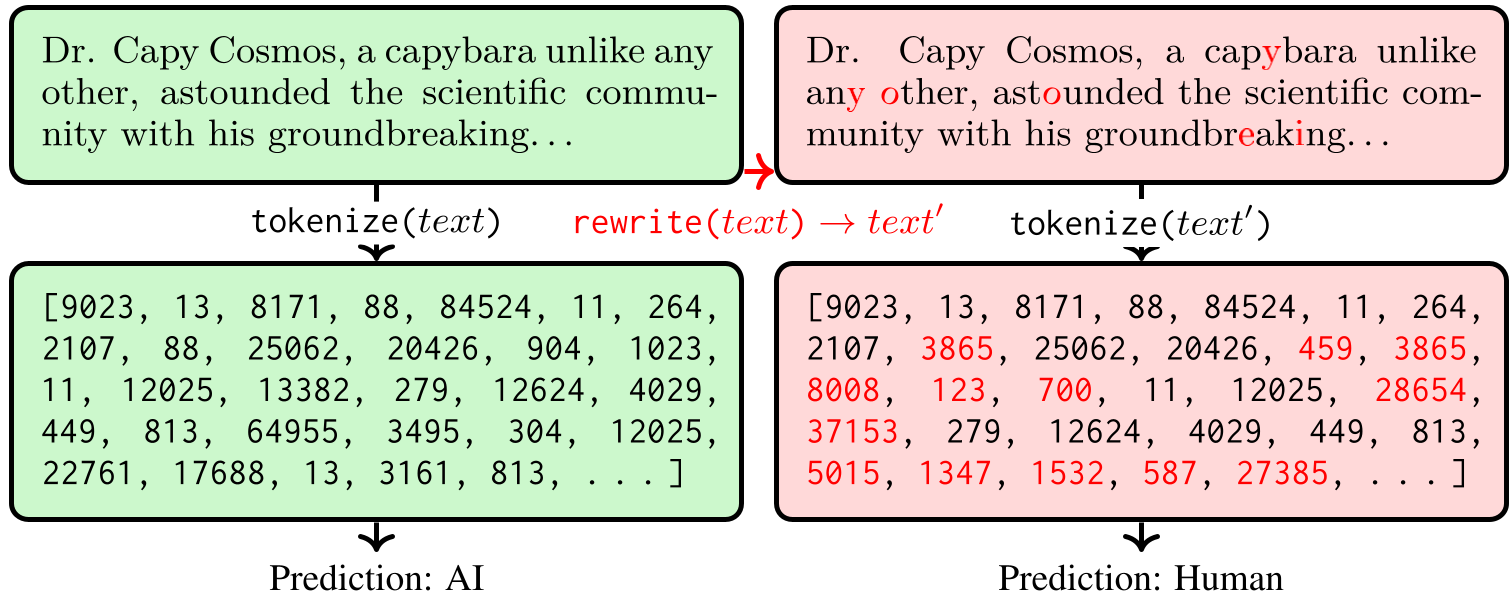 Figure 1: Visual comparison of original vs. attacked text and their resulting tokenization strings.
Experimental Results: A Total System Failure
The results were devastating for the "detection" side. In the "Greedy" setting, every single detector failed.
- Binoculars & Fast-DetectGPT: Previously considered highly robust zero-shot detectors, their performance plummeted as soon as a 5% replacement was introduced.
- Watermarking: Even though watermarks are cryptographically grounded, they rely on the sequence of tokens. Homoglyphs change the token seeds, making the "green token" patterns disappear instantly.
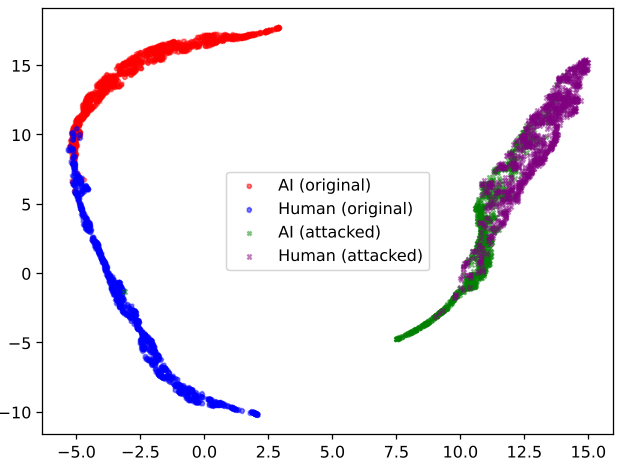 Figure 2: UMAP visualization of ArguGPT embeddings. While original AI and human texts are separated, attacked texts (purple/green) move to an entirely different, mixed subspace.
| Dataset | Detector | Original MCC | Greedy Attack MCC |
|---|---|---|---|
| CHEAT | ArguGPT | 0.94 | 0.00 |
| Essay | Binoculars | 0.91 | 0.05 |
| Reuter | Fast-DetectGPT | 0.92 | 0.04 |
| Average | All Detectors | 0.64 | -0.01 |
Deep Insights: Beyond "What" to "Why"
Why is this attack so effective? The research provides a mathematical justification:
- Embedding Displacement: For classifiers like RoBERTa, homoglyphs push the text representation into "unseen" regions of the latent space. The model has never been trained on Cyrillic/Latin hybrids, so its output becomes non-discriminative.
- Entropy Spikes: For perplexity models, the artificial "noise" created by rare UTF-8 characters mimics the high-entropy nature of human writing, effectively hiding the predictable patterns of AI.
Conclusion & Future Safeguards
The SilverSpeak paper is a wake-up call for the AI safety community. It demonstrates that the current generation of detectors is "unfit for purpose" in adversarial environments.
How do we fix this?
- Input Normalization: Detectors must include a pre-processing step that maps all homoglyphs back to a standard Latin character set before analysis.
- Visual Recognition: Future detectors might need to use OCR (Optical Character Recognition) to analyze the visual appearance of text rather than the raw byte encodings.
- Likelihood Analysis: Instead of just perplexity, checking for anomalous drops in token probability that coincide with specific character sets could signal an attack.
Ultimately,SilverSpeak proves that as long as we rely on token-level statistics, simple character swaps will remain the "silver bullet" for evading AI detection.