
MSC Method: Automating Covariate Selection through Expert Knowledge Reuse
Using the most similar case method to automatically select environmental covariates for predictive mapping
This paper introduces the Most Similar Case (MSC) method, a Case-Based Reasoning (CBR) approach for the automatic selection of environmental covariates in predictive mapping. By retrieving and reusing solutions from a curated case base of 191 expert-validated applications, the method achieves 58.7% recall in identifying correct topographic covariates for soil mapping without requiring extensive new field data.
TL;DR
Selecting the right environmental predictors is the "make or break" step in predictive mapping. This paper proposes the Most Similar Case (MSC) method, which stops treating every new mapping task as a fresh statistical problem and instead asks: "What did experts do in similar situations?" By matching new projects to a database of 191 successful applications, it automates covariate selection with high reliability, especially when field data is scarce.
The "Data-Hungry" Bottleneck
In fields like Digital Soil Mapping (DSM) or landslide susceptibility, researchers often face a paradox: to select the best covariates (like elevation, slope, or wetness index), you usually need a large amount of ground-truth field data to run statistical tests. But if you already had that much data, the problem of predictive mapping would already be half-solved.
Current state-of-the-art (SOTA) statistical methods (e.g., LASSO, Stepwise Regression) fail when samples are limited. This leaves non-experts to pick variables arbitrarily, often leading to poor model performance.
Methodology: CBR Meets Digital Soil Mapping
The core insight of the authors is that expert knowledge is hidden in plain sight—specifically within thousands of peer-reviewed publications. They formalize this using Case-Based Reasoning (CBR).
1. Case Formalization
The researchers built a case base by manually extracting data from 56 high-impact papers.
- The Problem: Defined by 9 factors including mapping target (e.g., Organic Carbon), resolution, and terrain characteristics (Total relief, mean slope).
- The Solution: The specific set of topographic covariates used successfully in that paper.
2. Similarity Reasoning
When a user starts a new project, the MSC method calculates the similarity () between the new project's context and all cases in the database. The covariates from the case with the highest are recommended.
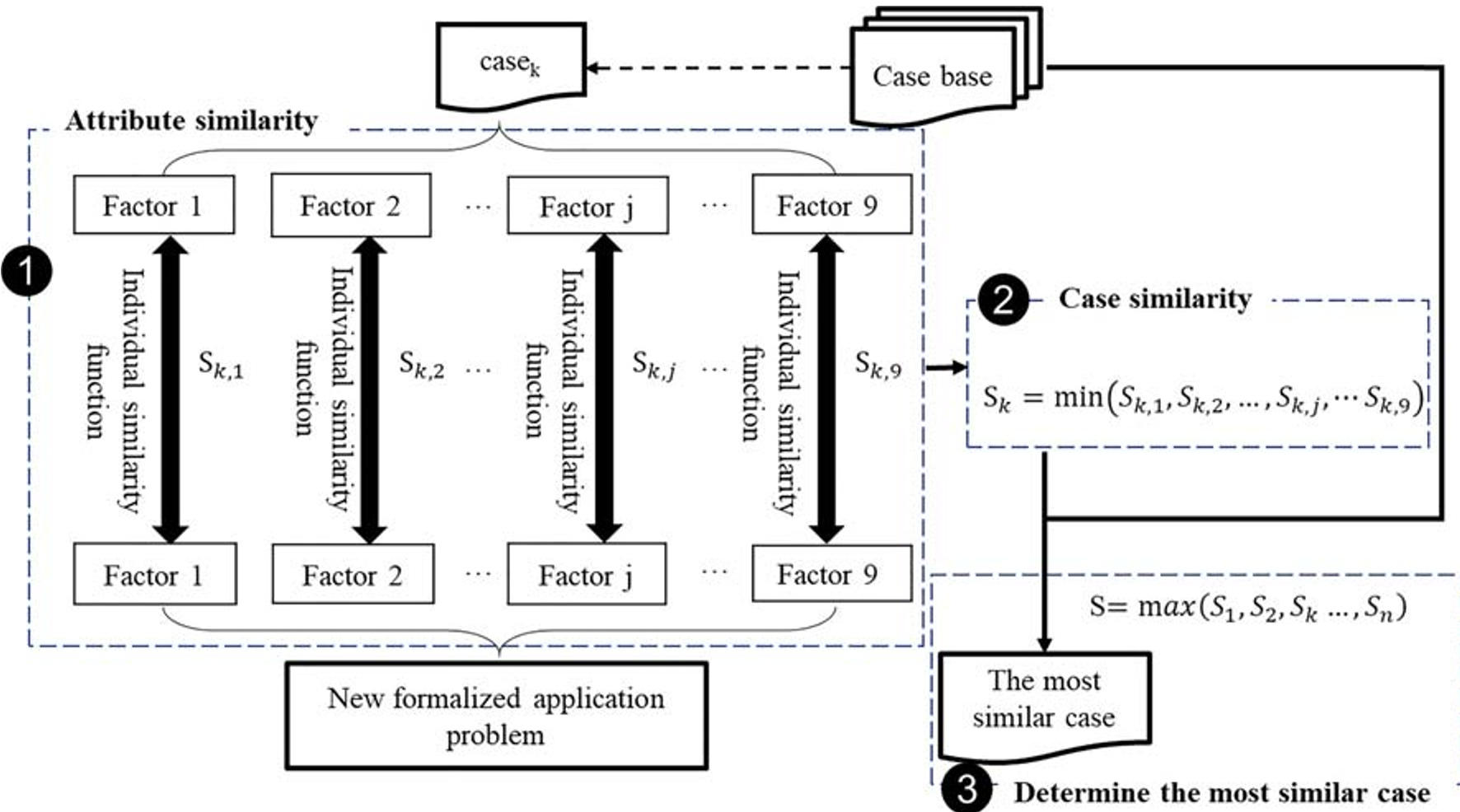 Figure 1: The workflow shows how individual factor similarities are synthesized into a global similarity score to identify the most relevant previous application.
Experimental Results
The authors tested the method using a Leave-One-Out (LOO) approach across 191 cases.
Key Performance Metrics:
- Recall (0.587): On average, the method correctly identified nearly 60% of the covariates experts originally chose.
- High Confidence, High Accuracy: For cases where the similarity was high (), the success rate skyrocketed, with many cases achieving perfect F1-scores.
- The Uncertainty Shield: The authors introduced an uncertainty index (). As uncertainty increases, the performance drops predictably, allowing users to know exactly when they should trust the system versus when they need more data.
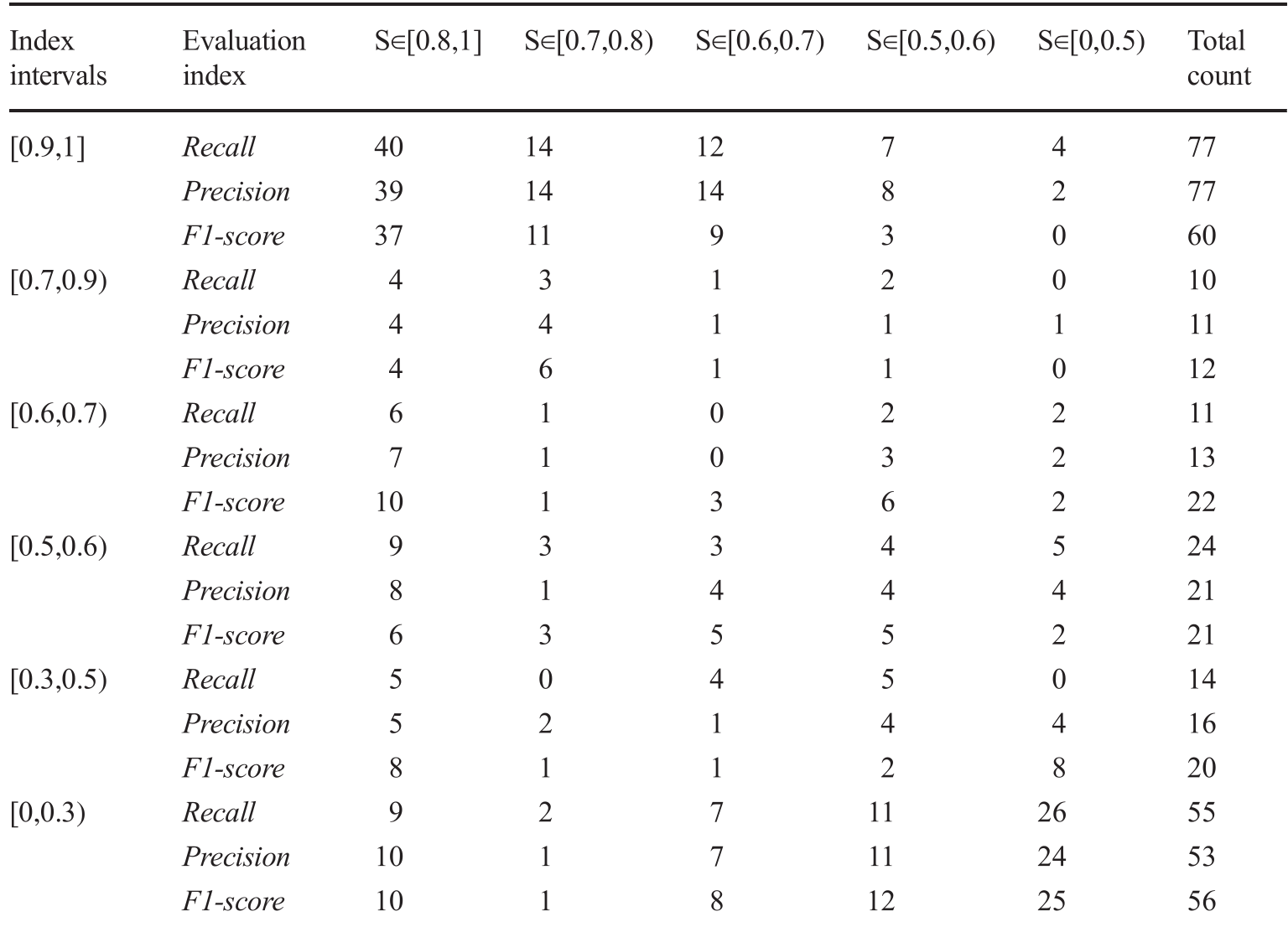 Table 1: The correlation between case similarity and evaluation indices (Recall, Precision, F1-score). Higher similarity tiers consistently yield better predictions.
Critical Insight: Beyond Statistics
The essence of this work is the shift from data-driven modeling to knowledge-driven automation. By quantifying "terrain complexity" and "application purpose" as searchable parameters, the authors have turned subjective expert experience into an objective, reusable resource.
Limitations: The current case base is focused only on topographic variables and was populated via manual extraction—a time-consuming process.
Conclusion & Future Outlook
The MSC method proves that even with a modest case base (191 cases), CBR can effectively bridge the gap between "expert intuition" and "automated mapping."
The future of this technology lies in Automatic Information Extraction. Imagine an AI agent reading every new paper on arXiv or Geoderma, instantly updating the global case base, and providing every GIS user with the collective wisdom of the entire scientific community. This paper marks a significant first step toward that "expert-in-the-loop" automation.