
Similarity Analysis in Mobile Societies: The Missing Link in Mobility Modeling
Similarity Analysis and Modeling in Mobile Societies: The Missing Link
The paper introduces a behavioral-profile framework to analyze user similarity in mobile societies, primarily for application in behavior-aware Delay Tolerant Networks (DTNs). It develops a quantitative index using Singular Value Decomposition (SVD) and cosine similarity on user-location association matrices to identify behavioral clusters.
TL;DR
Real-world mobile users aren't "carbon copies" of each other, yet our simulation models treat them as such. This paper uncovers a massive gap between real-world "Mobile Societies"—which are rich, clustered, and diverse—and existing mobility models (like RD and TVC) which produce unnervingly homogeneous populations. By applying SVD to spatio-temporal association matrices, the authors provide a mathematical framework to measure behavioral similarity and prove that current models are missing the vital "social link" necessary for evaluating next-gen protocols.
Background: The Rise of Behavior-Aware Networks
We are moving toward a generation of "behavior-aware" Delay Tolerant Networks (DTNs). Whether it is profile-cast, interest-based message forwarding, or participatory sensing, these systems rely on one core assumption: we can leverage the fact that certain users share similar movement patterns. However, if our simulation models don't reflect this similarity accurately, our protocol evaluations are effectively house-of-cards.
Problem: The Homogeneity Trap
Prior work in mobility modeling has progressed from simple Random Waypoint (RWP) models to more sophisticated ones like the Time-Variant Community (TVC) model. While TVC captures periodic re-appearance and location preferences, the authors find it suffers from a "homogeneity trap."
In existing models, even if nodes have "preferences," those preferences are often assigned such that the resulting population appears as one giant, uniform cluster. This lacks the assortative mixing and distinct community structures found in real-world campus data.
Methodology: Mining Eigen-behaviors
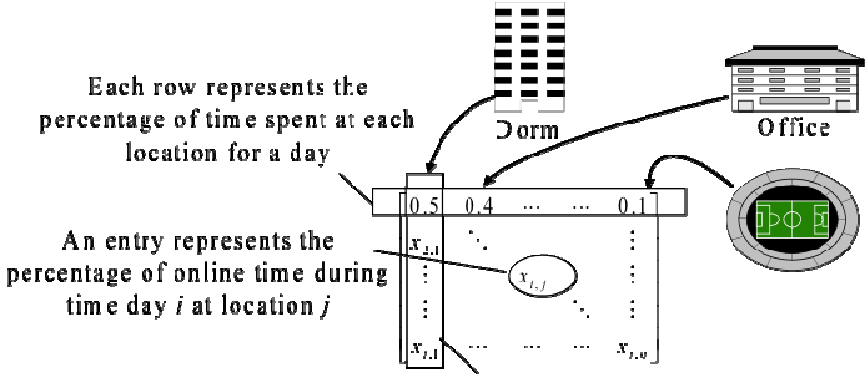
To quantify this, the authors move beyond simple contact hours and look at Spatio-Temporal Profiles.
- Association Matrix: A matrix where rows represent time intervals (e.g., days) and columns represent locations (Access Points). Each entry is the fraction of time a user spent there.
- SVD Decomposition: They apply Singular Value Decomposition (SVD) to this matrix: This extracts Eigen-behaviors (), which summarize the dominant trends of a user's life.
- Weighted Cosine Similarity: Instead of a simple dot product, they calculate similarity as a weighted sum of the inner products of Eigen-vectors, ensuring that the "main" behaviors of a user carry more weight than noise.
The Reality Check: Traces vs. Models
The researchers compared real-world traces from USC, MIT, Dartmouth, and UF against the TVC and Random Direction models.
Key Observation 1: Mobile Societies Exist
In real traces, the similarity distribution is "rich." There are users who are totally dissimilar (0.0-0.1) and tightly-knit groups with extreme similarity (0.9-1.0). When visualized as a graph, these form clear Mobile Societies with an average modularity of 0.64.
Key Observation 2: Models are "Flat"
When running the same analysis on the TVC model, the "richness" disappears. Almost all user pairs fall into the 0.9-1.0 similarity bracket. The TVC model essentially creates a "cloned" population.
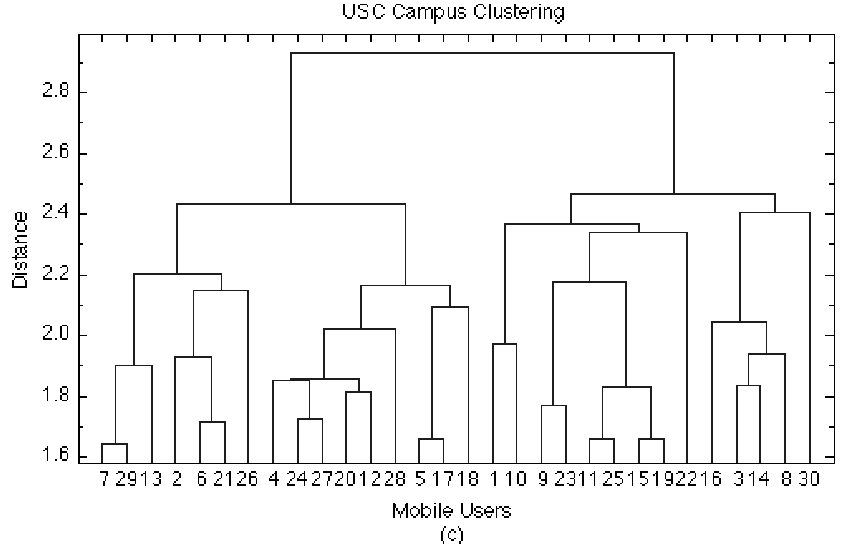 Figure: Dendrograms show real traces (a & c) having hierarchical, diverse clusters, while the TVC model (b & d) collapses everyone into a single top-level cluster.
Critical Analysis & Conclusion
The "Missing Link"
The "Missing Link" is explicit social structure. Current models focus on where a node goes and when, but they ignore who else is like that node. To fix this, future mobility models must:
- Assign communal probabilities to nodes based on behavioral groups.
- Incorporate parameters that capture the "inter-dependency" between similarity clusters.
Takeaway
This work is a wake-up call for the DTN and MANET research communities. We cannot trust a protocol's performance if it was tested in a "homogeneous vacuum." By proving that similarity is consistent and stable over time across multiple campuses, the authors provide the metric—Behavioral Distance—needed to build the next generation of realistic mobility generators.
Limitations: The study primarily focuses on campus environments (which are highly structured). Future work needs to validate if these "Mobile Societies" maintain the same modularity in less structured environments, such as city-wide vehicular networks or casual social gatherings.