
Do You Like What I Like? Efficient Similarity Estimation in Proximity-Based Mobile Social Networks
13807_Do You Like What I Like? Similarity Estimation in
This paper introduces a method for privacy-preserving similarity estimation in proximity-based Mobile Social Networks (MSNs). It proposes using Counting Bloom Filters (CBFs) and Count-Min Sketches (CMSs) to represent user profiles as multisets, achieving accurate similarity detection through a single device-to-device exchange without a central server.
Executive Summary
TL;DR: This research tackles the "stranger danger" of data privacy in social networking by allowing two mobile devices to calculate how much their owners have in common (e.g., musical taste) using a single, small data exchange. By leveraging Counting Bloom Filters (CBF) and a newly proposed CBF-Dice metric, the system estimates similarity without ever sending cleartext data or talking to a central server.
Context: Positioned at the intersection of Mobile Social Networking (MSN) and Privacy-Preserving Data Mining, this work provides a practical solution for ad-hoc social discovery using Device-to-Device (D2D) communication.
The Core Challenge: Frequencies Matter
Most proximity-based systems use standard Bloom Filters to see if two people share the same interests. However, in music or location data, frequency is key. Listening to a song 100 times signals a much stronger preference than listening to it once.
Previous methods using binary Bloom Filters lose this "cardinality" information. Sophisticated cryptographic methods (like Private Set Intersection) exist but are often too computationally heavy or require multiple "handshakes" that are impractical for a quick walk-by encounter via Bluetooth or NFC.
Methodology: Rethinking Probabilistic Structures
The author moves beyond binary sets to multisets using:
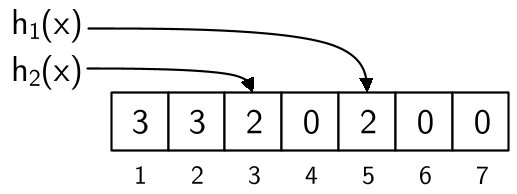
- Counting Bloom Filters (CBF): Instead of bits (0 or 1), each slot is a counter.
- Count-Min Sketches (CMS): A multi-row generalization of the CBF.
The Insight: Why "Less is More"
In traditional Bloom Filter applications (like database lookups), you use multiple hash functions () to reduce false positives. However, the author discovered a counter-intuitive truth for similarity estimation: Using only one hash function () is superior.
When you use multiple hash functions to estimate similarity, you increase the number of occupied slots in the filter, leading to more "collisions." While these collisions are manageable for membership queries, they lead to a consistent overestimation of similarity.
New Metrics: CBF-Dice and CMS-Dice
The author adapts the Dice Coefficient—a standard similarity measure—to work directly on the counters of these probabilistic structures: This formula allows devices to estimate the overlap of two multisets simply by comparing the arrays of counters they exchanged.
Experimental Validation
The method was tested on a synthetic dataset (SD) and real music listening data (RD) from the Million Song Dataset.
Key Findings:
- The Error Trend: As shown in the RMSE (Root Mean Square Error) plots, the error decreases as the filter length increases, but increases as more hash functions are added.
- The "Twice-the-Input" Rule: For a user profile with ~64 unique songs, a filter length of 128 was sufficient to identify significant similarities (score > 0.6) with high accuracy.
- Privacy by Imprecision: Interestingly, the higher error rate at low similarity levels acts as a natural privacy shield—if two people have nothing in common, the "noise" in the filter makes it impossible to tell exactly how different they are.
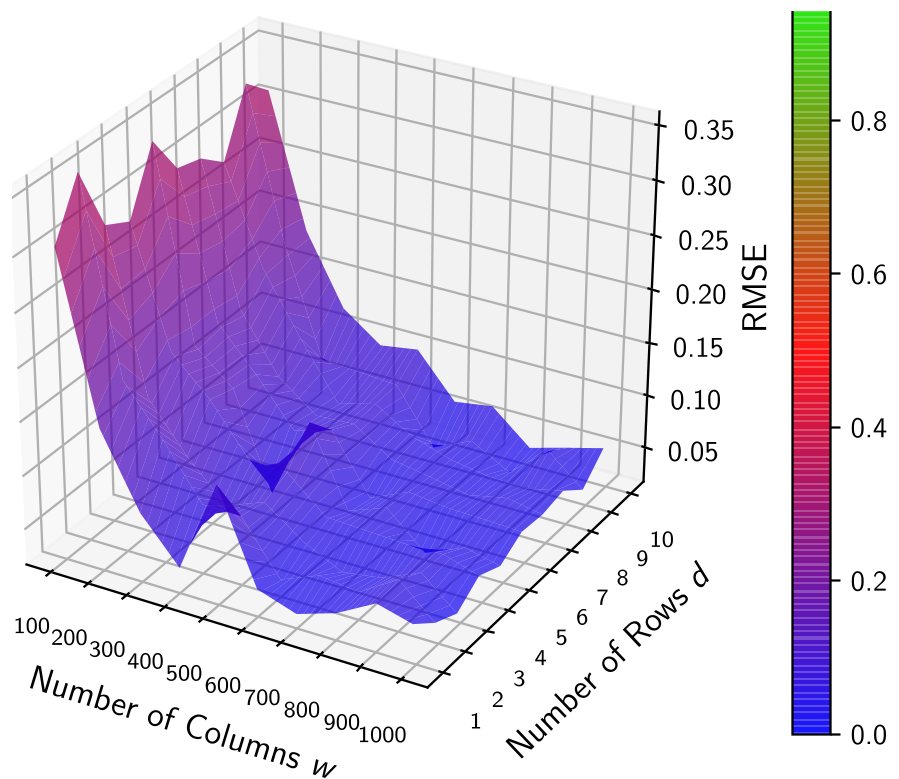 Fig: In the chart above, notice how the error (RMSE) remains flat or increases as the number of rows (hash functions) increases.
Critical Analysis & Conclusion
Takeaway
The research successfully demonstrates that we don't need "Big Data" or "Big Servers" to find common ground. A single-hash CBF is a "lean and mean" data structure that fits perfectly into the overhead constraints of D2D protocols like Bluetooth Low Energy (BLE).
Limitations
- Malicious Users: The paper acknowledges that a malicious user could craft a "full" filter to appear similar to everyone (the "Sybil" or "Chameleon" attack).
- Static Thresholds: The similarity threshold (e.g., 0.6) might need to be dynamic depending on the category of data (music vs. location).
Future Work
The next step for this technology is moving beyond music into multi-modal profiles—combining psychometrics, mobility patterns, and interests into a single, unified, privacy-preserving "digital handshake."