
Phonebook-Centric Social Networks: Solving the Identity Matching Puzzle
Similarity Management in Phonebook-Centric Social Networks
The paper introduces a "phonebook-centric social network" architecture and a weight-based similarity detection algorithm to bridge the gap between private mobile contacts and global social network members. By implementing the "phonebookmark" system, the authors demonstrate an efficient way to synchronize, merge, and update contacts across mobile and web platforms.
TL;DR
Building a contact list from scratch is the primary friction point in joining new social networks. This paper proposes a phonebook-centric approach that treats your mobile contacts as the foundation of your social graph. By utilizing a weight-based similarity algorithm and dynamic "customized contacts," the authors solve the problem of identifying and merging duplicate identities across private and public domains with a false-positive rate under 10%.
Context: The Phone as a Social Anchor
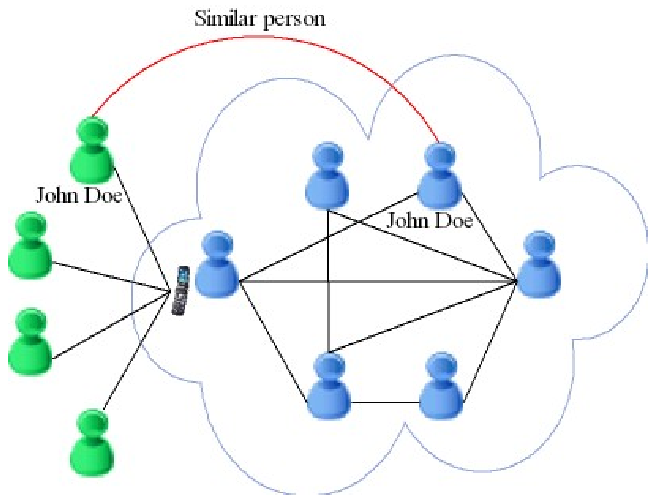
In the traditional social network model (Facebook, MySpace), you join a walled garden and manually "add" friends. The authors argue that your mobile phonebook is already a high-fidelity social structure. The challenge lies in Similarity Management: how does the system know that "Dad" in your phone is "John Doe" on the server?
The Problem: Why Exact Matching Fails
Most contact sync tools rely on exact string matching. If one record has "Joseph" and the other "Joe," or if two people share a central office phone number, traditional systems either miss the match or create a false duplicate.
- Prior Work Bias: Basic tools ignore the context of "social dimensions" (e.g., distance, common friends, or name synonyms).
- The Merging Dilemma: Once a private contact is linked to a network member, how do you allow the user to keep their nickname ("Dad") while still receiving updates when John Doe changes his official profile picture?
Methodology: The Weight-Based Engine
The core innovation is a heuristic algorithm that calculates a similarity score based on field-specific weights.
1. Architectural Overview
The system, named phonebookmark, uses a Drupal-based server with XML-RPC access for mobile and desktop clients, keeping the local phonebook and social graph in sync.
2. The Algorithm Logic
Instead of a binary "match/no match," the system calculates a weighted sum:
- Name Match: +30
- Private Mobile Number Match: +10
- Email Match: +15
- Conflicting Birthday: -40 (Significant penalty)
The raw weight () is then converted into a probability percentage () using an arc-tangent function: This ensures that while the score increases with more evidence, it never hits a "100% certainty" too easily, acknowledging the inherent uncertainty in social data.
3. Dynamic Name Handling
The system "learns" synonyms. If users frequently merge "Katharine" and "Kate," the system stores these in a similarity table, allowing the algorithm to automatically suggest Kate-to-Katharine matches in the future.
Experimental Results
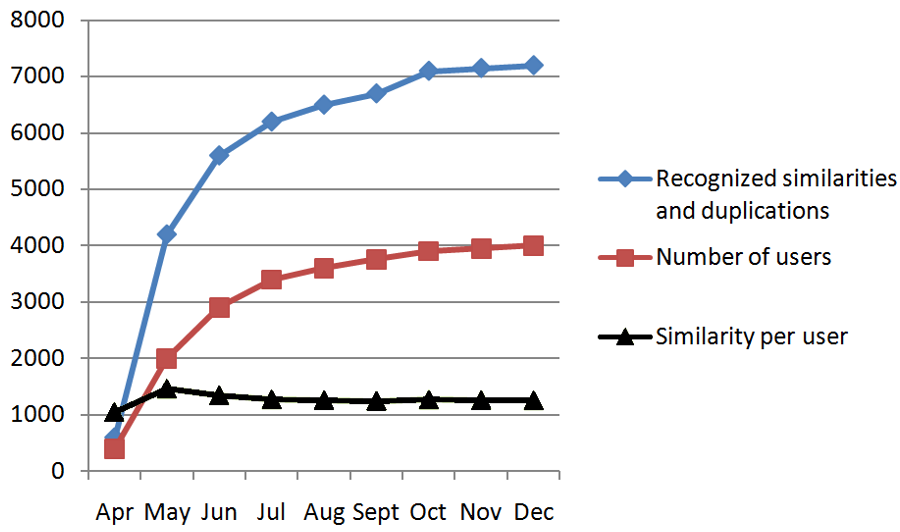
The authors validated the system using 400 internal users managing 70,000 contacts.
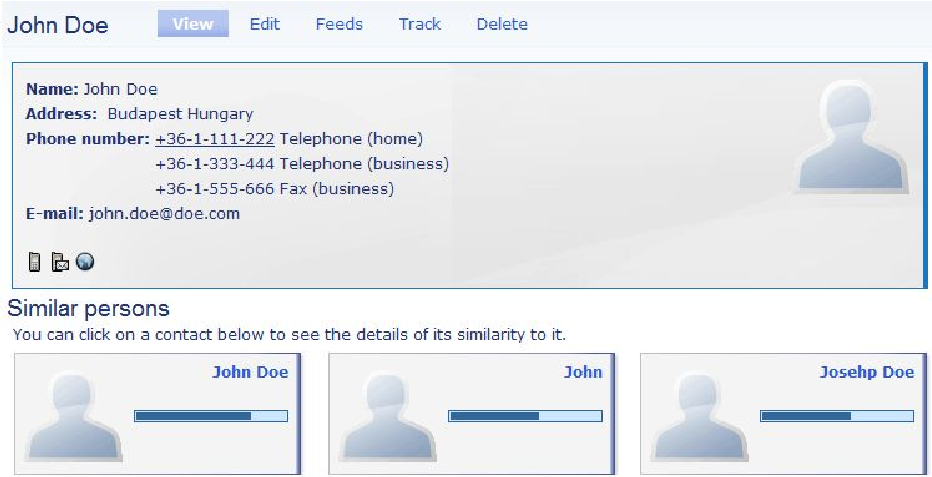
- False Positive Rate: Suggested matches were correct in over 90% of cases.
- Scalability: As the number of users grew, the number of detected similarities per person remained stable, proving that the algorithm filters noise effectively as the database expands.
Critical Insight: Customized Contacts
The most overlooked but valuable contribution is the Customized Contact definition. It creates a "triangular" link:
- Private Contact: Your raw phone data.
- Member Profile: The global user data.
- Customized Copy: A bridge that lets you rename a contact locally while subscribing to global updates. This provides the "best of both worlds"—personalization and real-time accuracy.
Conclusion and Future Outlook
While the current algorithm relies on manual weight tuning, it provides a robust framework for similarity management. The authors plan to implement machine learning models to adjust weights automatically based on user behavior logs. This work paves the way for advanced location-based recommendations and automated social graph expansion that feels seamless to the end-user.