
Decoding the Chaos of Care: Using LDA to Measure Similarity in Unstructured Clinical Pathways
10326_Similarity Measure Between Patient Traces for Clinical Pathway Analysis Problem, Method, and Applications.
This paper proposes a behavioral topic analysis approach using Latent Dirichlet Allocation (LDA) to measure similarities between complex patient traces in clinical pathways. By treating clinical events as "words" and patient traces as "documents," the method enables advanced Clinical Pathway Analysis (CPA) tasks including trace retrieval, clustering, and anomaly detection.
TL;DR
Clinical pathways—the journeys patients take through a healthcare system—are often messy and "unordered." Traditional methods that look for exact sequences of events fail to capture the underlying medical logic. This paper introduces a behavioral topic analysis approach using Latent Dirichlet Allocation (LDA) to treat medical traces as a mixture of latent treatment behaviors. This shift from "sequence-matching" to "feature-matching" leads to massive improvements in patient retrieval, clustering, and anomaly detection.
Problem & Motivation: The Order in the Chaos
Most Clinical Pathway Analysis (CPA) tools view the process from the outside (costs, mortality) or use Edit Distance to compare patient traces. Edit Distance assumes that if Event A happens before Event B in one trace but after it in another, the traces are different.
However, medical reality is unstructured. Doctors perform tests and treatments based on patient availability and immediate clinical needs, not always a rigid script. A "human-centered" process means many events occur arbitrarily. Sticking to a strict temporal sequence introduces "noise" that distorts similarity measures. The authors' insight: We shouldn't compare what was done when, but rather the intent of what was done.
Methodology: LDA for Medical Behaviors
The researchers treated a patient's medical history as a "document" and the specific clinical events (blood tests, surgeries, medications) as "words."
1. Generating Treatment Topics
Using LDA, the model discovers Latent Treatment Behaviors. For example, a cluster of events like "Intracranial hematoma surgery" and "Postoperative drainage" might naturally group into a "Surgical Intervention" topic.
2. The Statistical Framework
The model calculates the probability of a trace belonging to a topic () and the probability of an event belonging to a topic ().
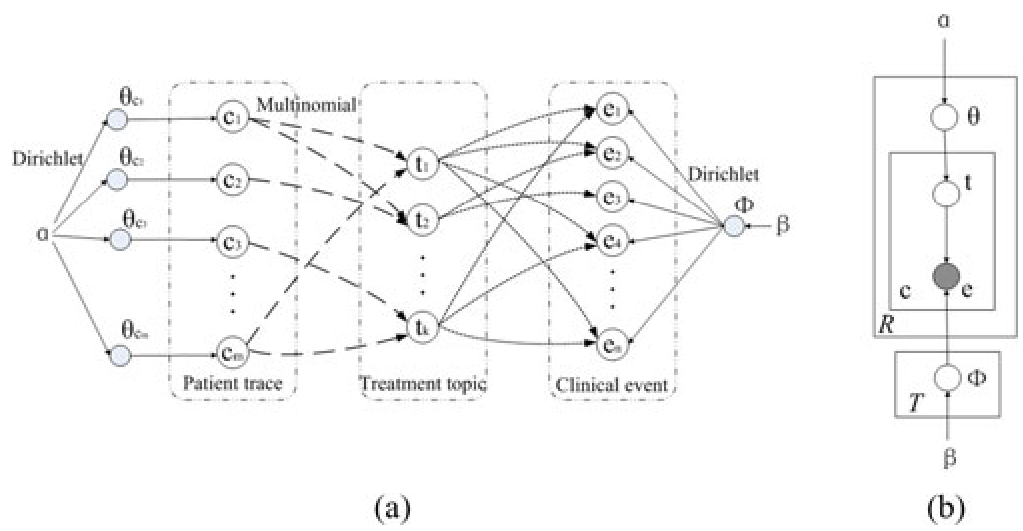 Fig 1: The Graphical representation of the LDA-based similarity measure. It views each patient trace as a distribution over latent topics.
3. Measuring Similarity
Instead of comparing strings of events, the system compares the Topic Vectors. If two patients have high probabilities in the "Cerebral Hemorrhage Treatment" topic, they are considered similar, regardless of the exact order of their specific blood tests.
Experiments & Results: A New Benchmark
The researchers tested their method against Edit Distance (ED) and Term Vector (TV) methods using real data from a Chinese hospital.
1. Patient Trace Retrieval
When searching for similar past cases to suggest treatments, LDA-11 (using 11 topics) achieved a precision of 0.792, strikingly higher than ED (0.632).
2. Clustering Performance
In grouping patients by their primary diagnosis (e.g., lung cancer vs. gastric cancer), the LDA approach outperformed ED by 84% in F0.5 scores. This proves that topical features are far more indicative of a patient's condition than chronological event sequences.
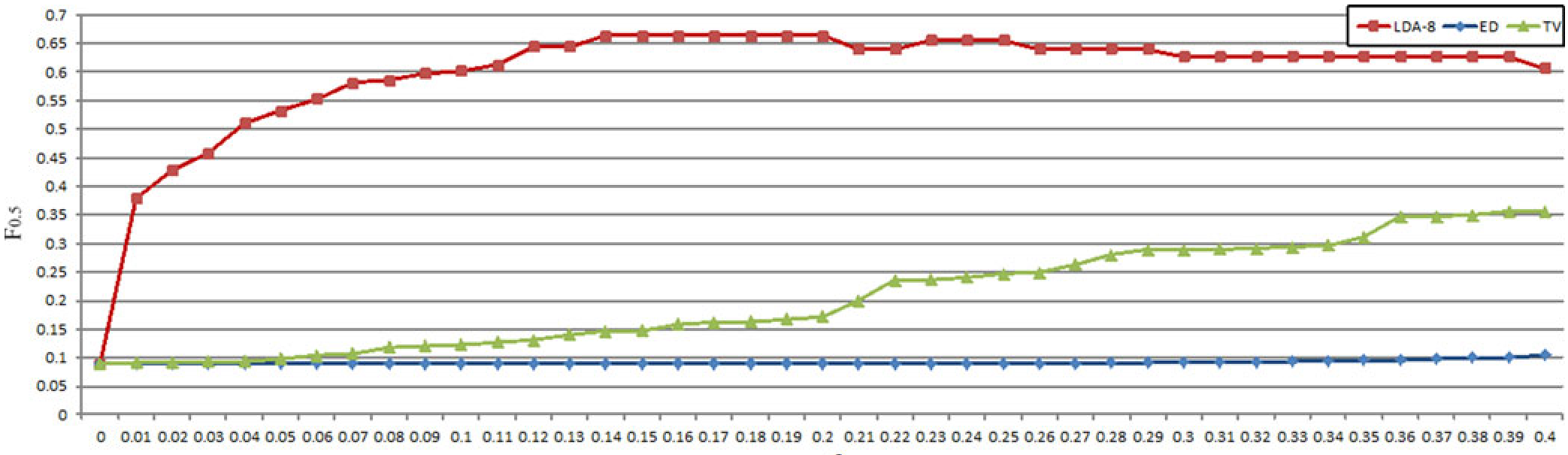 Fig 2: Performance comparison showing that as the merging threshold (ε) changes, LDA-8 consistently provides better clustering accuracy than sequence-matching methods.
3. Anomaly Detection
By establishing what a "normal" cluster looks like, the model can flag traces that deviate from the norm. This is vital for safety audits. The LDA model reached 92.3% precision in identifying anomalies confirmed by clinical experts.
Critical Analysis & Conclusion
Takeaway
The genius of this approach lies in its unsupervised nature. It doesn't require "gold standard" medical models to work; it learns the structure of care directly from the data. This makes it highly adaptable to different hospitals and varying regional medical practices.
Limitations
- Loss of Critical Order: While "chaos" exists, some order is vital (e.g., anesthesia must happen before surgery). Pure LDA ignores this. A hybrid model incorporating some temporal constraints might be even stronger.
- Topic Interpretation: LDA requires the user to pre-define the number of topics (K), which can be arbitrary without expert input.
Future Outlook
This work paves the way for "Recommendation Systems" for doctors. Imagine a system that sees a current patient trace and says: "Based on the latent behaviors of 500 similar patients, the next most effective step is X." It moves Clinical Pathway Analysis from a retrospective audit tool to a proactive clinical assistant.