
Optimizing Knowledge Mining: How Similarity Measures Shape Rule-Based Intelligence
Influence of Similarity Measures for Rules and Clusters on the Efficiency of Knowledge Mining in Rule-Based Knowledge Bases
This paper investigates the optimization of rule-based Knowledge Bases (KBs) through Agglomerative Hierarchical Clustering (AHC). It introduces the CluVis system to evaluate how 9 object similarity measures (e.g., Jaccard, Gower, Goodall) and 4 linkage methods impact the compactness and representativeness of rule clusters, aiming to enhance inference efficiency.
TL;DR
Managing massive rule-based Knowledge Bases (KBs) is an efficiency nightmare. This paper explores how Hierarchical Clustering—powered by 9 distinct similarity measures—can partition these rules into manageable clusters. By creating "representative rules" for each cluster, the authors demonstrate a path toward significantly faster inference and better visualization using their open-source tool, CluVis.
The Motivation: The "Rule Explosion" Problem
In traditional expert systems, an inference engine must match facts against an ever-growing list of "If-Then" rules. When the rule count reaches thousands, the system slows to a crawl. The authors argue that rules shouldn't be a flat list; they should be a partitioned structure.
The core challenge? Rules aren't just simple points in space. They are complex objects with varying lengths, symbolic descriptors (e.g., health=priority), and numeric values. Finding the "distance" between two logical implications requires more than just Euclidean math.
Methodology: The CluVis Approach
The researchers employed Agglomerative Hierarchical Clustering (AHC). The process revolves around two critical choice points:
- Intra-object Similarity: How do we compare two individual rules? Measures like Jaccard (focusing on attribute overlaps) and Gower (handling mixed data types) were tested against frequency-based measures like IOF (Inverse Occurrence Frequency).
- Inter-cluster Linkage: Once rules are grouped, how do we measure the distance between clusters? (Single, Complete, Average, or Centroid Linkage).
The Representative Engine
A standout feature of this work is the Representative Creation Algorithm. Instead of just grouping rules, the system generates a "Centroid Rule"—a simplified version of the cluster that includes only the most frequent descriptors.
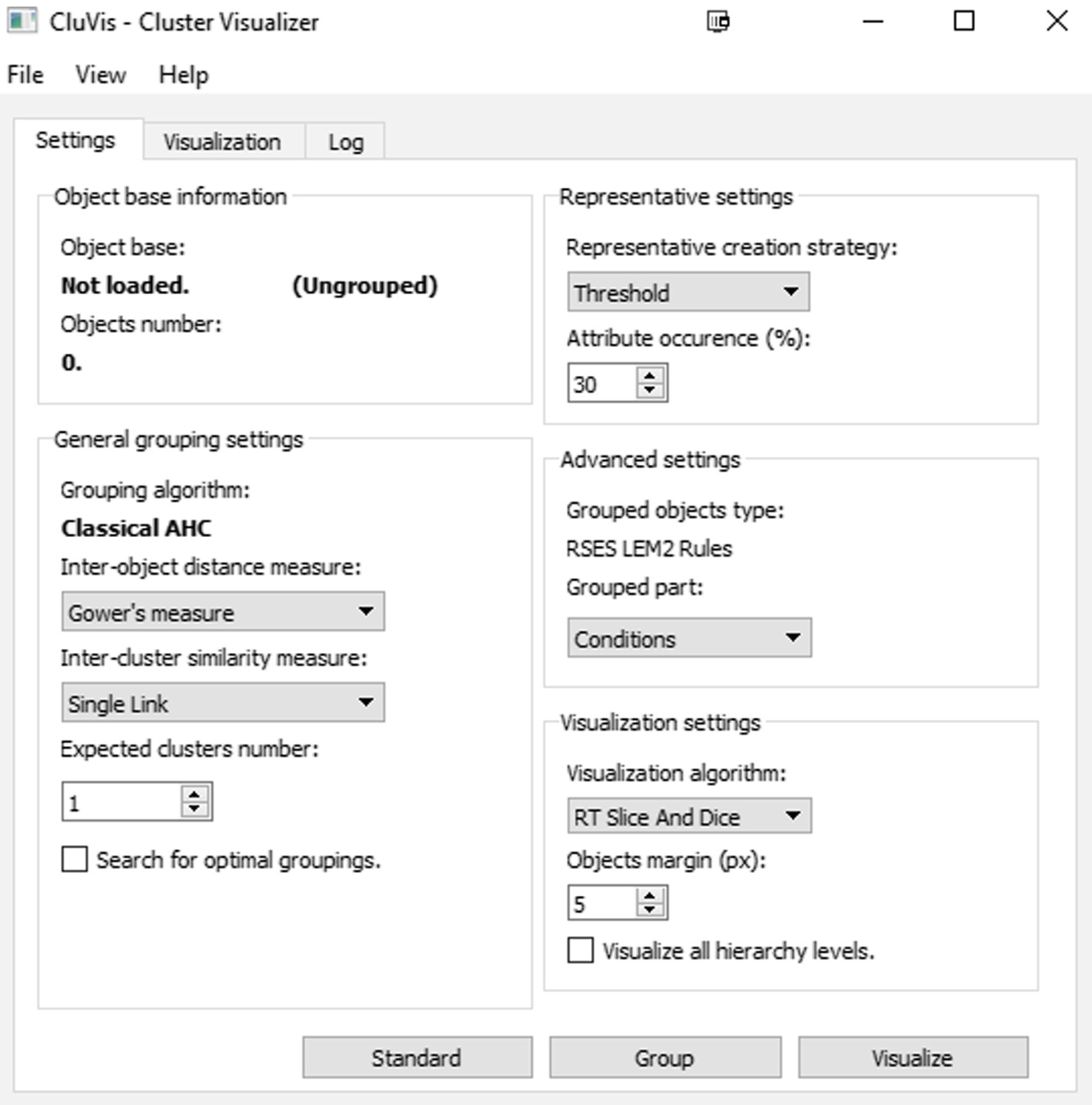 Figure 1: The CluVis UI, illustrating the parameter selection for similarity and linkage.
Experimental Insights: Measure Matters
The authors tested these configurations on 7 real-world datasets (e.g., Diabetes, Arrythmia).
Key Findings:
- The Length Bias: Simple Matching Coefficients (SMC) tend to favor longer rules. Jaccard similarity acts as a vital correction, normalizing by the total number of attributes to prevent long rules from dominating the clusters.
- The Linkage Trade-off:
- Single Link (SL): Leads to "chaining" and very large, messy clusters.
- Centroid Link (CL): Produces the most compact groups but is sensitive to outliers.
- Average Link (AL): The "Goldilocks" choice, providing a robust compromise for knowledge extraction.
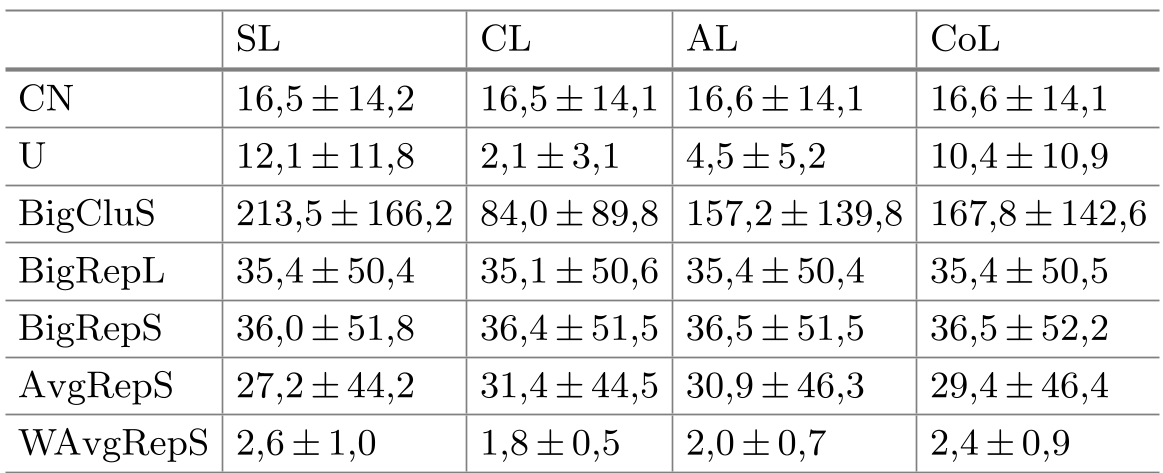 Table 1: Performance comparison across different Inter-cluster measures.
Critical Analysis & Future Outlook
The strength of this work lies in its empirical breadth. By testing nine different measures, the authors prove that "one size does not fit all" in knowledge mining.
Limitations: The "Representative Creation" relies on a percentage threshold (t%), which is a sensitive hyperparameter. If set too high, the representative becomes too vague; if too low, it remains as complex as the original rules.
The Future: As we move toward Neuro-Symbolic AI, the techniques described here—extracting structure from symbolic rules—will be essential for making LLMs and black-box models more interpretable. Transforming a messy KB into a Treemap visualization isn't just a UI trick; it’s a necessary step for human-in-the-loop AI debugging.
Takeaway for Architects
If you are building a rule-heavy system, don't just optimize the search algorithm; optimize the data topology. Use Jaccard or Gower similarity to group your logic, and let your inference engine "scan" the cluster representatives first. It's the difference between searching every book in a library and just looking at the shelf labels.