
Metric Social Networks: When P2P Search Meets Social Intelligence
Querying Similarity in Metric Social Networks
This paper introduces a Metric Social Network (MSN), a decentralized P2P architecture for similarity searching in metric spaces. By modeling peers as nodes and creating "friendship" and "acquaintance" relations based on data similarity, the system achieves efficient approximate query processing.
TL;DR
Traditional distributed databases struggle with the explosive growth of high-dimensional data. This paper proposes a Metric Social Network (MSN) that organizes peers not by arbitrary IDs, but by "interests" (data similarity). By leveraging "Friendship" and "Acquaintance" relations, the network transforms similarity searching into a social navigation task, achieving massive cost reductions in query processing with autonomous learning capabilities.
Problem & Motivation: The Scalability Wall
Similarity searching (e.g., finding similar images or biochemical records) is typically modeled in Metric Spaces. While centralized indexes like M-trees work for small sets, they fail to scale. Distributed versions often focus on "perfect" recall, which leads to massive network overhead.
The authors' insight is simple yet profound: Data isn't random; it forms communities. If a peer handles a query about "blue cars," its "friends" are likely the ones who also have data on "blue cars." Why contact the whole network when you can just ask a community of experts?
Methodology: The Social Architecture of Data
The MSN architecture moves away from rigid indexing to a Cognitive Knowledge Network. Each peer is defined by its data and a query history .
1. Defining Relationships
- Acquaintance (): Peers that have previously contributed to a query result. This is the entry point for navigation.
- Friendship (): A subset of acquaintances that provided a significant portion of the answer (defined by a constant ). These are the "core contributors" for specific data regions.
2. Navigation & FOAF Algorithm
The magic happens in how a query moves. Instead of broadcasting, the system uses:
- Simple Forwarding: Forward the query to the best-known acquaintance from history.
- Friend-of-a-Friend (FOAF): When a peer is contacted, it doesn't just check its own data; it recursively contacts its "friends" who might have relevant info.
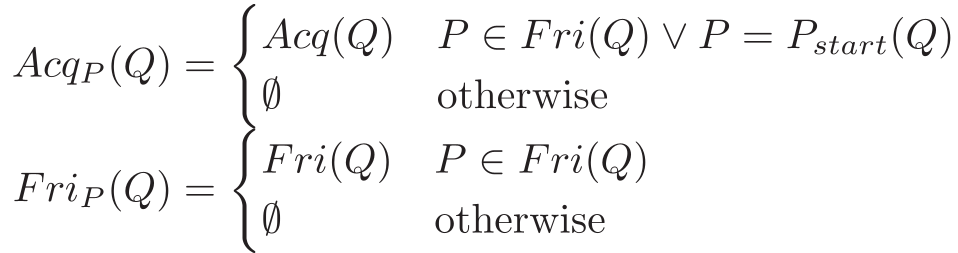 The mathematical definition of Acquaintance and Friendship sets based on query history.
Experiments & Results: Efficiency and Learning
The authors tested the MSN on 3-D and 45-D datasets (color image features).
High-Dimensional Efficiency
In 45-D spaces, where "clusterability" is notoriously difficult, the MSN outperformed the distributed M-tree significantly. While the M-tree touched a large percentage of nodes to find an answer, the Social Network (SocNet) achieved comparable recall by contacting only a fraction of the peers.
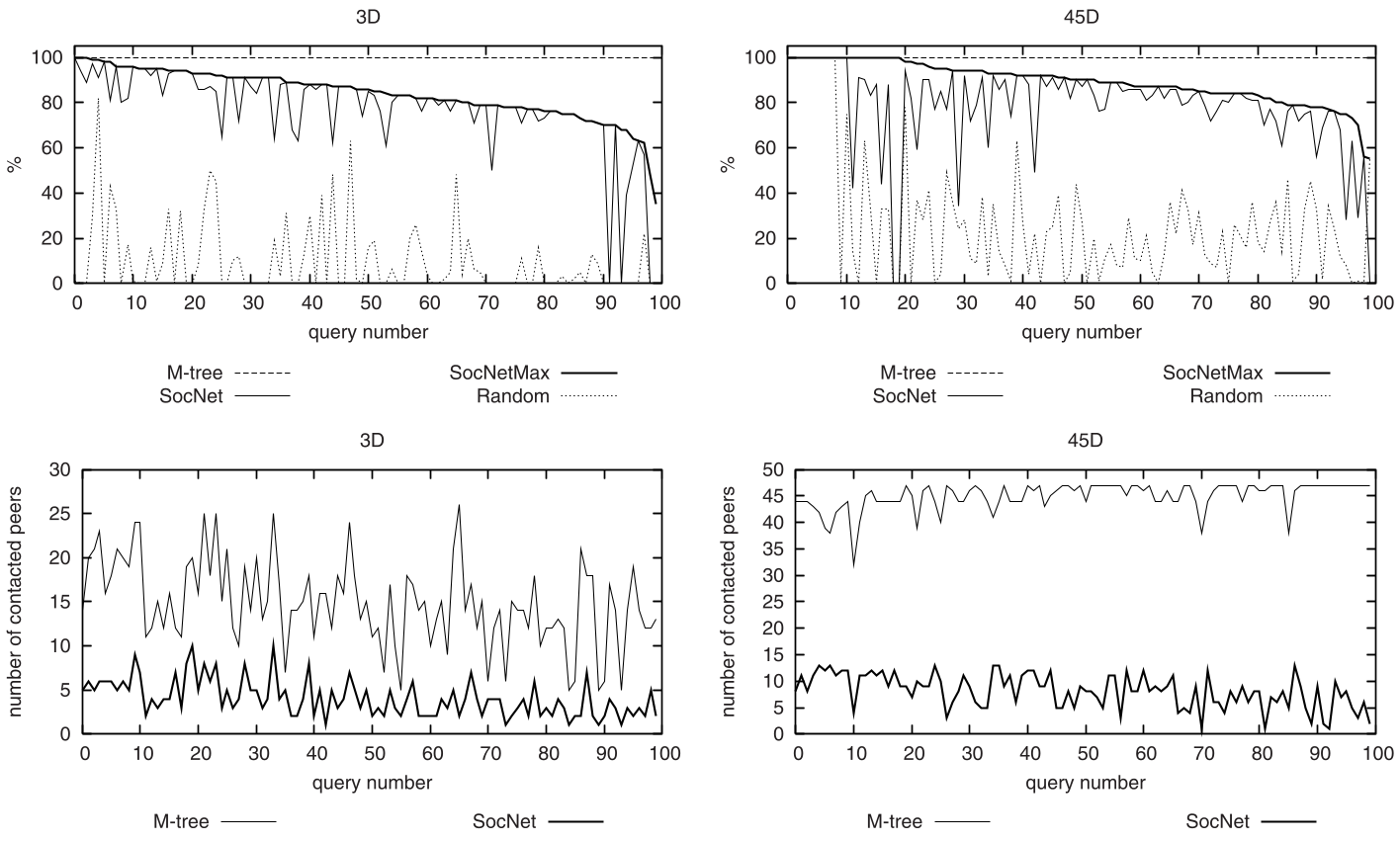 Performance comparison: SocNet achieves high recall with significantly lower costs compared to the baseline M-tree (top curves represent recall, bottom curves represent peers contacted).
The "Living" Network
The most striking result is the Learning Ability. As more queries are processed, peers update their friend lists. Even if the network starts with random links, the FOAF algorithm allows it to "evolve" its topology to match the data distribution.
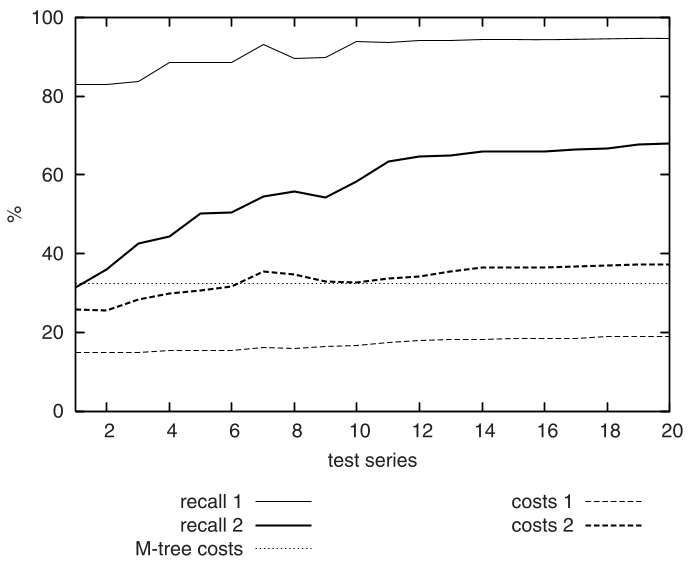 The network showing self-improvement: Over time, the recall increases while costs stabilize, even starting from a random state.
Critical Insight & Conclusion
The Metric Social Network proves that the "Small World" phenomenon (six degrees of separation) is not just for people—it's an efficient way to organize data.
Takeaway: This approach is a precursor to modern graph-based vector search. By treating peers as intelligent agents that remember who provided good answers, we move from "blind search" to "informed navigation."
Limitations: The current model assumes peers are relatively stable. In a highly dynamic P2P environment (peers constantly joining/leaving), "friendships" might become stale, requiring more robust maintenance strategies.