
Simmelian Backbones: Revealing the Hidden Core of Social Networks
Simmelian Backbones: Amplifying Hidden Homophily in Facebook Networks
This paper introduces Simmelian Backbones, a method for extracting the essential "strong" tie structure from social networks by amplifying hidden homophily. It utilizes a novel concept of triadic cohesion—rooted in Simmel's sociological theory—to filter out incidental or heterogeneous connections while preserving the primary group structure in large datasets like the Facebook100.
TL;DR
Social networks are often "noisy" aggregates of many different relationship types, making community detection difficult. This paper introduces Simmelian Backbones, a method that uses triadic cohesion and local neighbor ranking to strip away weak ties. By focusing on "super-strong" ties embedded in triangles, the authors successfully exposed hidden student dorm structures in Facebook networks that standard algorithms missed.
Background: The Density Trap
In most social media datasets, "friendship" is a catch-all term. You might be friends with a sibling, a coworker, or someone you met once at a party. When all these are treated equally, the network becomes a dense, featureless blob.
The authors argue that traditional Modularity-based community detection fails here. Why? Because it looks for density relative to a random model, but social ties aren't random—they are conditionally dependent. If A is friends with B, and B is friends with C, A and C are much more likely to be friends. This is "structural embeddedness."
The Core Insight: Why Triads Matter
Drawing on sociology (Simmel and Granovetter), the authors posit that "primary groups" are defined by Simmelian ties: relationships embedded in at least one triangle. These ties are "sticky" and redundant.
The paper shifts the focus from "What is the global density?" to "How similar are the top-ranked friends of these two people?"
Methodology: The Backbone Extraction
The authors propose a four-step pipeline to distill a network into its Simmelian Backbone:
- Tie Strength: In unweighted graphs, strength is the number of shared neighbors (count of triangles an edge participates in).
- Local Ranking: For every node (ego), rank its neighbors (alters) from strongest to weakest. This accounts for local heterogeneity.
- Redundancy Assessment: Compare the top-k lists of two connected nodes. If they share many of the same "best friends," the tie is strongly embedded.
- Filtering: Remove any tie that doesn't meet a threshold of mutual top-rank overlap.
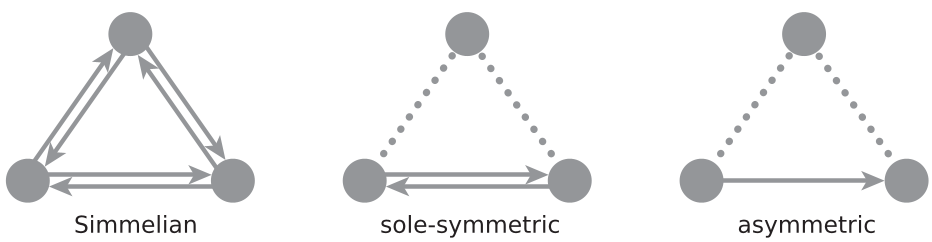 Figure 1: Different types of triadic embeddedness. "Super-strong" Simmelian ties (right) are the foundation of the backbone.
Experimental Results: The Facebook100
The authors tested this on the Facebook100 dataset (US collegiate networks from 2005).
Visual Breakaround
At the University of Chicago, the original network was too dense to show dorm-based clustering. After applying the Simmelian Backbone, distinct "houses" (dorms) appeared as clear clusters. Interestingly, the method also isolated a specific "Class of 2009" cluster who had just moved in and hadn't yet integrated with the rest of the dorms—a nuance lost in the raw data.
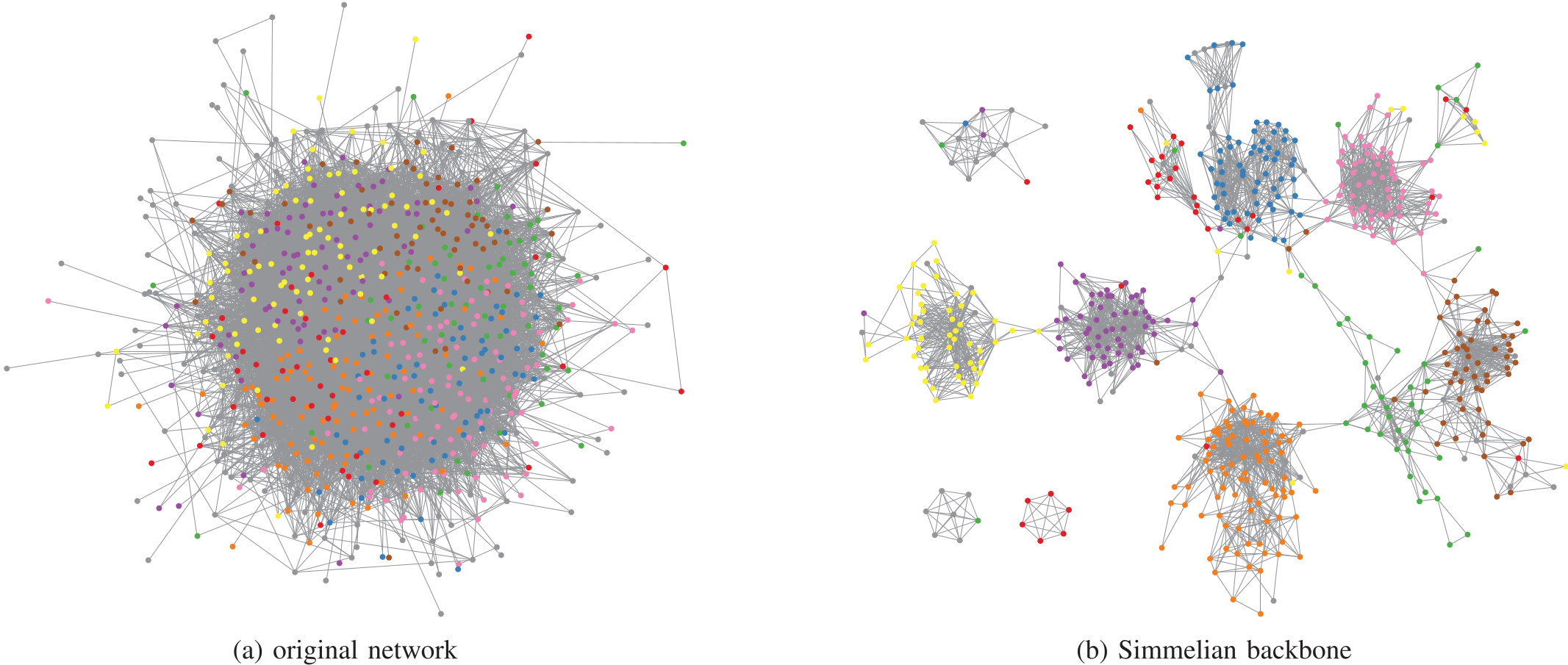 Figure 2: Caltech network before (left) and after (right) backbone extraction. The color-coded dorm clusters become significantly more apparent.
Quantifying Homophily
The "Simmelian" edges consistently showed higher homophily (similarity between connected nodes) than the full graph. In almost every institution, students were more likely to share the same graduation year, dorm, and gender when connected via the backbone than via a random edge.
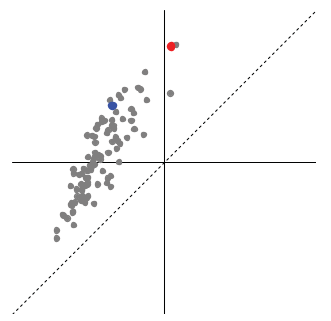 Figure 3: Scatterplots showing that Simmelian backbones (y-axis) consistently amplify homophily across various attributes compared to the original network (x-axis).
Critical Insight & Conclusion
The genius of the Simmelian Backbone is its locality. Because it only requires looking at a node's immediate neighbors, it scales to "Big Data" effectively ().
Takeaway: If your community detection algorithm is giving you "blobs," stop looking at edge density and start looking at Simmelian redundancy. The most meaningful groups in any social system are those where people don't just know each other—they share a common set of "strong" associates.
Limitations: The choice of (the ranking depth) still requires some domain knowledge or the use of the non-parametric Jaccard variant, which can be harder to interpret. Future work should look at how these backbones evolve over time as social groups form and dissolve.