
CQS: Reimagining Search Suggestions for the Elementary Classroom
Suggesting Simple and Comprehensive Queries to Elementary-Grade Children
The paper introduces CQS, a Query Suggestion module specifically designed for elementary-grade children. It leverages children's literature, reputable kids' websites, and Library of Congress Subject Headings to generate simple, age-appropriate N-gram suggestions using a supervised backpropagation ranking model.
TL;DR
Standard search engines are built by adults, for adults. When a child types "Greek," they likely want "Greek Myths," not "Greek Debt Crisis." This paper presents CQS (Children Query Suggestion), a specialized module that uses children's literature and simplicity metrics to provide query suggestions that are readable, topical, and relevant to a child's cognitive level.
The "Tiger Woods" Problem: Why General Search Fails Kids
Children represent roughly 5% of search engine users, yet they face a significant "vocabulary gap." Most Query Suggestion (QS) systems rely on query logs—massive databases of what other people search for. Since most users are adults, the suggestions reflect adult interests (finance, news, celebrities) and use complex language.
The authors identify three main pain points:
- Cognitive Mismatch: Children have lower reading levels and different search behaviors (longer queries, typically 3.2 words).
- Intent Ambiguity: General engines struggle to distinguish a child's interest in "Space" (planets) from an adult's interest in "Office Space."
- Lack of Specialized Data: Most "Safe Search" tools simply filter results but don't help the child formulate the query in the first place.
Methodology: How CQS Thinks Like a Child
CQS doesn't look at adult query logs. Instead, it builds a suggestion engine from the ground up using a "Backpropagation" (BP) ranking model fueled by seven distinct features.
1. The Core Architecture
The system extracts bigrams and N-grams from reputable sources like National Geographic Kids, Simple English Wikipedia, and the Library of Congress.

2. The Seven Pillars of Ranking
- Category Likelihood: Uses a Multinomial Bayes model to see if the query matches kid-centric categories like "Animals" or "Space."
- N-gram Frequency: Prioritizes word combinations that appear frequently in children's books.
- Simplicity Score: Cross-references phrases with Simple Wikipedia to ensure the vocabulary isn't too advanced.
- Subject Headings (LCSH): Measures how well a phrase aligns with 10,749 official subject headings used in children’s libraries.
- Locality: Ensures the suggested phrase isn't a "Frankenstein" creation by checking if the words actually appear together in a single document.
Experiments: CQS vs. The Giants
The authors tested CQS against Google, Yahoo!, and Bing using real queries from children (e.g., "arctic circle," "chocolate chip," "snow").
Quantitative Performance
Using the Normalized Discounted Cumulative Gain (nDCG) metric—which rewards systems for putting the best results at the top—CQS consistently outperformed the "Big Three."
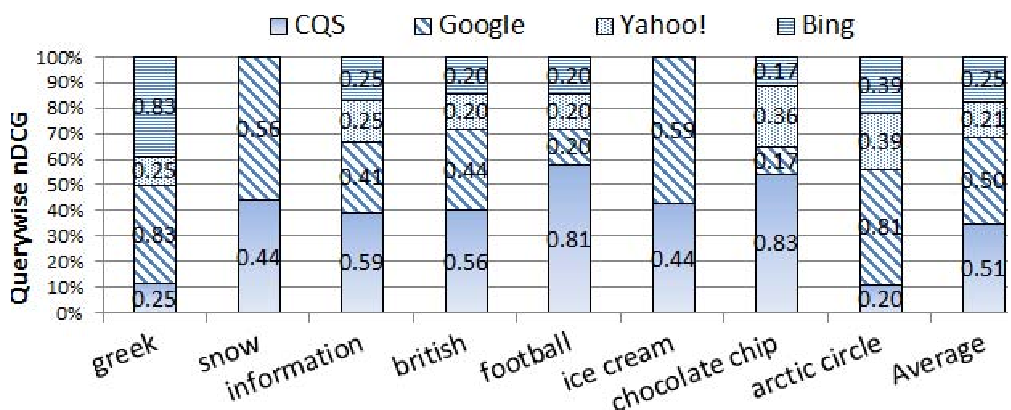 In the chart above, CQS (blue) demonstrates a higher gain in relevance across various test queries compared to general-purpose engines.
The "Human in the Loop" Validation
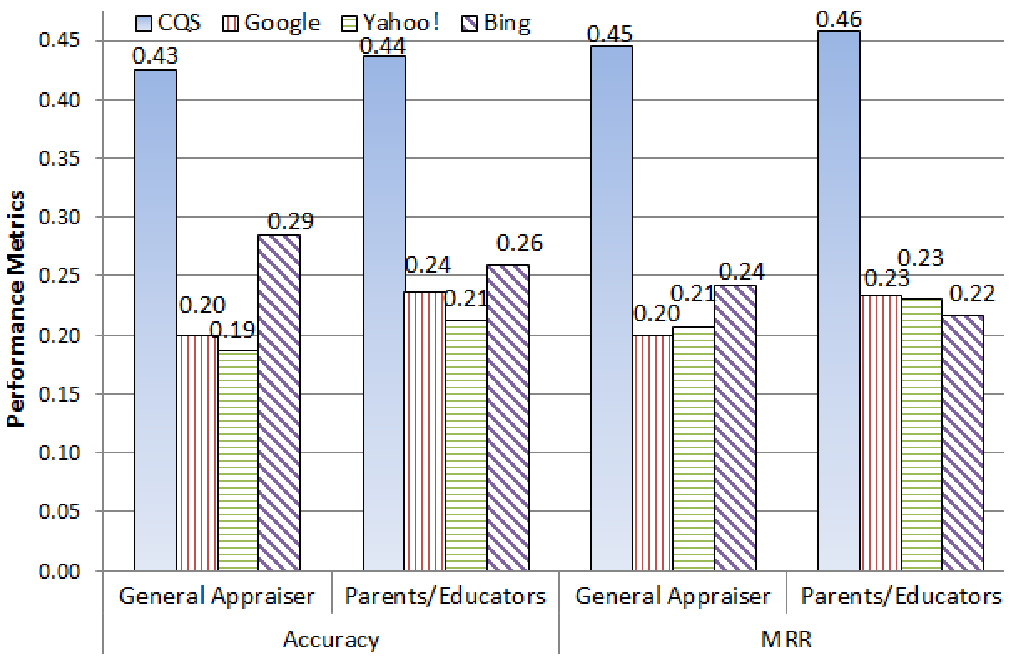
The researchers conducted two sets of human evaluations:
- Direct Feedback: 43 elementary students selected their preferred suggestions.
- Crowdsourcing: 65% of the Amazon Mechanical Turk evaluators were parents or educators, who confirmed that CQS provided safer and more "useful" educational paths.
Critical Insight & Conclusion
The significance of CQS lies in its data source independence. It doesn't need private query logs (which are hard to get due to COPPA and privacy laws). Instead, it uses open web content written by and for children.
Takeaway: As search moves toward more personalized AI agents, the CQS approach reminds us that "one size fits all" is fundamentally broken for younger audiences. The future of educational search isn't just about filtering out "bad" content; it's about proactively guiding children toward "good" vocabulary.
Limitations: The study used a small set of 8-10 test queries for the primary child-based evaluation. Future work should explore how these models scale to voice-based search, which is increasingly common among younger children who can't yet type fluently.