
Unified Metaheuristics: Decoding the Mechanics of SPPBO
16183_Simple Probabilistic Population-Based Optimization.
This paper introduces the Simple Probabilistic Population-Based Optimization (SPPBO) scheme, a unified framework for combinatorial optimization. It formally connects and generalizes Population-Based Ant Colony Optimization (PACO) and Simplified Swarm Optimization (SSO) by utilizing two fundamental operations: SELECT+COPY and RANDOM.
TL;DR
The research landscape of optimization is often cluttered by overly complex, metaphor-heavy algorithms. This paper introduces SPPBO (Simple Probabilistic Population-Based Optimization), a generic framework that strips away the fluff to reveal the "true mechanics" of why population-based solvers work. By unifying PACO (Ant Colony) and SSO (Swarm Intelligence), the authors demonstrate that efficient optimization can be achieved through just two operations: SELECT+COPY and RANDOM.
Problem & Motivation: The Metaphor Tsunami
In the quest for novelty, the academic community has seen an explosion of "novel" metaheuristics—from cuckoo search to jumping frogs. However, as noted by researchers like Sörensen, these often hide simple algorithmic truths under layers of biological analogy.
The authors argue for Occam’s razor: why use a complicated model if a simpler one works? The problem is twofold:
- Redundancy: Methods like SSO and PACO were treated as different species when they are effectively variants of the same probabilistic engine.
- Complexity: Many algorithms are unnecessarily opaque, making it hard to discern which part of the "population" actually drives performance.
Methodology: The Core of SPPBO
The SPPBO scheme defines a solution as a vector where each component is determined by the influence of different archives (populations).
The Probabilistic Engine
The heart of the method is a formal decision rule. To choose a value for component , the SCE (Solution Creating Entity, like an ant or particle) uses:
- SELECT+COPY: The term looks at how many solutions in a specific population already have value . It "copies" successful traits.
- RANDOM: The term injects diversity, preventing the algorithm from stalling in local optima.
- Heuristic Information ( ): For problems like TSP, it incorporates physical distances to bias the search.
Population Types
The paper categorizes archives into:
- Global Populations: Shared by all agents (e.g., the last best solutions).
- Personal Populations: Private memory of a single agent (e.g., "personal best" in PSO).
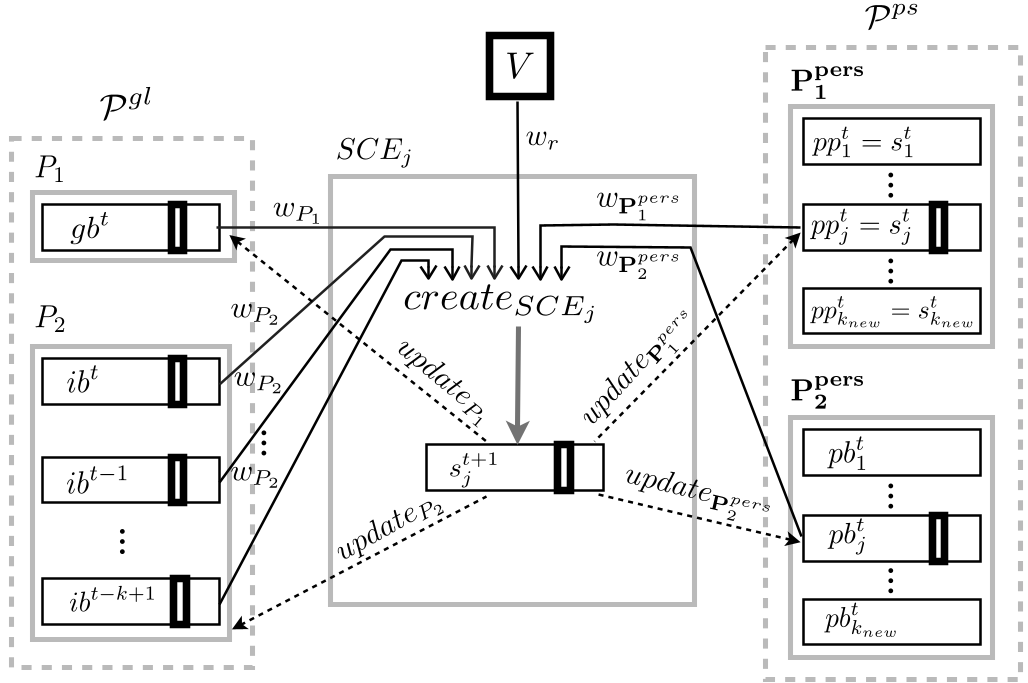 Fig 1: A visual representation of SCEs interacting with Global and Personal populations to generate new candidate solutions.
Experiments & Results
The authors tested seven SPPBO variants on the Traveling Salesperson Problem (TSP) and Quadratic Assignment Problem (QAP).
1. The Global Advantage
The most striking result is the dominance of Global Populations. Algorithms SPPBO-1 (essentially PACO) and SPPBO-3/4 (PACO-SSO hybrids) converged much faster than versions relying solely on personal memory.
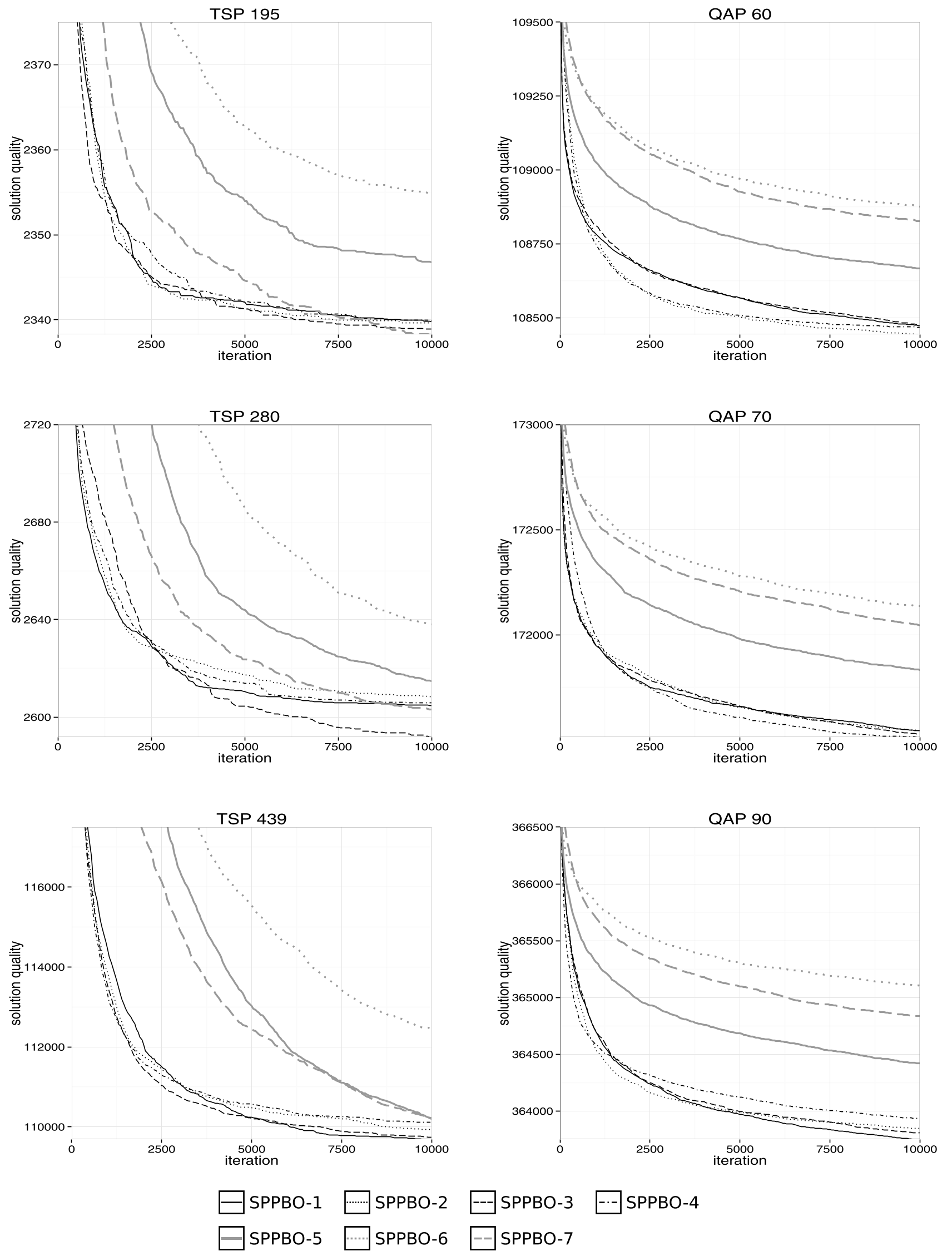 Fig 2: Convergence curves showing that variants with global populations (1-4) achieve higher solution quality in fewer iterations compared to purely local/personal variants (5-7).
2. Sensitivity to Weights
The study found that the "total weight" () assigned to the populations relative to randomness is critical. For complex landscapes like QAP, larger global populations (higher ) and stronger weights on the elitist solution were necessary to drive convergence.
SOTA Comparison: TSP vs. QAP
- TSP: Good solutions are structurally similar. Thus, even simple SSO (SPPBO-7) eventually finds high-quality results.
- QAP: The fitness landscape is much more rugged. Here, global populations are non-negotiable for success.
Critical Analysis & Conclusion
Takeaways
- Efficiency in Simplicity: You don't need complex biomimicry. A few archives and a frequency-based decision rule outperform many complex hybrids.
- Design Choice: If building a distributed system, personal populations (SSO style) are easier to implement due to lower communication overhead. However, for sheer performance on tough problems, global archives are superior.
Limitations
While SPPBO is excellent for discrete combinatorial problems, its application to continuous function optimization (where "copying" a value is less intuitive) requires further refinement of the "distance" between population members.
Future Outlook
The SPPBO scheme acts as a "periodic table" for metaheuristics. Future researchers can use it to map out unexplored algorithm variants—such as grouping SCEs into independent tribes with tribal archives—without getting lost in the "metaphor tsunami."