
SIMPS: Decoding the Sociology of Human Movement
15921_SIMPS using sociology for personal mobility.
The paper introduces SIMPS (Sociological Interaction Mobility for Population Simulation), a behavioral mobility model for pedestrian crowds based on sociological principles. It replaces traditional random walks with two core mechanisms: "socialize" (attraction to acquaintances) and "isolate" (repulsion from strangers), successfully replicating heavy-tailed scaling laws observed in real-world human motion traces.
TL;DR
Human movement isn't random. SIMPS (Sociological Interaction Mobility for Population Simulation) is a groundbreaking model that moves away from the "random walk" paradigm. By defining individuals through their innate sociability and two simple behaviors—socialize and isolate—it naturally generates the complex power-law patterns (heavy tails) seen in real-world human interactions without artificial tuning.
Back to the Roots: Why Randomness Fails
For decades, the Networking community relied on the Random Waypoint (RWP) model. While mathematically convenient, RWP is essentially a "brainless" model where entities move between random points. Real humans don’t behave this way; we are driven by social needs, schedules, and relationships.
Existing research often tries to "fix" RWP by fitting it to empirical traces (top-down). The authors of SIMPS argue for a bottom-up approach: if we model the causes of mobility (sociological drivers), the consequences (realistic movement patterns) will emerge naturally.
Methodology: The "Sociostation" Mechanism
The core of SIMPS is Sociostation. This principle suggests that every individual has an intrinsic "comfort zone" for social interaction.
- Intrinsicality: Your social need is a personal trait (like being an introvert or extrovert).
- Interactivity: You act to maintain that level.
The Feedback Loop
SIMPS implements this via a control loop:
- Perception: A node senses its surroundings (surround count ) within a social radius .
- Decision: If the surround count is too low, the node enters Socialize mode (attraction to acquaintances). If it's too high, it enters Isolate mode (repulsion from others).
- Execution: This intent is translated into physical acceleration and velocity.
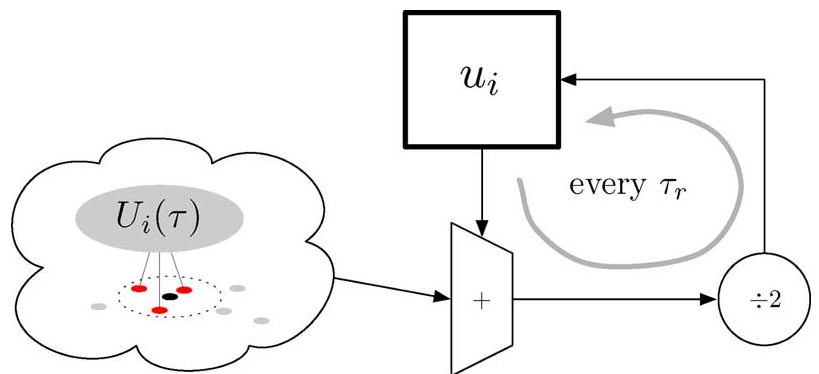 Fig 1: The feedback decision process using hysteresis to switch between socialization and isolation.
Instead of rigid "groups," SIMPS allows collective behaviors like group formation and path evolution to emerge from these individual rules.
Experimental Evidence: Emergence of Power Laws
The most striking result is how SIMPS matches the "watermark" of human mobility: power-law distributions. In real-world Bluetooth traces (iMotes), the time between meetings (inter-contact time) follows a heavy tail.
SIMPS achieves this effortlessly. Interestingly, the researchers found that the structure of the social graph (Random vs. Scale-Free) matters less than the behavioral interaction itself. This suggests that the "socialize/isolate" tension is a fundamental driver of human spatial statistics.
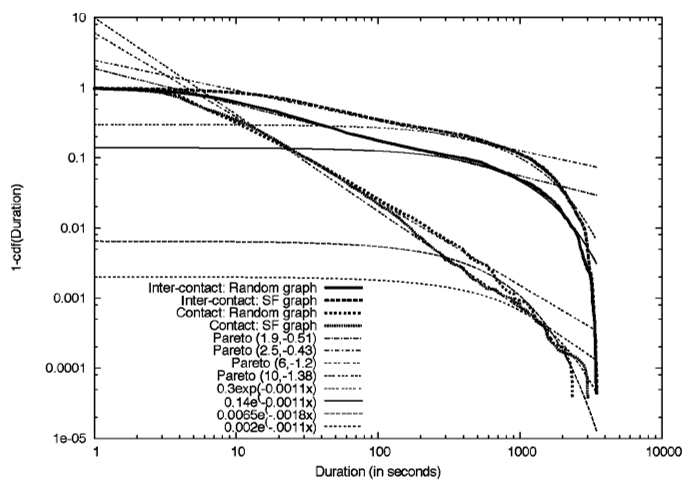 Fig 2: Contact and Inter-contact distributions showing clear power-law characteristics across different graph types.
Key Insights from Ablation:
- Socialize Only: Results in a "staircase" distribution, failing to capture the full spectrum of movement.
- Isolate Only: Matches the power law but leads to nodes drifting apart indefinitely in open space.
- The Synergy: The interplay between the two is what creates the realistic "churn" of human crowds.
Critical Analysis & Future Outlook
SIMPS represents a shift toward Behavioral Mobility Modeling. By focusing on the "Why," it provides a more robust framework than simple trace-replay.
Limitations:
- The model currently focuses only on the social component. In reality, physical constraints (walls, traffic) and "activity planning" (going to work) also dictate motion.
- It assumes a static social graph, whereas human relationships evolve over time.
Future Work: Integrating SIMPS with geographic constraints and temporal schedules could create the ultimate "Synthetic Human" simulator for smart city and 5G/6G network planning. If we can model the soul of the crowd, we can build better networks for the people in them.
Final Takeaway
Don't simulate the walk; simulate the wanter. When agents have a "reason" to move, the resulting patterns are more "human" than any random distribution could ever achieve.