
SimRec: Solving Cold-Start in Recommendations via Semantic Similarity
SimRec: Mitigating the cold-start problem in sequential recommendation by integrating item similarity
SimRec is a novel sequential recommendation framework designed to mitigate the cold-start problem by integrating item similarity into the training process. By employing a customized loss function that leverages textual embeddings (e.g., GTE-Large), it achieves SOTA performance on sparse datasets within the SASRec architecture without adding trainable parameters or inference latency.
TL;DR
The "Cold-Start" problem remains a graveyard for recommendation performance. SimRec, a new approach from Amazon researchers, revives rare items by teaching the model that "Items that look alike should be ranked alike." By integrating a specialized similarity loss based on LLM embeddings, SimRec achieves a staggering 78% boost in HR@10 for rare items without increasing inference time by even a millisecond.
The "Data Desert" Problem
In many e-commerce datasets, item interaction data follows a long-tail distribution. In the Amazon Beauty dataset, for instance, 91% of items appear fewer than 10 times.
Traditional models like SASRec (Self-Attentive Sequential Recommendation) treat item IDs as independent tokens. If the model hasn't seen "Item A" enough times, it simply cannot learn a meaningful embedding for it. However, "Item A" (a 1oz lavender oil) might be almost identical to "Item B" (a 4oz lavender oil) which has thousands of clicks. SimRec's core insight is to bridge this gap using the semantic similarity of item metadata.
Methodology: Injecting Intelligence via Loss
Instead of changing the Transformer architecture, SimRec changes the objective.
1. Item Similarity Distribution
First, the authors use a pre-trained LLM (GTE-Large) to convert item titles into dense vectors. They then compute a similarity matrix. For any target item, they create a probability distribution showing which other items are most similar to it.
2. The SimRec Loss Function
The training objective is a weighted combination:
- : The standard "did the user click this?" loss.
- : A Cross-Entropy loss that forces the model's predicted scores to match the pre-calculated item similarity distribution.
 (The Similarity Loss ensures that even if an item is rare, the model treats it similarly to its "popular" neighbors)
Experiments: Dominating the Long Tail
SimRec was tested against heavyweights like SASRec, BERT4Rec, and CARCA across various datasets.
Key Results:
- Sparse Datasets (Amazon Tools, Beauty, etc.): SimRec consistently outperformed all baselines. In "Beauty," it achieved a 28.85% improvement in HR@10 over SASRec.
- Zero-Shot Capability: Remarkably, SimRec could recommend items that were never seen in the training set (Zero Frequency), whereas standard ID-based models failed completely (0% accuracy).
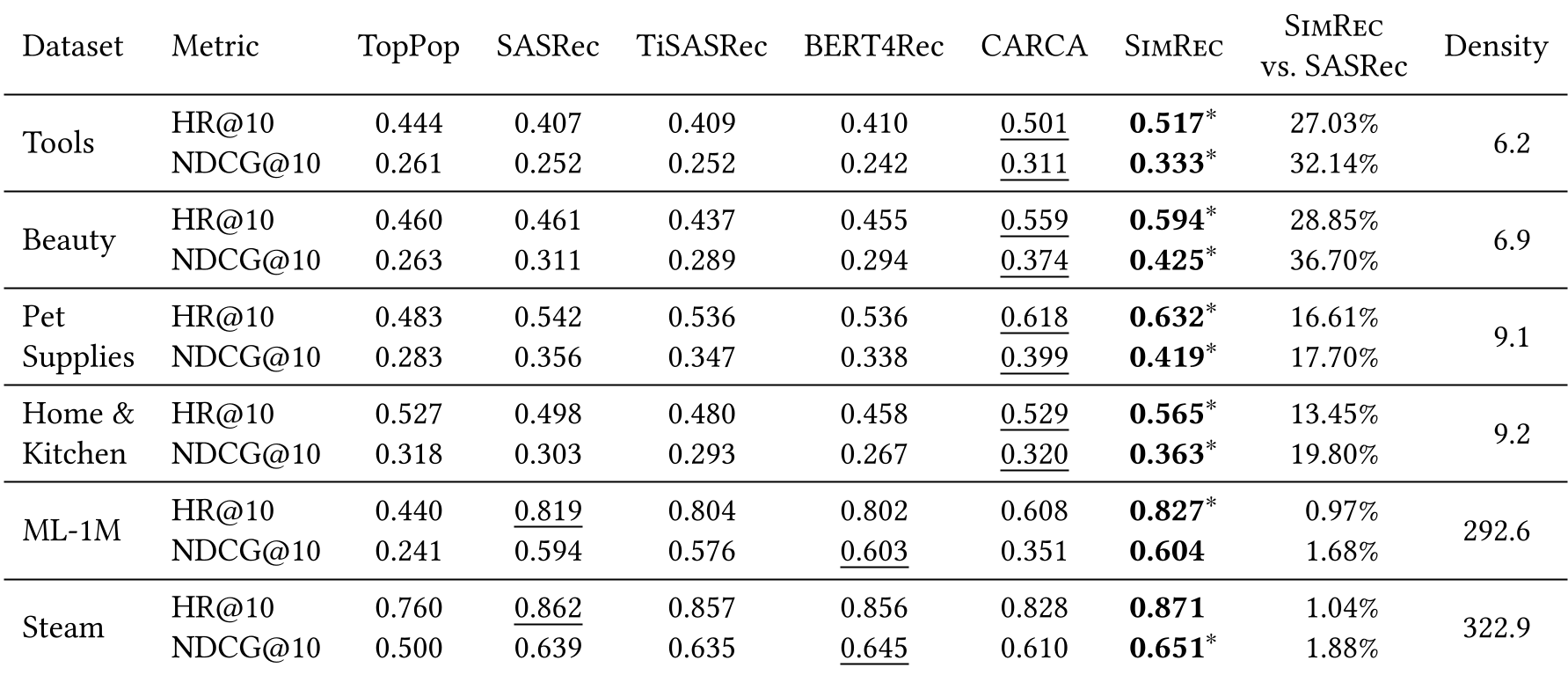
Density vs. Performance
The researchers found an inverse correlation: the sparser the dataset (the less data available), the higher the relative gain of SimRec. This proves that SimRec is specifically "medicine" for the cold-start ailment.
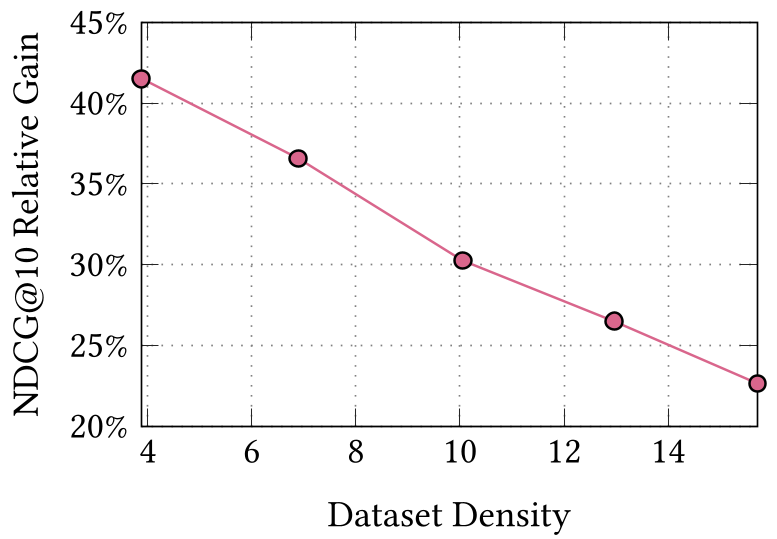 (As dataset density drops, SimRec's performance edge over SASRec grows significantly)
Critical Insights
- Architectural Purity: Because SimRec uses a standard SASRec backbone during inference, it is highly "production-friendly." You get the power of LLM-based understanding without the latency of running an LLM at runtime.
- Loss vs. Initialization: The ablation study showed that simply initializing embeddings with LLM vectors isn't enough. The Similarity Loss is the real engine of improvement, as it continuously guides the model to learn the relational structure of the item space.
- Generalization: While this paper focused on text, the framework can easily extend to visual similarity (using CLIP embeddings) or price-point similarity.
Conclusion
SimRec proves that we don't always need "larger" models to solve hard problems; we need smarter training signals. By anchoring ID-based embeddings to a semantic manifold, SimRec effectively eliminates the "identity crisis" of cold-start items in sequential recommendation.
Author's Note: This work is a significant milestone for practitioners dealing with high-churn catalogs (like fashion or news) where items appear and disappear before traditional models can even learn their names.