
Simulating Human Behaviors: Why "Irrational" Humanity Survives in a Rational Agent World
Simulating human behaviors in agent societies
The paper "Simulating Human Behaviors in Agent Societies" investigates the dynamics of mixed human-agent societies by modeling human agents based on sociological data and pitting them against rational agent types. Using the "Dictator" and "Indirect Reciprocity" games, the study identifies specific "prosperous niches" and vulnerabilities for human-like behaviors within a computational agent environment.
TL;DR
As we move toward a world where humans and AI agents coexist, a critical question arises: Will humans be outmaneuvered by "perfectly rational" code? This paper simulates this collision by modeling human prosocial behaviors—derived from real-world sociological data—against various rational agent archetypes. The findings suggest that while humans are prone to exploitation, our social "irrationality" (like indirect reciprocity) creates stable niches for survival and cooperation.
Background: The Blur Between Sociology and AI
For decades, computer scientists built agent societies based on Rational Choice Theory. Meanwhile, sociologists observed human societies driven by Social Norms. As these worlds merge into "Mixed Societies," the authors argue that we must stop treating agent behavior as a purely mathematical optimization problem and start treating it as a sociological one.
The Core Problem: The Gap of Irrationality
Existing Multi-Agent Systems (MAS) struggle to predict human interaction because humans don't always maximize their own utility. We give to others even when it's "illogical." Why?
- Altruism vs. Egoism: Our internal values.
- Public vs. Private: Our fear of reputation loss.
The authors identify that failing to model these "human-factors" makes agent societies fragile or incompatible with real-world human users.
Methodology: Modeling the "Human" Agent
The researchers utilized data from two psychological benchmarks: The Dictator Game and The Indirect Reciprocity Game.
1. The Human Archetypes
Based on the work of Simpson and Willer, the authors created four human-like agent profiles based on donation probability:
- HAPr / HAPu: Human Altruists (Private/Public)
- HEPr / HEPu: Human Egoists (Private/Public)
2. The Rational Opponents
They pitted these "humans" against three classic AI archetypes:
- Philanthropic (P): Always gives 50%.
- Selfish (S): Takes everything, gives nothing.
- Reciprocative (R): Gives based on the opponent's past behavior (Tit-for-Tat style).
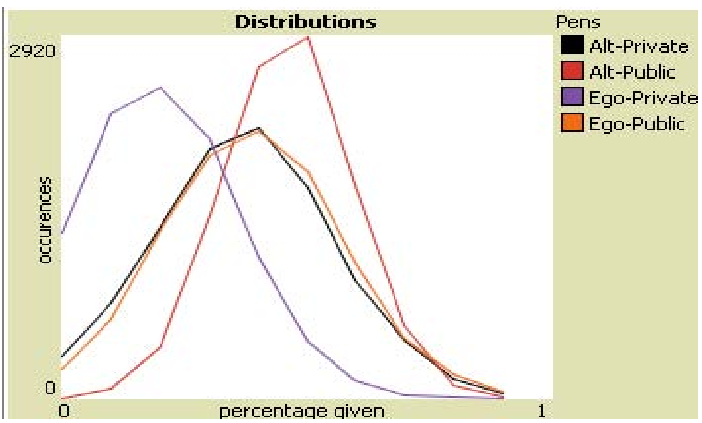 Figure 1: Probability distributions of human donations used to calibrate the simulated agents.
Experiments: How Humans Fare
Using the NetLogo simulation environment, the authors ran thousands of iterations of resource-sharing games.
Key Finding 1: The "Fragility" of Public Image
Human-like agents, especially egoists in public (HEPu), donated significantly more when "observed" (46%) compared to private (22%). Selfish agents (S) ruthlessly exploited this drive for reputation in the Dictator game, leading to a massive resource drain from the "human" to the "rational" agent.
Key Finding 2: The Indirect Reciprocity "Shield"
The tide turns in the Indirect Reciprocity Game. Here, a third party rewards or punishes an agent based on its reputation. In this setting, the Selfish rational agents were effectively "starved" of resources because human-like agents refused to reciprocate to non-donors.
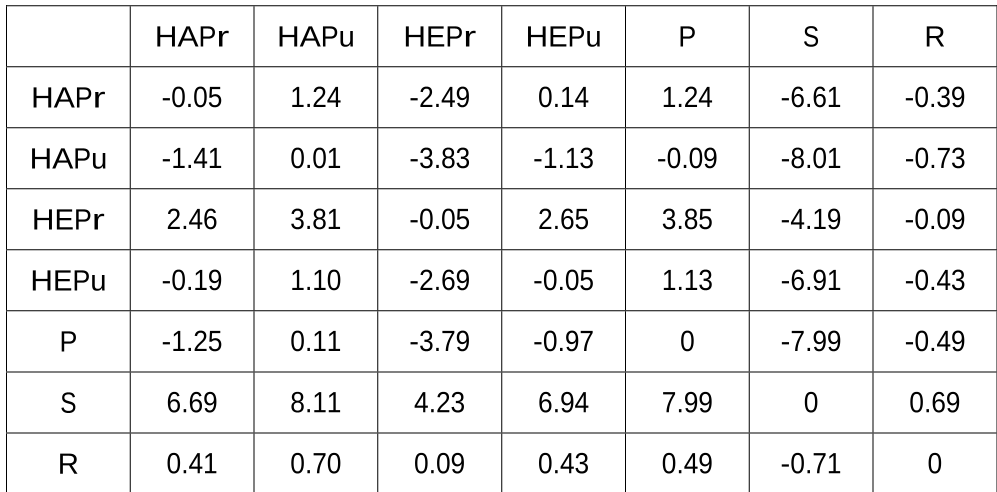 Table 2: Accumulated resource differences in the Dictator Game. Note how Selfish agents (S) consistently gain (positive values) against all human types.
Critical Analysis & Conclusion
The paper concludes that human "irrationality" is a feature, not a bug.
- Pros: Prosocial inclinations (altruism) facilitate prosperity when humans interact with "Reciprocative" or "Philanthropic" agents. This suggests that for AI to be successful in human society, it should be designed with reciprocity at its core.
- Cons: Humans are uniquely vulnerable to "Parasitic" agents. Our innate fear of social ramifications (appearing mean) often forces us to give to those who will never give back, a loophole that rational agents can exploit.
Future Outlook
The study assumes humans treat agents exactly like other humans. However, as AI becomes more ubiquitous, we must ask: Will humans remain altruistic toward a machine they know has no soul? The authors suggest that the next frontier is repeating these sociological experiments with real human participants playing alongside AI to see if our "social fear" extends to the silicon world.
Takeaway: In a world of rational agents, the most successful strategy isn't being the smartest; it's being the best at identifying who to trust.