
Simulating the Human Element: The RHIM Approach to Precise Medical Record Linkage
Simulating regional medical record systems (student poster)
The paper introduces the Regional Health Information Modeler (RHIM), a specialized framework designed to simulate Regional Health Information Organizations (RHIOs). Its primary goal is to generate representative data sets with known links to evaluate record linkage algorithms, using communication theory to model the error-prone registration process.
TL;DR
The Regional Health Information Modeler (RHIM) is a simulation framework designed to solve the "ground truth" scarcity in medical record linkage research. By modeling the registration process through the lens of Communication Theory, RHIM generates synthetic yet regionally representative datasets that allow researchers to rigorously test and tune patient-matching algorithms.
Background: Why Patient Matching is a High-Stakes Game
In the medical world, the inability to link a patient's records across different hospitals can be fatal; however, linking two different patients' records (a false positive) is often considered even more dangerous due to privacy violations and incorrect treatments. This work positions itself as a critical diagnostic tool for Regional Health Information Organizations (RHIOs), providing a controlled environment to measure the delicate trade-off between false positives and false negatives.
The Core Problem: The Data Drought
Current SOTA methods for record linkage frequently hit a wall due to:
- Lack of Ground Truth: Real-world datasets rarely come with "perfect" labels.
- Regional Variance: Errors in a rural clinic in Tennessee might look very different from those in a metropolitan hospital in New York.
- The "Human" Factor: Most simulators only account for typos (physical errors), ignoring cognitive errors like name variants or phonetic substitutions.
Methodology: The RHIM Process
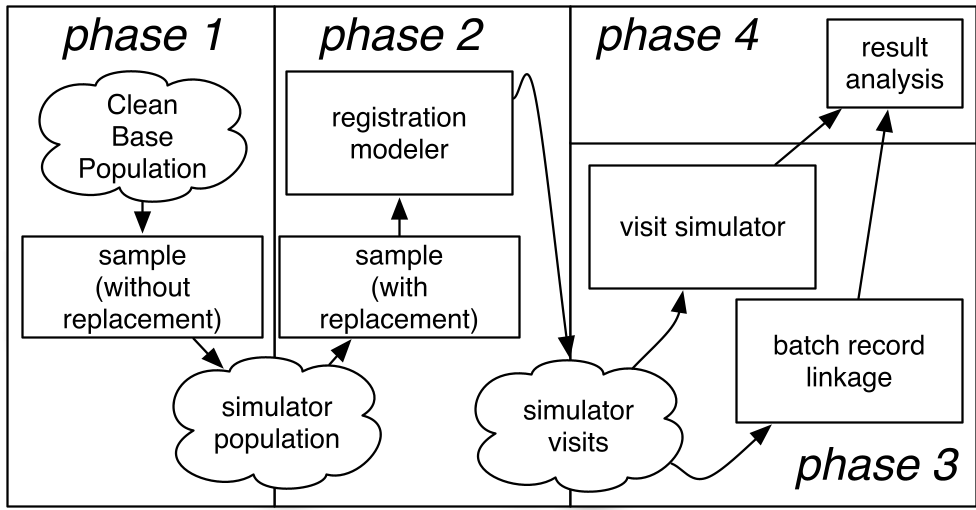
The RHIM framework operates in a four-stage pipeline (Pipe and Filter architecture), ensuring modularity and scalability.
1. The Simulation Pipeline
The architecture follows a clear progression from population generation to final evaluation:
- Phase 1 & 2: Extracting a "Base Population" and simulating visits through a "Registration Modeler."
- Phase 3 & 4: Executing linkage algorithms in batch or real-time modes and evaluating performance against the synthetic ground truth.
2. Modeling Errors as "Noise"
Drawing from Shannon’s Communication Theory, the author treats the registrar (the person typing the data) as a noisy channel. The model identifies three critical failure points:
- Point 1 (Environmental): External factors at the time of registration.
- Point 2 (Cognitive): The registrar's brain substitutes a name for a similar variant or a grapheme/phoneme.
- Point 3 (Physical): Traditional typographical errors (insertions, deletions, transpositions).
(Note: This conceptual model integrates cognitive psychology with string-matching logic, a significant departure from purely statistical noise models.)
Experimental Potential and Future Work
The simulator is built using Python, emphasizing a modular "pipe and filter" design. This allows other researchers to plug in their own registration models or linkage algorithms easily.
- Data Mining for Rules: The author is currently using data mining to extract real-world error "rules" from matched datasets, ensuring the simulator isn't just generating random noise but is mimicking regional human behavior.
- Benchmarking: By implementing common string comparators (like Levenshtein or Jaro-Winkler), RHIM will serve as a standardized benchmark for the RHIO community.
Critical Insight: Beyond Simple Typos
The true value of this work lies in its hierarchical rule structure. By allowing rules to be sequential or mutually exclusive (e.g., a "whole word replacement" rule might prevent a "single character typo" rule from firing), the RHIM captures the complex, non-random nature of human error.
Conclusion & Future Outlook
While this is a student poster, the framework addresses a fundamental bottleneck in healthcare informatics. The move toward Regional Health Information Organizations necessitates a robust way to validate the algorithms that handle our most sensitive data.
Limitations: Currently, environmental factors (Point 1 in the model) are not specifically modeled. Future iterations could benefit from incorporating "registrar fatigue" or "high-stress environment" variables to further increase simulation fidelity.
Takeaway: To build better algorithms for humans, we must first build better simulations of human error.