
Simulating Online Sociability: Agent-Based Modeling as a Sandbox for Community Design
Simulating Social Networks of Online Communities: Simulation as a Method for Sociability Design
This paper proposes an Agent-Based Model (ABM) for simulating social network formation in online communities, specifically within a Massively Multiplayer Online Role Playing Game (MMORPG) guild. By formalizing empirical interaction data from World of Warcraft into computational rules, the authors demonstrate how simulation can serve as a "virtual laboratory" for sociability design.
TL;DR
Building a successful online community is more than just a UI/UX challenge; it is a "sociability" challenge. This paper moves beyond static questionnaires to propose Agent-Based Modeling (ABM) as a tool to simulate how social networks form in MMORPGs like World of Warcraft. By tweaking parameters like "social budget" and "activeness," designers can predict whether a new feature will foster strong communal bonds or create an exclusionary elite.
The "Sociability" Bottleneck
In the world of HCI, we have mastered usability (how humans interact with computers), but we often struggle with sociability (how humans interact with each other via computers). Existing research relies heavily on post-hoc analysis—looking at what happened after a community has already formed or failed.
The authors argue that online communities are non-linear complex systems. You cannot understand the whole community just by looking at individual parts; behavior emerges from the bottom-up. To solve this, they treat the community as a "silica" society that can be grown, tested, and stressed in a controlled simulation.
Methodology: From Chat Logs to Computational Rules
The researchers followed a four-phase pipeline to bridge the gap between real behavior and virtual simulation:
- Observation: They collected nearly 2,000 chat messages from a WoW guild.
- Formalization: Messages were categorized into interaction types: Help Provision, Help Seeking, and Friendly Chat.
- Simulation (ABM): These behaviors were programmed into agents in the NetLogo environment.
- Validation: Using Social Network Analysis (SNA), they ensured the simulated networks matched the real-world guild's density and reciprocity.
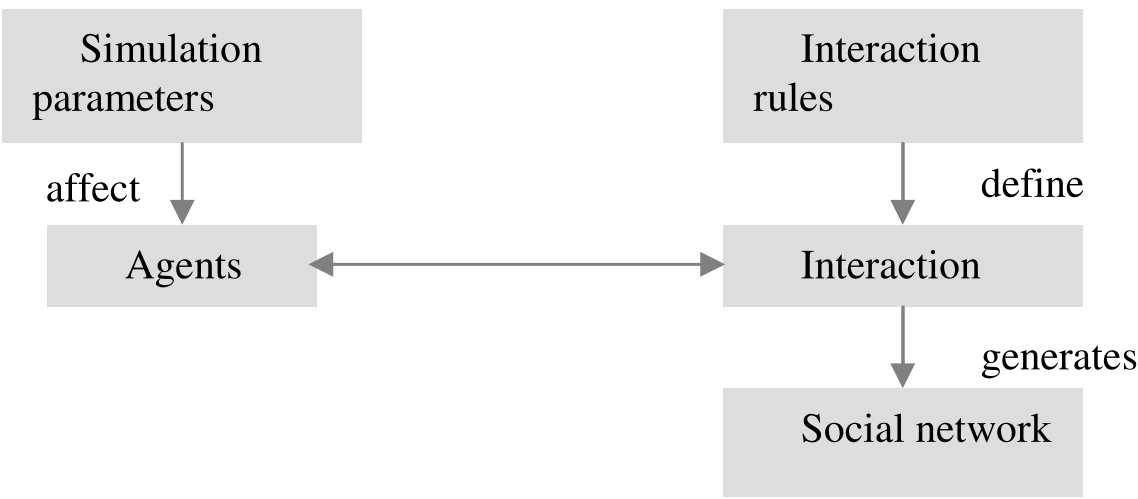 Figure 1: The conceptual framework illustrating how extrinsic parameters influence agent interaction rules to produce an emergent social network.
Key Experiments & Counter-Intuitive Insights
1. The Paradox of Activity
We often assume that a more "active" community is a better one. However, the simulation showed that as the activeness factor increased, reciprocity dropped. Why? Because agents were initiating more interactions but not necessarily responding to them. Furthermore, high activity levels amplified in-degree centralization, meaning a small group of "popular" agents received most of the attention, while the "activity gap" for quieter members widened.
2. The Social Budget Ceiling
The authors tested the social budget (the maximum number of friends an agent keeps). They found that once a small friend network is formed, agents almost entirely stop interacting with "strangers." This suggests that without design interventions like "friend suggestions," communities can become stagnant and fragmented into isolated cliques.
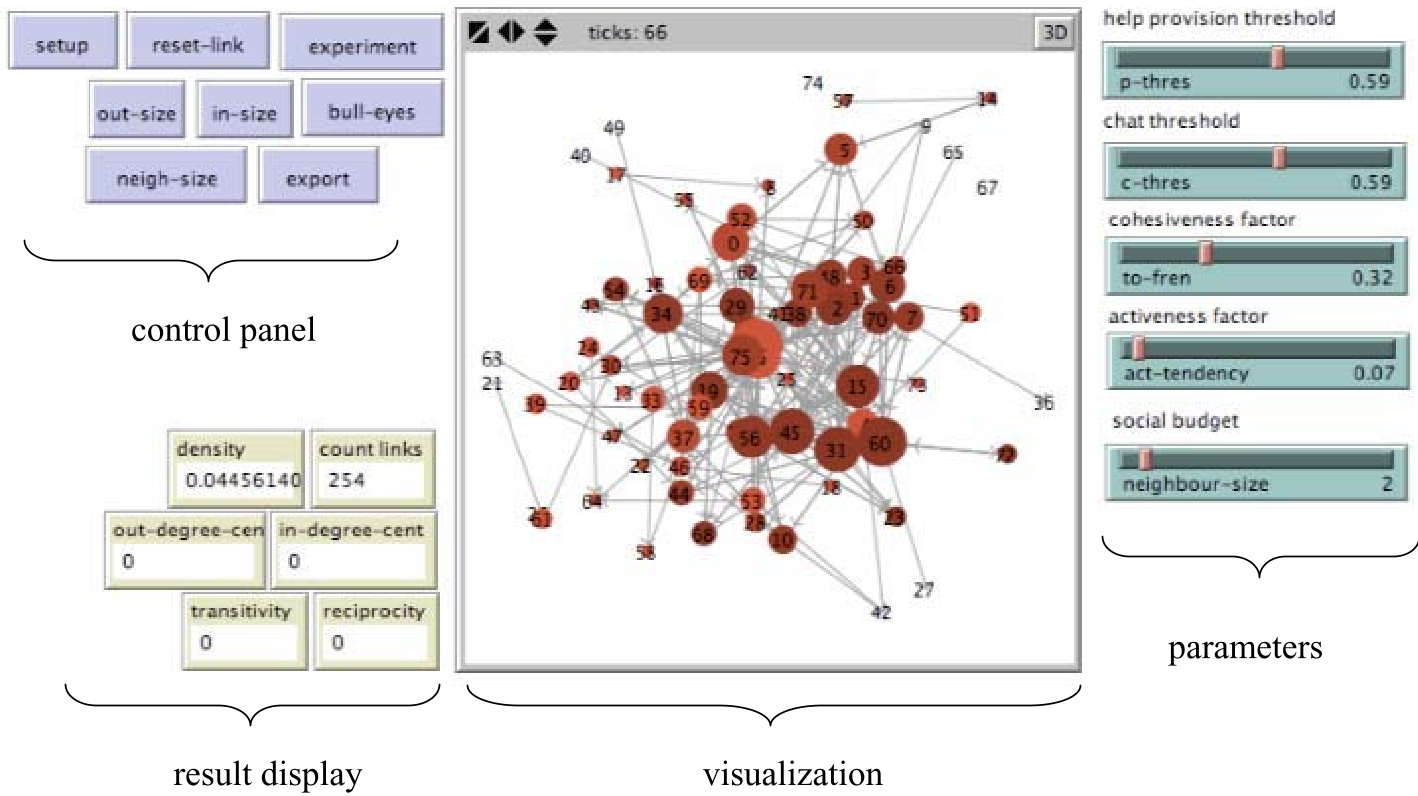 Figure 2: The NetLogo simulation interface showing the real-time evolution of social ties and centralization metrics.
Critical Analysis & Takeaways
The brilliance of this work lies in its predictive power. Instead of launching a "reward system" and hoping it works, a designer can simulate it:
- Finding: High activity creates "elites."
- Design Fix: Implement a system that rewards interacting with new members rather than just rewarding volume of posts.
Limitations: The model is based on chat logs from 2008. In the modern era of Discord and TikTok, social dynamics are influenced by algorithmic feeds and asynchronous interactions that are far more complex than the three categories studied here. However, the methodological blueprint remains highly relevant for anyone building metaverses or digital "third places."
Future Outlook
As we move toward AI-integrated social platforms, using ABM to simulate how AI agents and humans co-create social networks will be the next frontier. This paper provides the foundational "virtual laboratory" approach needed to ensure these digital spaces remain equitable and cohesive.