Engineering Human Participation: Simulation-Based Design of Crowdsourcing Incentives
Simulation-Based Modeling and Evaluation of Incentive Schemes in Crowdsourcing Environments
The paper introduces a simulation-based methodology and an abstract model for designing and calibrating incentive schemes in crowdsourcing environments. It proposes a framework to evaluate "Composite Incentive Schemes" (CIS) by simulating the interactions between provider-side rewards and worker-side social behaviors, specifically targeting collective adaptive systems.
TL;DR
Crowdsourcing systems often fail not because they lack workers, but because their incentive structures create unforeseen costs or invite malicious behavior. This paper presents a methodology to simulate and calibrate complex incentive schemes before they are deployed. By modeling workers as agents with distinct personalities and reputations, the authors demonstrate how to balance system costs against data quality in scenarios like traffic reporting and software testing.
Context: This work shifts the focus from theoretical microeconomics to practical, simulation-driven engineering of "Collective Adaptive Systems."
The Problem: The High Cost of Human Unpredictability
In traditional business environments, incentive models (like pay-for-performance) are predictable. However, in the "Wild West" of crowdsourcing, these models break down.
- The Scalability Paradox: As more users participate, the cost of verifying their work can grow faster than the value they provide.
- Malicious Adaptation: Workers are not static; they adapt to rules. If you reward submissions, you get duplicates; if you reward quality, they might "game" the reputation system.
- Inadequacy of Current Research: Formal game theory is too rigid for human erraticism, while real-world experiments (e.g., on Amazon Mechanical Turk) are too expensive and slow for iterative design.
Methodology: The Feedback Loop of Incentives
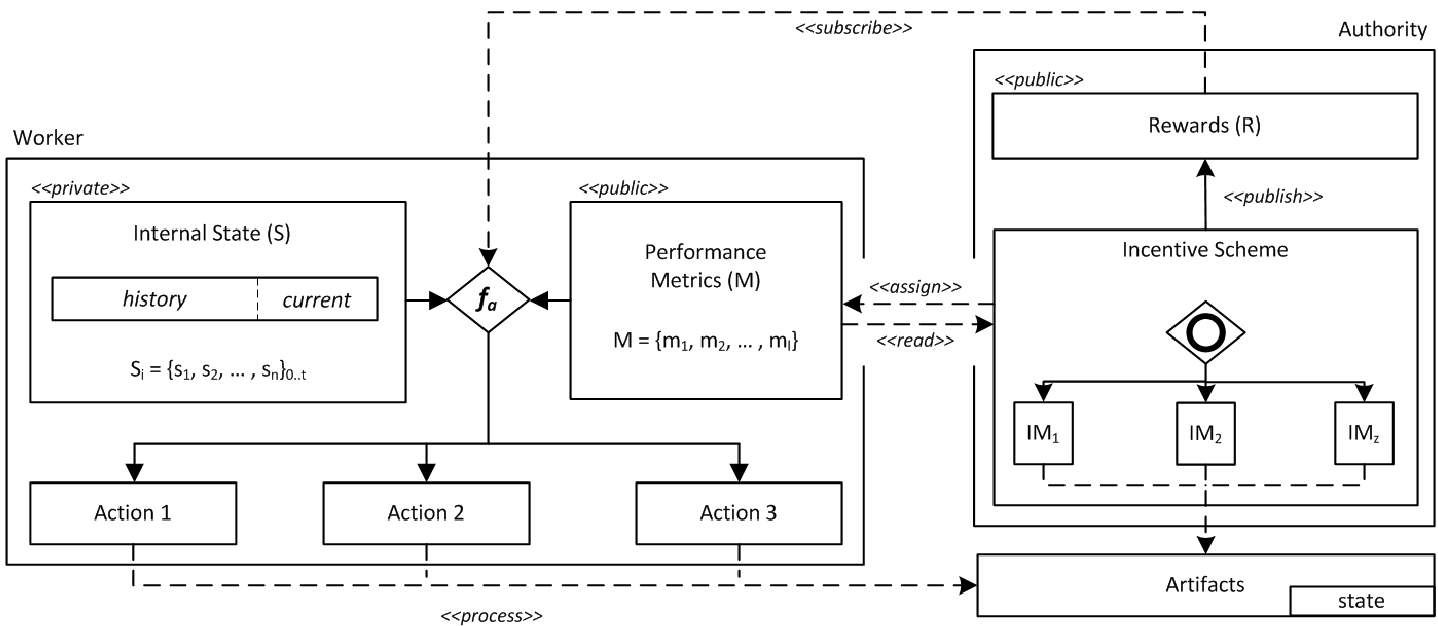
The core of the paper is an Incentive-Centric Meta-Model. It treats incentives as a control-loop system:
- The Authority: Offers artifacts (e.g., bug reports) and promises rewards.
- The Worker: A private agent with an internal state (accuracy, speed, honesty) and a decision-making function .
- The Feedback: The Authority updates a worker’s public metrics (Reputation, Points) based on their action, which then influences the worker’s next decision.
Composite Incentive Schemes (CIS)
The authors propose that effective incentives are not monolithic but "composed." They tested three levels:
- CIS1: Fixed rewards (Point-per-task).
- CIS2: Quality-adaptive (Points based on report scarcity or accuracy).
- CIS3: Social-aware (CIS2 + Reputation tracking).
Key Insights from Simulations
The authors ran simulations across 10 phases and 250 time units, focusing on a generalized reporting scenario (similar to Waze or crowdsourced QA).
1. The Danger of "Overpaying"
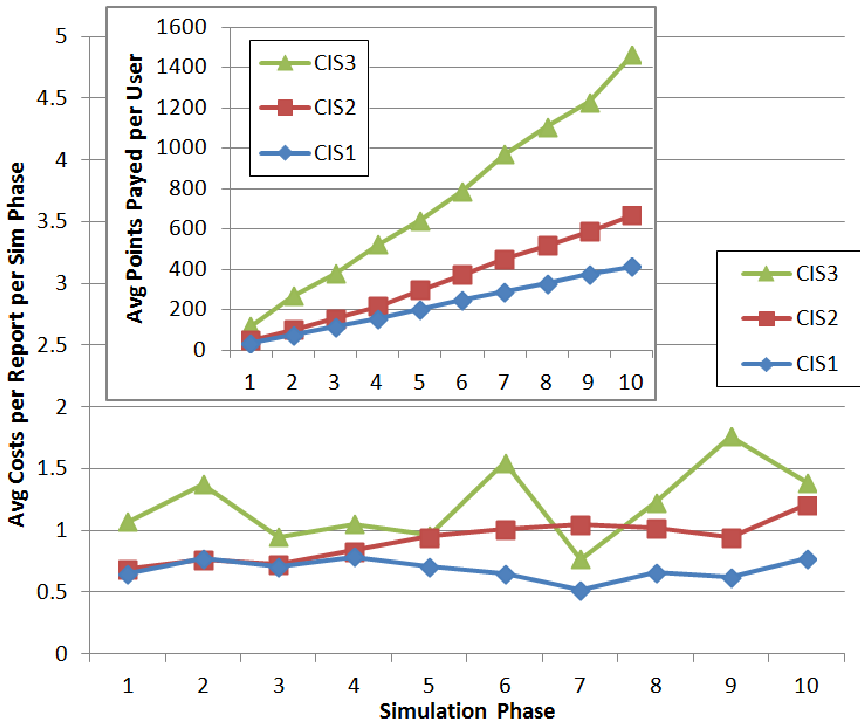
One might think higher rewards always lead to better results. Experiment 1 proved otherwise. While CIS2 (dynamic rewards) increased participation, it actually led to higher systemic costs than flat fees because workers became too active, generating a flood of duplicate reports that the authority had to pay to process.
2. Reputation as a Shield
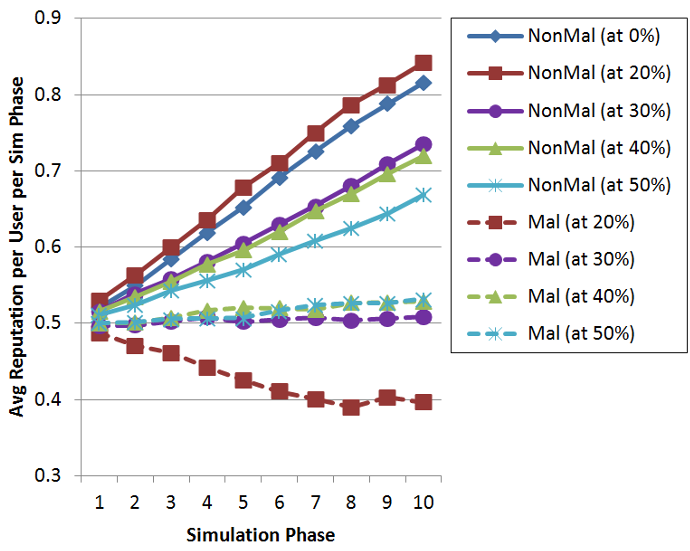
The study highlights the critical role of reputation in handling Malicious Workers. Malicious agents were programmed to submit inaccurate data or sabotage existing reports.
- Result: Under CIS3, the system "learned" to ignore low-reputation workers.
- Threshold: The system remained stable up to 20% malicious participation. Beyond 30%, simple reputation scoring was insufficient, requiring "worker blocking" mechanisms.
Critical Analysis & Conclusion
This research moves the needle by providing a low-cost sandbox for platform designers. The primary takeaway is that incentives have a "Stability Range." If the ratio of workers to situations shifts (e.g., too many workers and not enough tasks), the reputation system can stagnate, making it impossible to distinguish between a new honest worker and a malicious one.
Limitations: The model assumes a "normal distribution" of personalities. In reality, crowd behavior can be non-linear and prone to "herd mentality," which agent-based models sometimes struggle to capture without more complex social interaction rules.
Future Outlook: The integration of such simulations with automated incentive management systems (where the platform shifts rewards in real-time based on simulation-predicted outcomes) represents the next frontier in social computing and gig-economy platform design.