
SPACES: Predicting Crowd Riots through Social Media Sentiment and Agent-Based Simulation
Simulation-Based Prediction and Analysis of Collective Emotional States
The SPACES project introduces a novel framework for predicting crowd aggression by combining real-time Sentiment Analysis from social media (Twitter) with the ASCRIBE Agent-Based Simulation model. This integration allows for the spatial mapping and future projection of collective emotional states to assist law enforcement in preemptive crowd control.
TL;DR
The SPACES (Simulation-based Prediction and Analysis of Collective Emotional States) project proposes a hybrid intelligence system that uses Twitter as a real-time sensor for crowd emotion. By feeding sentiment data into the ASCRIBE social contagion model, the system can predict the emergence and spread of aggressive outbursts before they escalate, providing a strategic "early warning system" for security personnel.
Background Positioning
In the landscape of crowd safety, we are shifting from physical monitoring (where are the people?) to psychological monitoring (how do the people feel?). SPACES sits at the intersection of Sentiment Analysis and Agent-Based Modeling (ABM), upgrading traditional "social force" models with deep neurological insights into how emotions spread like viruses through a crowd.
The "Blind Spot" in Modern Crowd Control
Current safety measures often react to physical movement—detecting a crush or a rush once it has already begun. However, as noted in the paper, riots are often triggered by "small stimuli" like a minor dispute or a heated atmosphere. Traditional sensors (CCTV, Infrared) cannot "read the room."
The authors argue that the missing link is the qualitative state of the individuals. Previous models either lacked real-time data or failed to account for how one person's anger increases the "susceptibility" of their neighbors to also become aggressive—a process known as social contagion.
Methodology: From Tweets to Trajectories
The SPACES framework operates in a two-stage pipeline:
1. Sentiment Analysis as a Distributed Sensor
Instead of asking crowd members to report their feelings, the system scrapes Twitter (now X) using topic clusters (e.g., event names) and feature clusters (e.g., "violence," "stadium").
- Emotional Nuance: It doesn't just measure "happy/sad" but extracts 32 distinct emotions including aggression, fear, and disapproval.
- Spatial Mapping: Using metadata, these emotions are mapped onto a 2D grid of the physical location.
2. The ASCRIBE Model: The Engine of Contagion
The core innovation lies in the ASCRIBE (Agent-based Social Contagion Regarding Intentions, Beliefs, and Emotions) model. Unlike models that treat agents as simple particles, ASCRIBE uses differential equations to model:
- Intra-agent dynamics: How an agent's fear influences their belief that a situation is dangerous.
- Inter-agent dynamics: How the "aggression value" of Agent A raises the state of Agent B based on physical proximity and susceptibility.
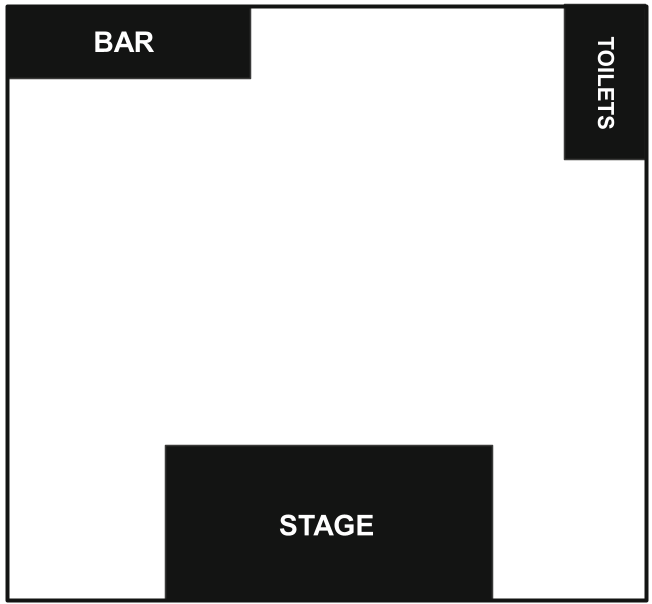 Figure 1: (Left) Initial aggression detected at restrooms via social media. (Right) Predicted expansion of aggression 5 minutes later using ASCRIBE simulation.
Why It Works: The Physics of Emotion
The brilliance of this approach is that it treats aggression almost like a heat map. By identifying a "hot spot" at a bar or restroom through a few angry tweets, the simulation uses its internal "psychological laws" to forecast whether that heat will set the rest of the room on fire.
The paper highlights that this model is rooted in the Somatic Marker Hypothesis, suggesting that our emotional states are fundamental to our decision-making (e.g., the intention to flee or fight).
Competitive Performance
While SPACES is an ongoing project, the underlying ASCRIBE model has already proven superior to the industry-standard Helbing "Social Force" model. In a 2010 Amsterdam incident simulation, ASCRIBE successfully modeled scenarios where people stopped panicking once they perceived the threat was gone—a nuance that purely physical models cannot capture.
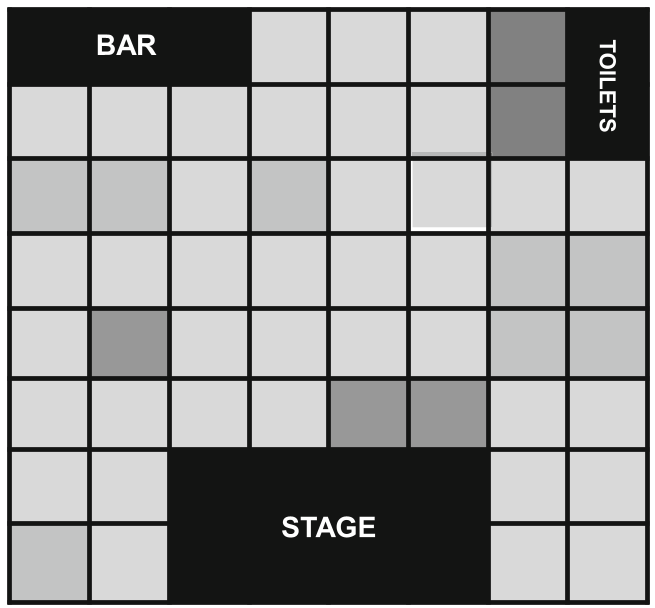 Figure 2: The conversion of a physical space into a computational grid for cellular-level emotional analysis.
Critical Analysis & Future Outlook
Contribution: This work bridges the gap between big data (social media) and micro-simulation (ABM). It moves security from "seeing" to "foreseeing."
Limitations:
- Selection Bias: Not everyone in a crowd tweets. The model assumes the "tweeting minority" is a representative proxy for the "silent majority."
- Latency: In a high-stress riot, the seconds spent processing natural language could be the difference between prevention and escalation.
Future Work: The authors look toward integrating Instagram and Facebook data and moving into real-world validation trials. As AI-based sentiment analysis becomes more robust, the sensitivity of these "emotional smoke detectors" will only improve, potentially making mass casualties at festivals a thing of the past.
Conclusion
SPACES represents a shift toward Algorithmic Guardianship. By understanding that a crowd is a collection of interacting minds—not just moving bodies—this methodology provides a roadmap for a safer, more responsive public safety infrastructure.