
FPGA and Machine Learning: A New Frontier for Simulating Economic Innovation Outcomes
Simulation of Economic Benefits of Technological Innovation Based on FPGA and Machine Learning
This paper explores the simulation of economic benefits derived from technological innovation by integrating FPGA (Field Programmable Gate Arrays) with Machine Learning (ML). It proposes a reconfigurable FPGA cluster architecture to accelerate ML algorithms like SVM and Neural Networks, aiming to model and quantify regional innovation performance and productivity growth.
TL;DR
This research bridges the gap between hardware engineering and economic science. By leveraging an FPGA cluster to accelerate Machine Learning (ML) algorithms, the paper provides a high-performance simulation environment to quantify how technological innovation translates into tangible economic benefits. The study highlights that innovation is not just an "input," but a complex system that requires massive computational power to model accurately.
Background & Positioning
In the landscape of economic research, "Technological Innovation" is often treated as a black box. Traditional statistical models (like linear regression) often fail to capture the multi-stage nuances of regional innovation systems. This paper positions itself as a technical bridge, moving economic simulation from serial CPU processing to a parallel, hardware-accelerated paradigm.
The Core Problem: The Complexity of the "Innovation Loop"
Regional innovation functions as an input-output system where technical efficiency (Step 1) leads to productivity gains (Step 2), eventually manifesting as social benefits (Step 3). Modeling this involves:
- High Complexity: Managing multiple variables like R&D expenditure, patent counts, and labor productivity.
- Computing Bottlenecks: Standard CPU-based environments struggle with the non-linear processing required by deep learning and SVMs in large-scale economic datasets.
Methodology: The FPGA-ML Hybrid Architecture
The author proposes a reconfigurable FPGA-based co-processor designed to handle the heavy lifting of ML training and inference.
1. Hardware-Level Optimizations
Instead of relying on the CPU for vector operations, the system utilizes DSP units and Multiplier Accumulators (MACs) in parallel. This allows for SIMD (Single Instruction Multiple Data) processing, which is ideal for the matrix multiplications found in Support Vector Machines (SVMs) and neural networks.
2. Communication Protocol
The system uses an FPGA Cluster connected via Ethernet using a custom protocol. The host (Intel i5 quad-core) acts as a client, while the FPGA nodes handle the intensive computations. Asynchronous communication threads ensure that data transfer doesn't become a bottleneck.
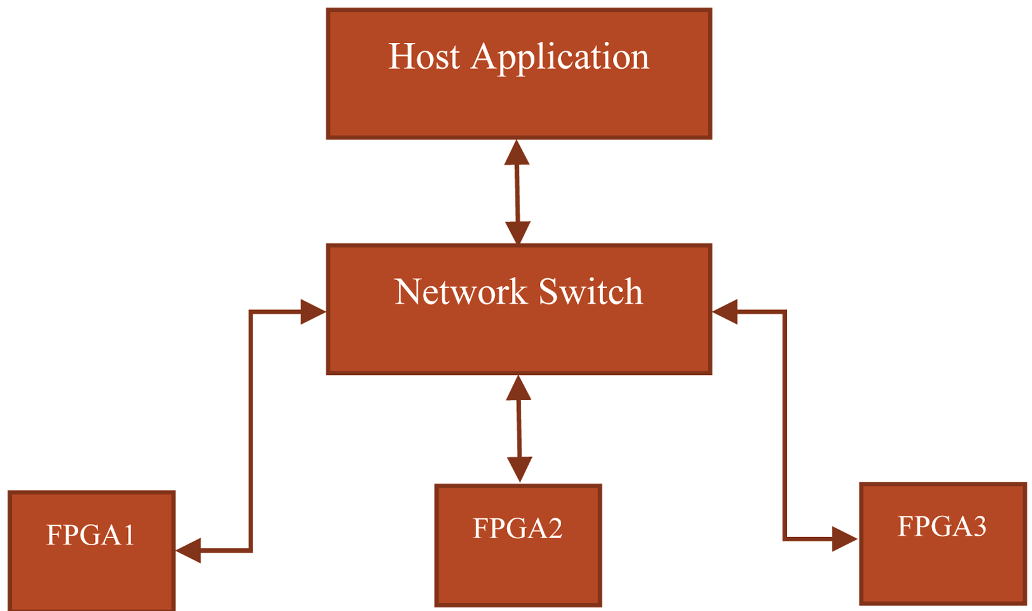 Figure: The host-client relationship and thread management for FPGA asynchronous communication.
Experiments and Key Findings
The simulation was conducted using the .NET environment (Visual C#) with a 200MB data size representing high-tech industry statistics.
- Resource Efficiency: The FPGA configuration demonstrated high resource utilization on a single board, managing up to 100 simultaneous file transfers with low latency.
- Economic Insights: The simulation validated that R&D integration and patent applications have a "profoundly positive effect" on the value-added of industrial sectors.
- Cost-Effectiveness: Unlike high-end GPU clusters, the proposed FPGA architecture offers a "modest, simple-to-extend" solution for academic and regional government use.
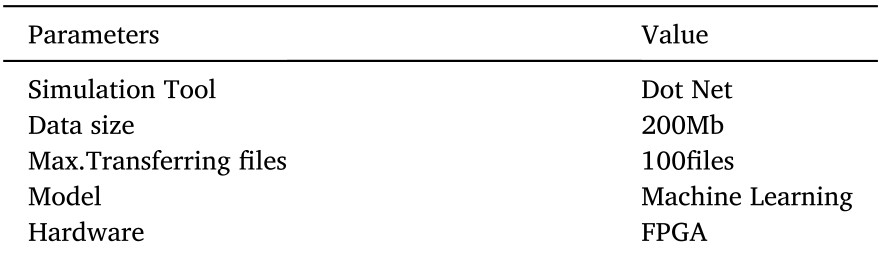 Table: Key simulation parameters for the FPGA-based Machine Learning model.
Critical Analysis & Conclusion
Takeaways
The paper successfully argues that Machine Learning is the "how" and FPGA is the "where" for future economic simulations. By offloading the "Productive Force" calculations to hardware, economists can run more granular simulations of policy changes.
Limitations
- Software Abstraction: While the paper mentions the .NET framework, it lacks a detailed analysis of the HDL (Hardware Description Language) code complexity.
- Dataset Variety: The simulation is focused on industry-level stats; it remains to be seen how this architecture handles more volatile "Social Media" or "Sentiment Analysis" data for economic forecasting.
Future Outlook
As we move toward a "Modern Economic System," real-time simulation will become a standard tool for policymakers. This work paves the way for "Economic-Digital Twins" where hardware acceleration allows for the instantaneous evaluation of technological roadmaps.
Keywords: FPGA, Machine Learning, Economic Growth, Technological Innovation, SOTA Simulation.