
Hierarchical Ageing Chains: Solving the Population Drainage Problem in System Dynamics
Simulation Approach to Forecasting Population Ageing on Regional Level
The paper introduces a simulation model utilizing the System Dynamics (SD) method to forecast regional population ageing. It specifically proposes a hierarchical "main and elementary cohort" approach to solve the common "drainage problem" in ageing chain models, implemented within the ExtendSim 9.2 environment.
TL;DR
Predicting how a city's population grows old isn't just about simple math; it's about modeling transitions. This paper introduces a refined System Dynamics (SD) approach that breaks down broad age groups into "elementary cohorts" of a single year. By doing so, the authors solve the "drainage problem"—a common error where models lose too many people during transitions—achieving high-precision forecasts for the Wrocław Region without resorting to "black-box" optimization.
The Problem: The "Leaky" Ageing Chain
In traditional System Dynamics, population is modeled as a series of "stocks" (buckets) connected by "flows" (pipes). As time progresses, people flow from the 0–4 age bucket to the 5–9 bucket, and so on.
However, researchers face a persistent challenge known as the drainage problem. In a continuous simulation, if you have intermediate outflows like death or emigration, the math often results in a "thinning" of the population that doesn't match reality. Previous attempts to fix this involved using genetic algorithms to artificially "stretch" maturation times—effectively hacking the model to fit the data. While numerically accurate, these methods lack transparency and fail when applied to different regions.
Methodology: The Hierarchical Breakthrough
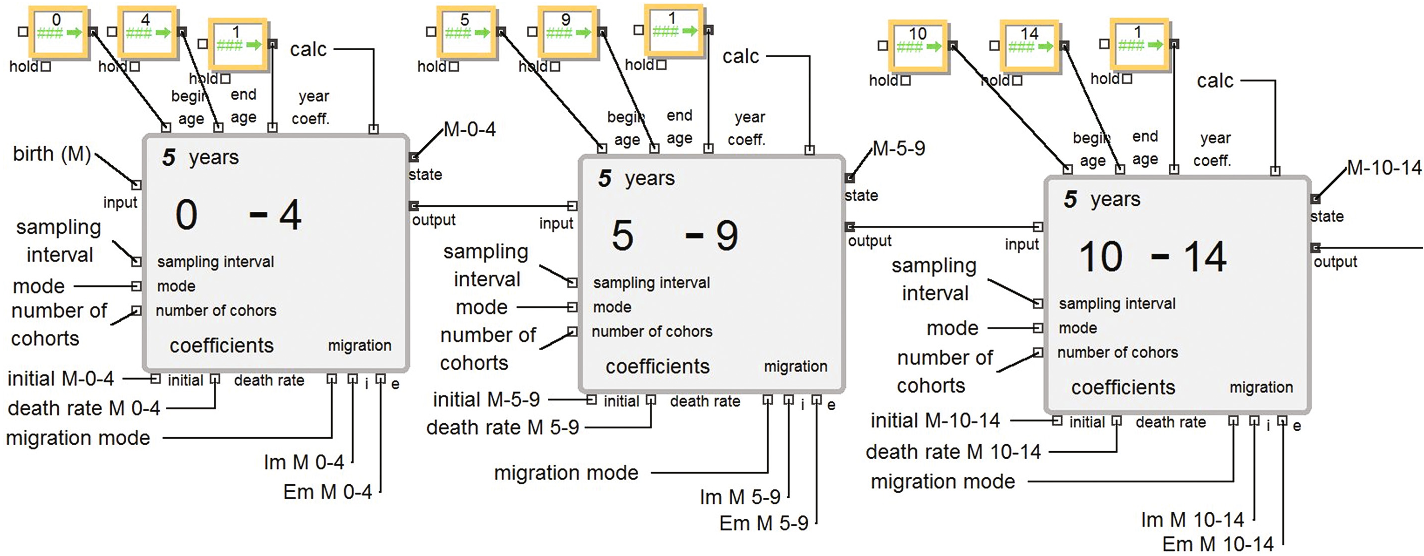
The authors' core insight is to replace broad, 5-year buckets with a granular hierarchy of 105 elementary cohorts (one for each year of life up to 105).
1. Structural Decomposition
Instead of a single maturation flow for a 5-year block, the model simulates 105 separate stages. Each stage is encapsulated in a Hierarchical Block in ExtendSim, acting like an object in programming. This allows for:
- Encapsulation: Each year of life has its own internal logic for death and migration.
- Precision: Aging occurs in exact one-year increments, preventing the "smearing" of age groups seen in coarser models.

2. Feedback Loop Logic
The model maintains complex feedback loops:
- Positive Loops: Birth rates linked to specific female age cohorts.
- Negative Loops: Death and emigration rates applied at the elementary level, ensuring that the "drainage" is distributed realistically across every year of age.
Experimental Validation
The researchers tested their model against empirical data from the Wrocław Region (2002–2015).
Key Findings:
- Accuracy: The MAPE (Mean Average Percentage Error) was significantly reduced compared to standard SD models.
- Versatility: Unlike the previous "Hacked" versions that used genetic algorithms, this model is data-independent. You can plug in birth/death rates for any region (e.g., Warsaw or Berlin), and it works immediately because the underlying biology of "aging one year at a time" is now accurately represented in the model's architecture.
Critical Insight: Why This Matters for Infrastructure
The real value of this work lies in Hybrid Simulation. Demographics (System Dynamics) don't exist in a vacuum; they drive demand for systems like hospitals (Discrete Event Simulation).
By creating a "clean" demographic engine, the authors have built a foundation for a master model that can predict:
- Morbidity Shifts: How many more oncology beds will Wrocław need in 2030?
- Resource Allocation: Where should we train more geriatric specialists versus pediatricians?
Limitations and Future Work
The primary trade-off is computational overhead. Simulating 210 entities (105 for each gender) is more intensive than simulating 36. However, in the context of strategic policy planning, these few extra seconds of simulation time are a small price to pay for a model that finally mirrors the real-world passage of time.
The next frontier is integrating this "clean" demographic data with real-time healthcare demand modules to create a truly predictive regional management tool.
Conclusion
This paper rectifies a long-standing technical glitch in demographic modeling. By shifting from "tuning parameters" to "improving architecture," the authors provide a transparent, reliable framework for forecasting the challenges of an ageing society.