
Marketemy: Bridging the Digital Marketing Skills Gap Through Scaffolding and Simulation
Designing simulation games for information systems education — A case study in teaching for digital marketing
This paper presents "Marketemy," a custom-designed simulation game aimed at teaching Search Engine Marketing (SEM) and Social Media Marketing (SMM) within Information Systems (IS) education. By integrating core game design elements like challenges, clear goals, and control, the authors achieved significant improvements in students' perceived learning, validated through a post-game survey and regression analysis.
TL;DR
Digital marketing education often suffers from a "theory-practice" gap. This paper introduces Marketemy, a simulation game designed to teach students Search Engine Marketing (SEM) and Social Media Marketing (SMM). By employing a scaffolded approach and rewarding performance with digital badges, the study proves that engagement is the vital bridge between game mechanics (challenges, goals, control) and actual learning outcomes.
The "Hands-on" Crisis in Digital Marketing
In the fast-evolving landscape of digital media, traditional lectures are insufficient. Students can learn the definition of "Click-Through Rate" (CTR) or "Quality Score," but without managing a budget or selecting keywords in a live environment, the knowledge remains abstract. However, letting students run real campaigns is expensive and risky.
The authors identify a clear void: existing marketing sims (like Cesim SimBrand) are too general, while niche sims (like Simbound) lack a comprehensive view of the multi-channel digital ecosystem.
Methodology: The Marketemy Framework
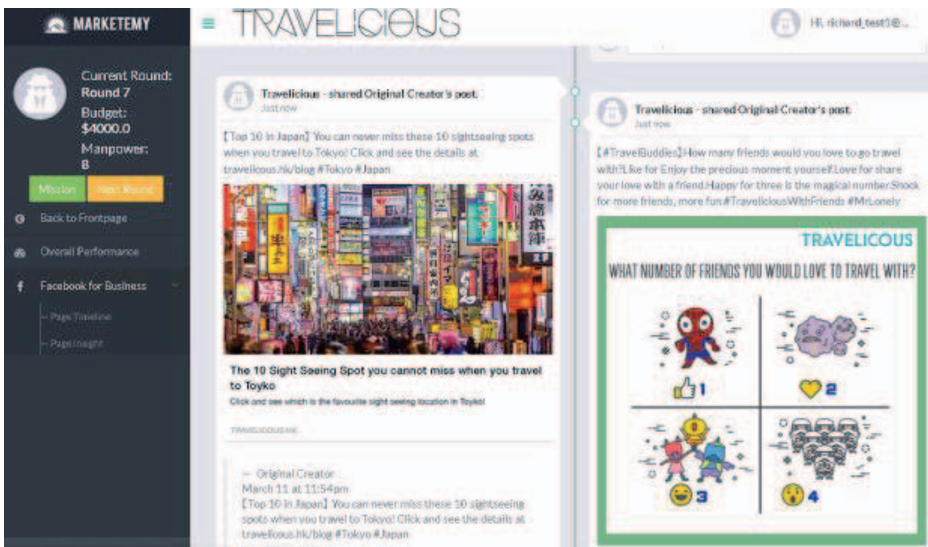
The researchers built Marketemy around the persona of a Marketing Director for a Japanese Online Travel Agency (OTA). The game is structured into two primary silos:
- Search Advertising: Players bid on keywords, write headlines/descriptions, and select landing pages.
- Social Media Marketing: Players create content, manage fan pages, and target specific demographics (age, gender, interests).
Scaffolding and Feedback
A critical methodology used here is Scaffolding. Instead of throwing students into the deep end, the game utilizes:
- Introductory Missions: Focus on brand awareness and page likes.
- Advanced Missions: Focus on conversion (sales generation).
- Feedback Loops: Use of digital badges (Level 1 to Level 3) provides immediate gratification and clear performance indicators.
Theoretical Analysis: The Role of Engagement
The core of this research is the Theoretical Model based on the GameFlow concept. The authors hypothesized that three elements—Challenge, Control, and Clear Goals—drive engagement, which in turn drives learning.
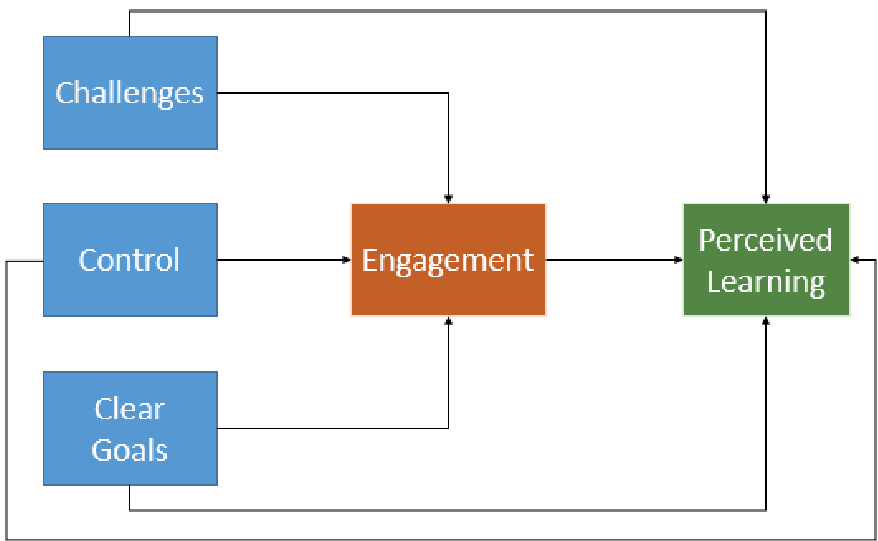
Using a 4-point Likert scale to avoid "middle-category" bias, the authors surveyed 70 students. The results were telling:
- Clear Goals had the highest impact on Engagement ().
- Engagement served as a partial mediator. This means that while good game design directly helps learning, a huge portion of that success comes from how much the student actually "gets lost" in the game.
Experimental Results
The regression analysis confirmed that students felt the game provided the "right level" of difficulty. Interestingly, despite an 80.6% male participant rate, a two-sample t-test showed no significant difference in learning outcomes or engagement between genders, suggesting the simulation approach is universally effective.
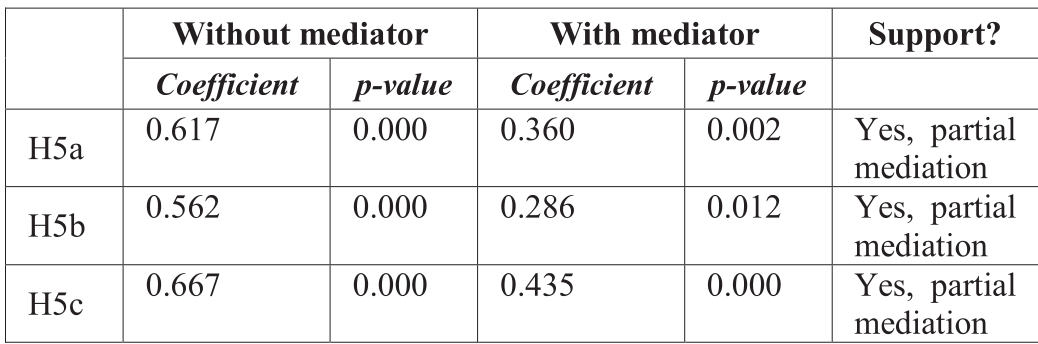 The table shows that even with the 'Engagement' mediator, the correlations remain strong, proving that the game's intrinsic mechanics are well-aligned with educational goals.
Critical Analysis & Conclusion
Takeaway
The success of Marketemy lies in its progressive learning path. By allowing students to fail and iterate in a risk-free environment, they develop an "intuitive feel" for metrics like A/B testing and targeting that a textbook simply cannot provide.
Limitations & Future Work
The study is localized (Hong Kong) and the sample size is relatively small (N=70). Furthermore, the fast-paced nature of real-world platforms like Google Ads or TikTok means any simulation needs constant content updates.
The authors suggest that future research should look into Competition (Leaderboards) and Collaboration (Team play) to see if social pressure further enhances the learning curve.
Final Thought: If you are designing an educational tool, don't just focus on the interface. Focus on the goals. Clear targets (Badges) and a sense of agency (Control) are what transform a digital chore into a profound learning experience.