
Sustainable PPP Management: A System Dynamics Perspective on National Infrastructure
Simulation Modelling Practice and Theory
This paper introduces a novel System Dynamics (SD) decision support tool designed to assess the financial and social sustainability of national-level Public-Private Partnership (PPP) programs. Unlike previous case-specific models, this research provides a holistic simulation framework that integrates fiscal risks, infrastructure gaps, and employment generation, successfully validated against UK Private Finance Initiative (PFI) historical data.
TL;DR
Infrastructure isn't just about building bridges; it’s about the long-term economic feedback loops between the public sector, private investors, and society. This paper presents a System Dynamics (SD) model that moves away from one-off project assessments to evaluate the national sustainability of Public-Private Partnership (PPP) programs. It reveals that the hidden costs—specifically public sector wages—are often the "silent killers" of national fiscal health over a 30-year horizon.
Problem & Motivation: The Project-Centric Trap
Historically, PPP research has focused on the "how-to" of individual projects: concession pricing, risk allocation, and contract periods. However, governments like the UK have recently seen their flagship programs (like PFI) collapse under the weight of unforeseen fiscal pressure.
The authors argue that the problem is a lack of holistic perspective. When a country scales PPPs nationally, the individual projects create a collective footprint. If the government fails to model the interplay between rising public debt, employment ripple effects, and social acceptability, the entire system eventually reaches a breaking point where taxpayers can no longer afford the "necessary" tax rates.
Methodology: Mapping the Invisible Feedback Loops
To solve this, the researchers built a complex SD model utilizing circular causality. The core insight is that PPPs are adaptive systems: building infrastructure creates jobs, which reduces unemployment, which in turn increases public revenue through taxes and reduces "demand risk."
1. The Power of Feedback
The model identifies 11 critical feedback loops. For instance:
- Loop 2 (Reinforcing): PPPs create jobs attracts migration increases infrastructure demand triggers more PPPs.
- Loop 8 (Balancing): More PPPs higher Unitary Charges lower Public Affordability slows down new deals.
2. Physical to Financial Translation
The research transforms qualitative causal links into quantitative "Stock-and-Flow" diagrams. This allows for the simulation of "PPPs Under Construction," "Operating PPPs," and "Delivered PPPs" as levels that drain or fill based on policy rates.
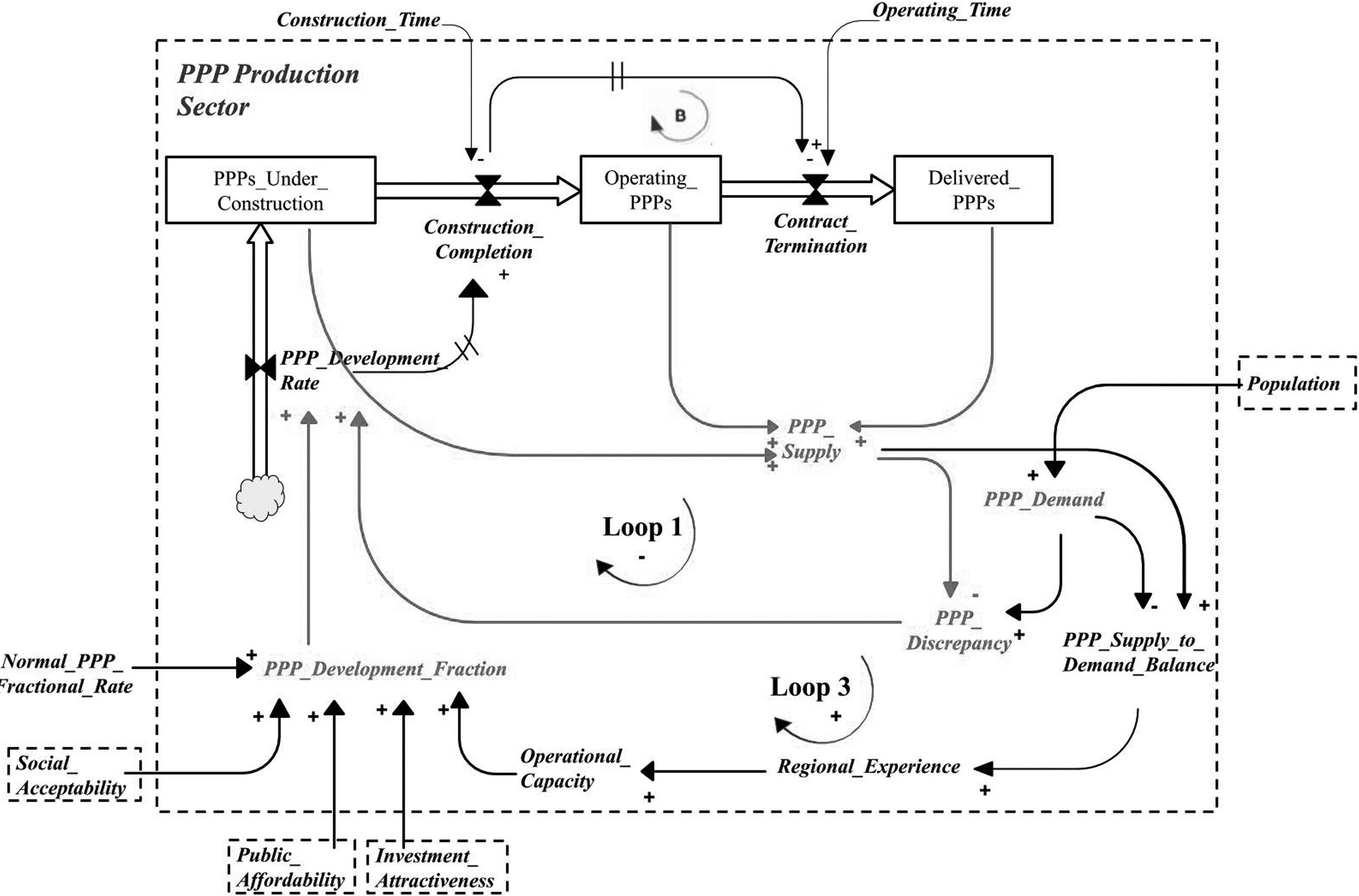 Figure 1: The Stock-and-Flow structure showing how projects migrate from construction to operation and eventually to delivery.
Experiments & Results: The "Wages" Redline
The model was calibrated against historical UK data (1990–2011), achieving a remarkably high fit (MAPE of 2.41%).
The 30-Year Fiscal Cliff
The most striking experiment compared two conditions:
- Unitary Charges only: The budget remains sustainable.
- Unitary Charges + Public Wages: The budget crashes into negative territory after 30 years.
This explains why "social infrastructure" (schools, hospitals) feels so expensive over time; it's not the build cost—it's the service and staff costs that escalate.
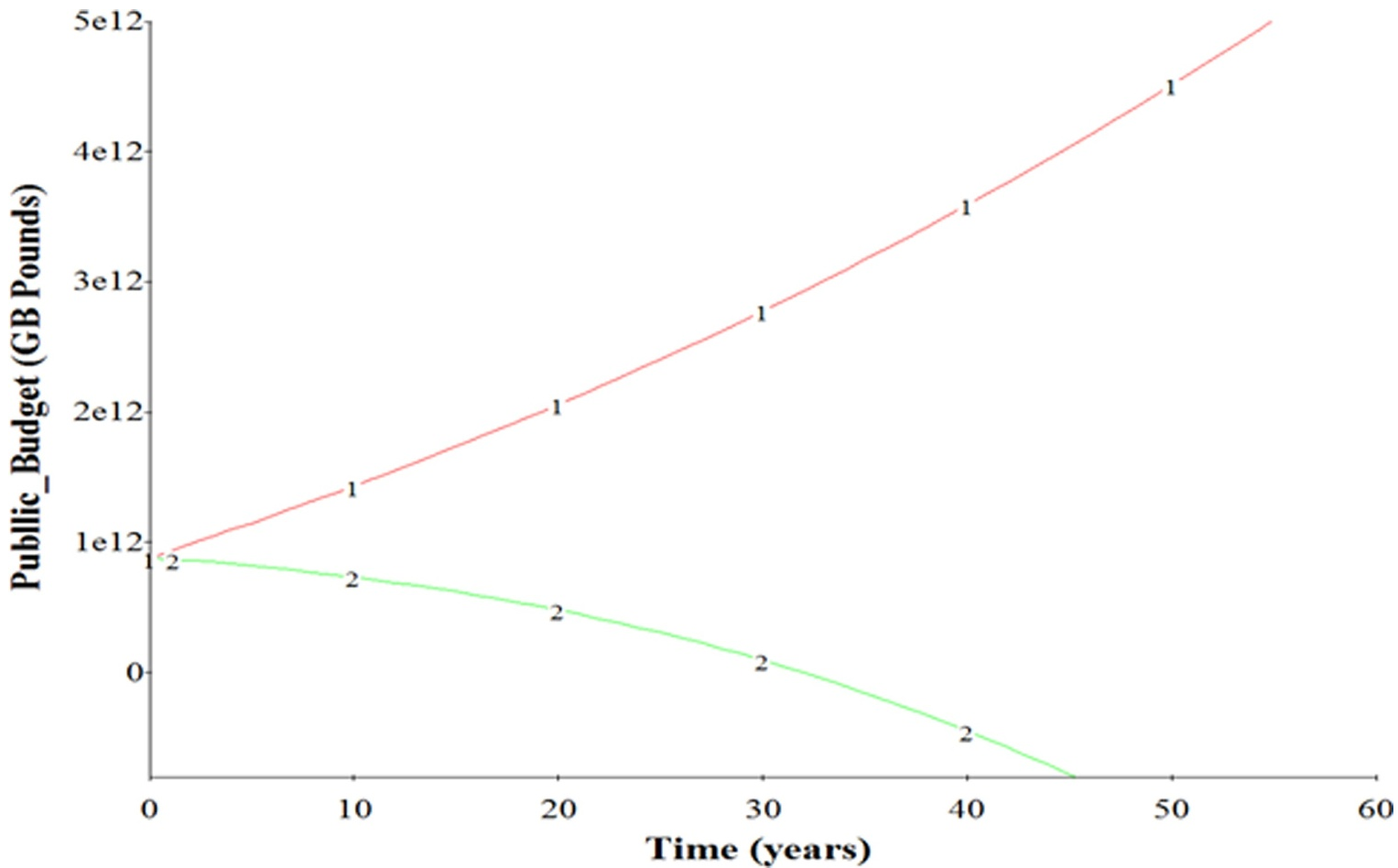 Figure 2: Run 1 (Unitary charges) vs Run 2 (Charges + Wages). Note the severe divergence after year 30.
The Employment "Lever"
Through ANOVA (Analysis of Variance), the authors found that Jobs per Operating PPP is the strongest lever for sustainability. High employment intensity acts as an economic shock absorber, increasing the "willingness to pay" among the populace and stabilizing the system.
Critical Insight & Conclusion
Takeaway
The research proves that "policy resistance"—where a policy fails or makes the problem worse—is inevitable if governments only focus on the infrastructure gap without looking at the public budget as a dynamic stock. Sustainable PPP management requires precise prioritization.
Limitations
- Mono-funding: The model assumes PPPs are the only way to build, ignoring traditional public procurement.
- Risk Symmetry: It assumes the public sector retains all usage risk, which may not apply to "user-pay" models like toll roads.
Future Outlook
The next step for this research is to integrate equity co-investment (where the government acts as a shareholder) to see if shared profits can offset the wage-driven fiscal deficits identified in this study. For policymakers, the message is clear: watch the wages, not just the bricks.