
StoRM: Redefining Trust in the Social IoT via Microservice-Based Agents
Simulation Modelling Practice and Theory
StoRM (Social Trust Model) is a novel reputation-oriented trust management framework for the Internet of Things (IoT) that integrates Intelligent Agents (IAs) with Microservice Architecture. By leveraging social principles and a distributed locating mechanism, it achieves superior trustworthiness estimations and resource efficiency compared to traditional models like CRM and DISARM.
TL;DR
The paper introduces StoRM, a distributed, social-aware trust model designed specifically for the heterogeneous sprawl of the Internet of Things. By treating every sensor, service, and user as an Intelligent Agent and structuring them via Microservice Architecture, StoRM creates a "social network of things" that can autonomously judge the reliability of partners. It eliminates the need for central authorities while maintaining high utility gain and low storage overhead.
Problem & Motivation: The Chaos of Heterogeneity
In the open environment of IoT, malicious actors can easily inject fake data or deny services. Existing trust solutions often treat devices as "dumb" nodes or rely on heavy centralized databases—neither of which works when the network scales to billions of heterogeneous entities.
The authors' core insight is twofold:
- Social Consciousness: Things don't exist in a vacuum; they interact in patterns similar to human social networks.
- Structural Modularity: Microservices provide the perfect wrapper for these entities, allowing even simple "Things" to exhibit complex, autonomous behaviors like learning and adaptation.
Methodology: The Core of StoRM
1. Agent-Microservice Fusion
StoRM categorizes IoT entities into three types: Entities (human/virtual), Services, and Devices. To bridge the gap between "simple" hardware and "intelligent" software, it uses three specific microservice types:
- Device_microservice: Manages raw data and functionality.
- Gateway_microservice: Acts as a smart middleware for discovery and registration.
- Service_microservice: Handles high-level logic.
2. The Rating Mechanism
Trust isn't just a single number. StoRM evaluates partners based on a tuple of 6 critical criteria: Response Time, Validity, Correctness, Cooperation, QoS, and Availability.
3. LOCATOR: Socialized Rating Discovery
How do you find out if a stranger is trustworthy in a trillion-node network? StoRM uses LOCATOR, a P2P-inspired mechanism that traverses a "Social Graph." It categorizes neighbors into:
- Local Neighbors: Direct past interactions.
- Longer Ties: Path length ≤ 5.
- Longest Ties: Path length > 5 (higher risk).
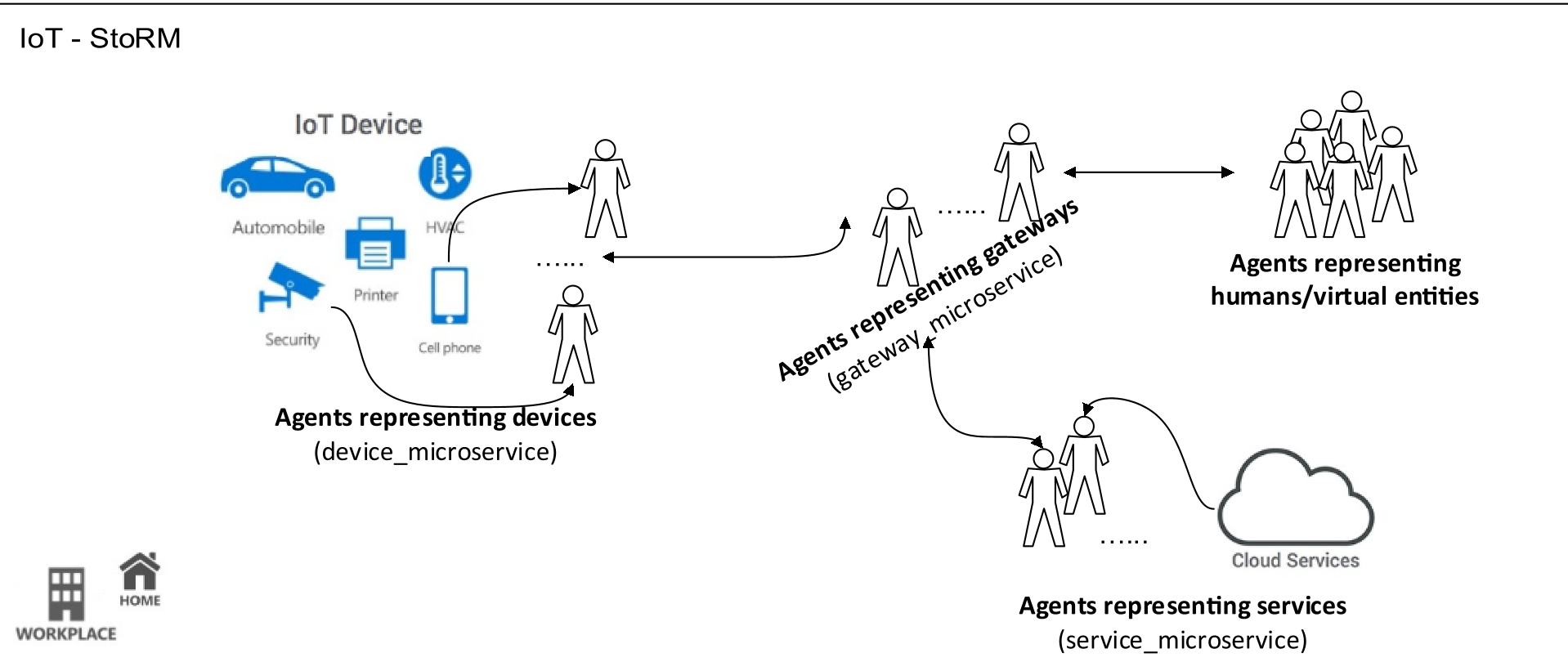 Fig 1: The architectural overview showing how the gateway microservice bridges the gap between devices and the social network.
Experiments & Results: Efficiency at Scale
The authors tested StoRM against well-known models like DISARM and Certified Reputation using a multi-agent testbed in the EMERALD framework.
Key Findings:
- Utility Performance: StoRM consistently reached higher Utility Gain (UG) scores, proving it effectively filters out "intermittent" malicious agents that behave randomly to bypass simple filters.
- Storage Optimization: In IoT, memory is expensive. StoRM showed a downward stabilized usage of storage space compared to its peers, as its social-pruning algorithm discards irrelevant ratings efficiently.
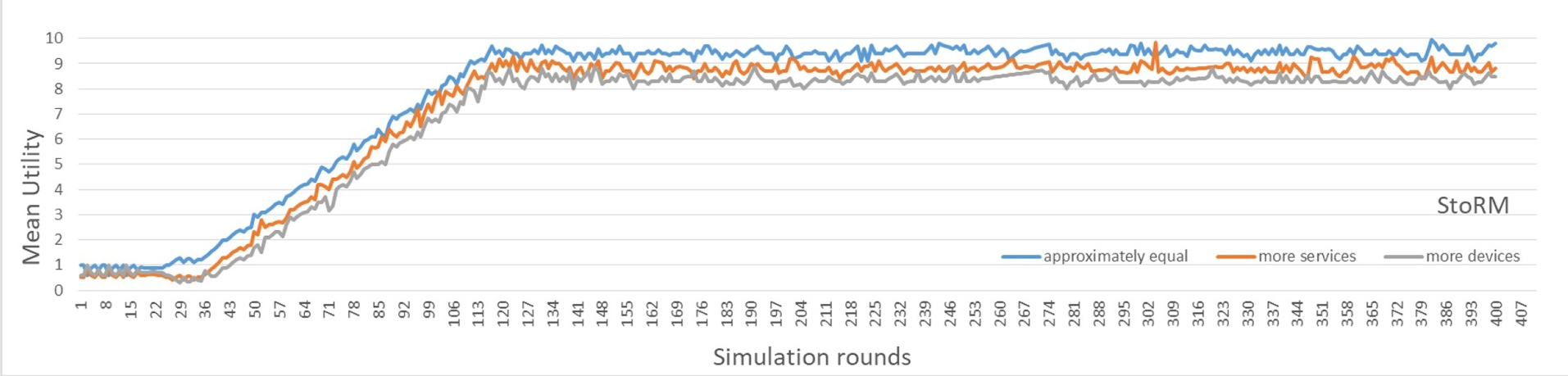 Fig 2: Mean utility gained over time, showing StoRM's stable upward trend compared to other distributed models.
Critical Analysis & Conclusion
StoRM succeeds because it treats the IoT not just as a network of wires, but as a society of agents.
Takeaway: The marriage of Microservices and Multi-Agent Systems (MAS) provides the "Intelligence" and "Trust" layer that the traditional IoT has lacked.
Limitations: While powerful, the model assumes entities are willing to share ratings for "credits." In highly competitive industrial environments, "Social Interest" might be harder to incentivize. Future work involving Ontologies (like ORDAIN) and formal identity management will be crucial to securing the "Identity" of these agents beyond simple global names.
StoRM sets a high bar for decentralized trust, proving that the future of IoT is not just "smarter" devices, but more "socially aware" architectures.