
Simulating the Pulse of the Past: Multi-Ethnic Social Dynamics in 19th Century Penang
Simulation of Past Life: Controlling Agent Behaviors from the Interactions between Ethnic Groups
The paper introduces a microscopic crowd simulation framework designed to recreate the multi-ethnic social dynamics of Weld Quay, a 19th-century Malaysian trading port. By implementing a state-machine-based interaction formalism, the system models the distinct behaviors and inter-population exchanges of Indian coolies, Malay vendors, British colonists, and Chinese traders.
Most digital heritage projects focus on the "bones"—the architecture, the textures, and the lighting of a lost era. But a city is more than its ruins; it is the friction and flow of its people. In this paper, "Simulation of Past Life: Controlling Agent Behaviors from the Interactions between Ethnic Groups," researchers tackle the challenge of populating the UNESCO heritage site of George Town, Penang, with a living, breathing multi-ethnic society from the 1800s.
TL;DR
The researchers developed a microscopic crowd simulation that uses a specialized state-machine formalism to drive social interactions. Unlike standard simulations where everyone follows the same "social force," this model assigns specific cultural and professional roles to four distinct ethnic groups, allowing a vibrant "global atmosphere" to emerge from individual-level trading, working, and patrolling.
The Problem: The "Deserted City" Syndrome
While we can model the 3D structures of ancient Rome or Victorian London with stunning accuracy, these environments often feel like empty movie sets. Prior work in crowd simulation has focused on collision avoidance or simple navigation (moving from point A to B). However, in a 19th-century trading port like Weld Quay, behaviors were dictated by a complex web of social status, ethnic identity, and economic events (like a boat docking). Existing models lacked the inter-population formalism needed to make different groups react uniquely to the same stimulus.
Methodology: Social Logic and Steering
The authors adopt a bottom-up approach to simulation. Each ethnic group is governed by a Behavioral Pattern Graph (state machine), where transitions are triggered by two types of interactions:
- Global Interactions: These affect entire groups at once. When a boat enters the "Sailing" state near the pier, a global signal switches all local Indian coolies to a "Reaching-Boat" state.
- Local Interactions: These occur at the individual level. A Malay vendor in a "Mobile-Selling" state seeks out the nearest "Wandering" agent. If they get close enough, both switch to a "Resting" state to simulate a transaction.
Architecture of the Interaction Model
The model integrates standard steering behaviors (separation, alignment, cohesion) with high-level decision-making logic.
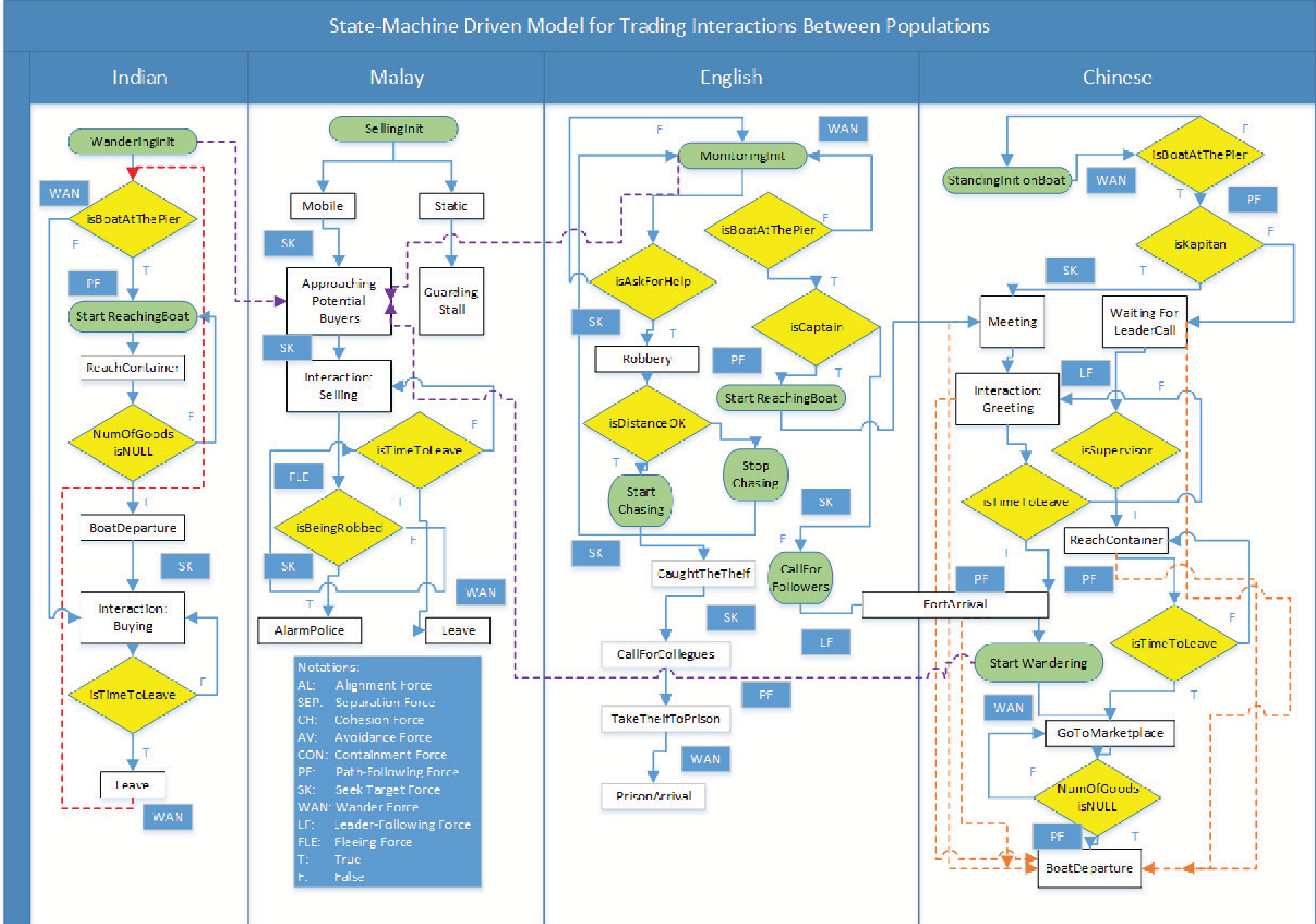 Fig 1: The structure of the state machine-based model for diverse populations. Yellow diamonds represent decision logic, while white squares represent interaction triggers.
Ethnic Group Modeling
The researchers meticulously modeled the roles of the era:
- Indian Coolies: Change mass and speed dynamically when carrying goods.
- Malay Vendors: Alternate between static stalls and aggressive mobile selling.
- English Colonists: Form structured military formations (T-shaped or River-like) and respond to "robbery" events via signal propagation.
- Chinese Traders: Arrive via boats, interact with officials, and supervise the logistics of the port.
Experiments and Results: A Living Port
The simulation was implemented in Unity3D, managing 120 Indian coolies, 30 Malay vendors, 50 English colonists, and 36 Chinese traders.
One of the most impressive results is the Group Formation logic. For instance, when an English captain welcomes Chinese traders, the system generates a "negated V-like" formation. When arresting a thief, it switches to a "River-like" formation, demonstrating how social context dictates physical spacing.
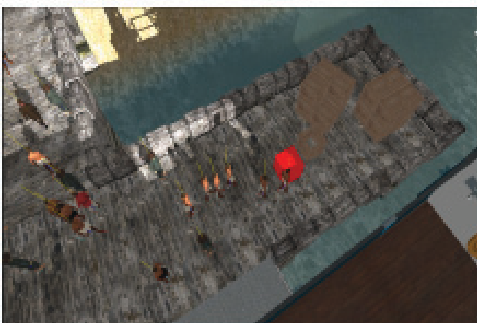 Fig 2: Different leader-following formations based on the social scenario, such as military patrols or prisoner escorting.
The simulation successfully recreated the "hectic" feel of a 19th-century port, where the arrival of a boat sets off a chain reaction across the entire population—from coolies rushing to work to vendors preparing to sell to the new arrivals.
Critical Insight: Why This Matters
The real achievement of this paper isn't just "moving characters"; it is the formalism for multi-ethnic interaction. By categorizing interactions into Global and Local tiers, the authors provide a scalable roadmap for creating complex social ecosystems.
Limitations & Future Work
- Scale: The current simulation uses about 240 agents. While sufficient for a proof of concept, the authors note that 2,000+ agents would be needed for true historical scale.
- Interactivity: The environment is currently mostly autonomous. Future work aims to introduce "user-controlled" agents to see how the multi-ethnic society reacts to an outsider's presence.
- Fine-tuning: The quality of the animation currently relies heavily on the "artistic skills" of the designer. A more automated way to map steering parameters to specific "cultural traits" could be the next frontier.
Conclusion
This research proves that the "spirit of a place" is found in the way its inhabitants interact. By bridging the gap between microscopic steering and macroscopic social rules, the researchers have turned a digital model of Penang into a pedagogical tool for understanding historical social history.