
Vidya: How Egoism and Altruism Forge Order in Multiagent Societies
Simulations of egoistic and altruistic behaviors using the vidya multiagent system platform
This paper presents a social simulation study within the "Vidya" game platform, utilizing a Multiagent System (MAS) to model egoistic and altruistic behaviors among autonomous agents called Jivas. By integrating mechanisms for reputation formation, clan creation, and leadership-based co-action, the study demonstrates how global social order emerges from local agent interactions.
TL;DR
Can a world of selfish agents find peace? Using the Vidya game platform, researchers simulated a society of "Jivas"—autonomous agents that use Genetic Algorithms to survive—and discovered that by introducing social reputation and clan-based leadership, a stable, ordered society emerges. The study proves that even with disproportionate "social status," decentralized societies can achieve fair resource distribution through emergent altruism.
Problem & Motivation: The Chaos of Open Systems
In the realm of Multiagent Systems (MAS), "open societies" are notoriously difficult to manage. Without a central authority or a "God-player" to dictate rules, these systems often descend into resource depletion or chaotic competition.
The authors identify a critical gap: the lack of understanding of how micro-level behaviors (an individual's choice to be egoistic or altruistic) translate into macro-level social order. Drawing inspiration from "Socionics," the paper aims to bridge the gap between sociology and computer science by asking: Can we architect an environment where social order is a natural byproduct of individual survival instincts?
Methodology: The Jiva's Social Brain
To solve this, the authors enhanced the Vidya platform. At the heart of every Jiva is an Intelligent Decision Module powered by Genetic Algorithms (GA), which evaluates potential movement-actions based on a "General Vital Condition" (GVC).
1. Reputation: The Symbolic Asset
Instead of just chasing food (economic assets), Jivas track social reputation.
- If Jiva A's presence coincides with an increase in Jiva B's health, B views A as altruistic and increases A's reputation.
- This reputation is communicated locally, creating a "socially disseminated opinion" of trustworthiness.
2. Clan Creation and Leadership
Jivas aren't lone wolves for long. They form clans based on reputation thresholds. Within these clans, a "co-action" context arises:
- Leadership: Agents with the highest "intelligence + reputation" combination become leaders.
- Co-action: Subordinates are not forced but stimulated to follow leader actions, creating coordinated group movements without centralized code.
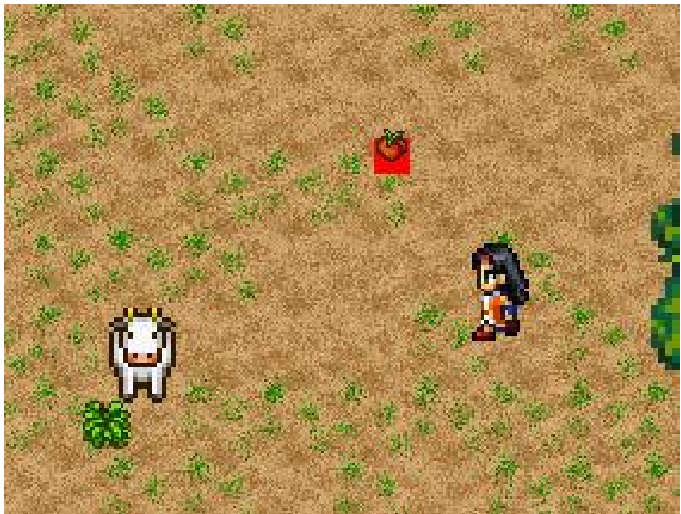 Figure 1: The Jiva's decision-making involves selecting the best coordinate (x, y) to maximize survival, now influenced by social ties.
Experiments & Results: The Emergence of Balance
The researchers simulated 20 Jivas over hundreds of generations. The results revealed a fascinating paradox:
- Disproportionate Reputation: As seen in the graphs, the standard deviation of reputation grew rapidly. A few "celebrity" Jivas held most of the social power.
- Fairer Resource Distribution: Despite the power gap, the Average GVC (vitality) of the society grew steadily and stabilized. The reputation mechanism acted as a "hidden hand" that prevented stronger agents from purely predatory behavior, leading to a fairer ecosystem.
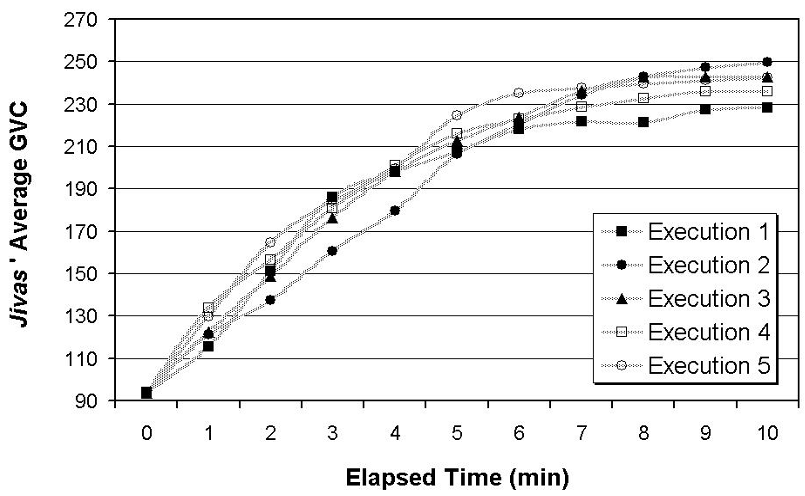 Figure 2: The steady growth of the average General Vital Condition (GVC) suggests that social behaviors act as a successful distributed control mechanism.
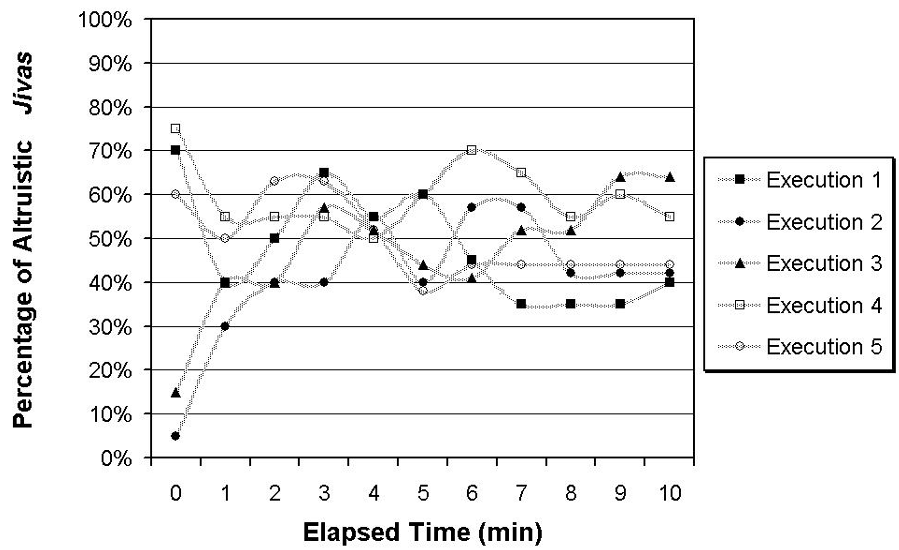 Figure 3: The percentage of altruistic Jivas in the population eventually stabilizes around 50%, suggesting a natural social equilibrium.
Critical Analysis & Conclusion
The most profound takeaway is that reputation is the currency of order. By making agents care about a symbolic asset (status), the "Rational Egoism" of an individual often transforms into "Adaptive Egoism," where helping the group becomes the most rational way to help oneself.
Limitations & Future Outlook
While the Vidya platform provides a robust sandbox, the mapping of "altruism" is simplified—it is measured primarily through GVC impact rather than complex intent. However, for AI researchers, this provides a blueprint for building self-governing robotic swarms or decentralized digital economies.
Final Takeaway: Social order doesn't require a dictator; it requires a transparent way for individuals to judge and group with others. In the world of Jivas, as in ours, reputation is what prevents the survival of the fittest from becoming the death of the many.