
ZrHfNbTaW: Pushing the Limits of Refractory Alloys through Torsional Alchemy
Developing a single-phase and nanograined refractory high-entropy alloy ZrHfNbTaW with ultrahigh hardness by phase transformation via high-pressure torsion
This study reports the development of a novel equiatomic refractory high-entropy alloy (RHEA), ZrHfNbTaW, achieving an ultrahigh hardness of 860 Hv. The researchers utilized High-Pressure Torsion (HPT) to induce a phase transformation, converting a dual-phase cast structure into a single-phase nanograined Body-Centered Cubic (BCC) structure.
TL;DR
Researchers have engineered a new refractory high-entropy alloy (RHEA), ZrHfNbTaW, that shatters typical hardness benchmarks for single-phase alloys. By applying High-Pressure Torsion (HPT), they transformed a coarse, dual-phase ingot into a 12nm nanograined single-phase BCC structure, reaching an ultrahigh hardness of 860 Hv.
Context: In the coordinate system of materials science, this work sits at the intersection of Severe Plastic Deformation (SPD) and High-Entropy Alloy (HEA) design, proving that mechanical force can override thermodynamic tendencies to create superior "meta-stable" phases.
Motivation: The Quest for Single-Phase Refractories
Refractory alloys are the "special forces" of metallurgy, required to endure extreme heat, wear, and corrosion. While high-entropy alloys (HEAs) naturally offer high stable solid solutions, most refractory variants end up as dual-phase mixtures or brittle intermetallics.
The authors identified a gap: Can we create a single-phase refractory alloy that combines the high melting point of tungsten-heavy systems with the extreme hardness of nanostructured materials? The bottleneck was the massive lattice distortion and slow diffusion (sluggish diffusion effect) that makes traditional homogenization nearly impossible.
Methodology: High-Pressure Torsion (HPT)
To overcome the homogenization barrier, the team used HPT—a process where a disc is subjected to GPa-level hydrostatic pressure while being twisted.
The Mechanism of Phase Transformation
As the shear strain () increases (reaching turns), the two initial BCC phases in the as-cast ingot begin to "dissolve" into one another. This isn't just simple mixing; it is a strain-induced phase transformation. The high pressure suppresses atomic diffusion, while the massive shear forces the atoms into a new, unified lattice.
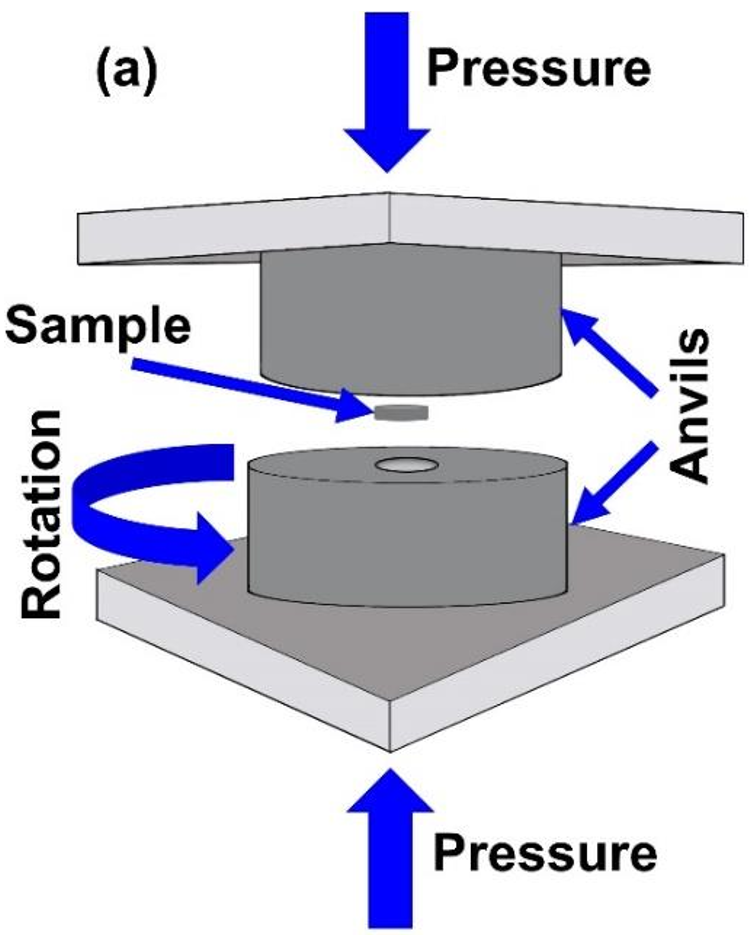
Figure 1: The lower anvil rotates under 6 GPa of pressure, generating the shear strain required for "metallurgical alchemy."
Results: 12nm Nanograins and Dislocation Survival
The microstructural transformation is staggering. Using TEM and Rietveld analysis, the authors confirmed:
- Nanograin Refinement: Grain size dropped from 260 m to just 12 nm.
- Dislocation Density: Despite the tiny grain size (where grain boundaries usually "swallow" dislocations), they observed a density of 3.2×10¹⁵ m⁻². This "dislocation survival" is credited to the high lattice distortion of RHEAs, which traps dislocations in place.
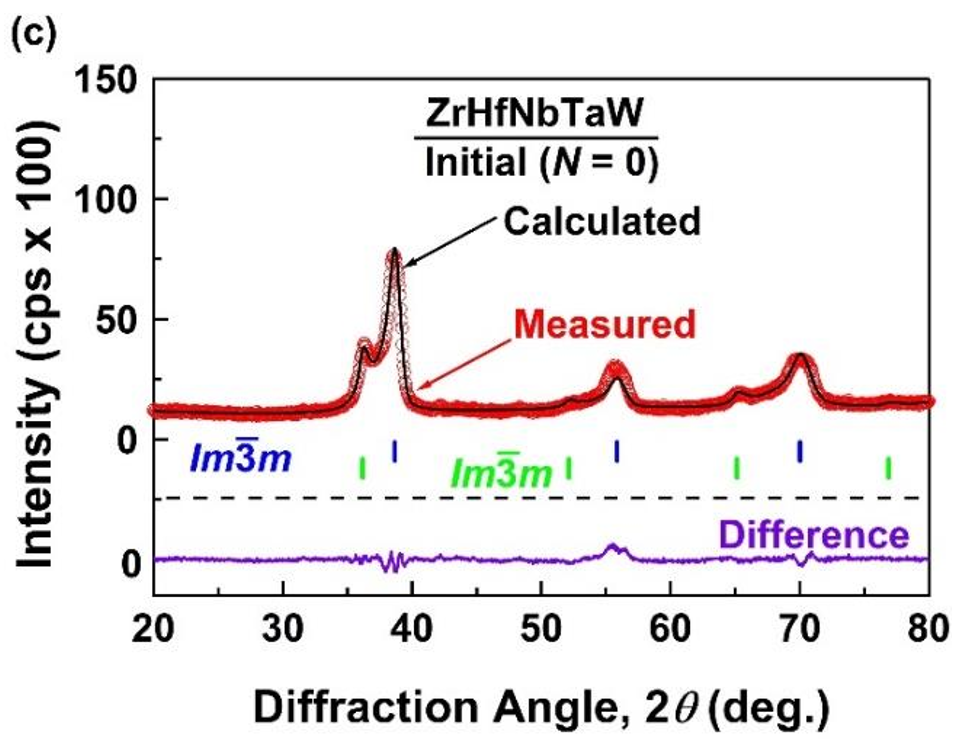
Figure 2: XRD profiles show the convergence of two BCC peaks into a single unified BCC peak after 50 turns.
Hardness Benchmark
The final product achieved 860 Hv. As shown in the comparison chart below, ZrHfNbTaW occupies the "top-right" corner of the refractory map, combining a high predicted melting point (~2908 K) with hardness levels that dwarf traditional alloys like MoNbTaTi.
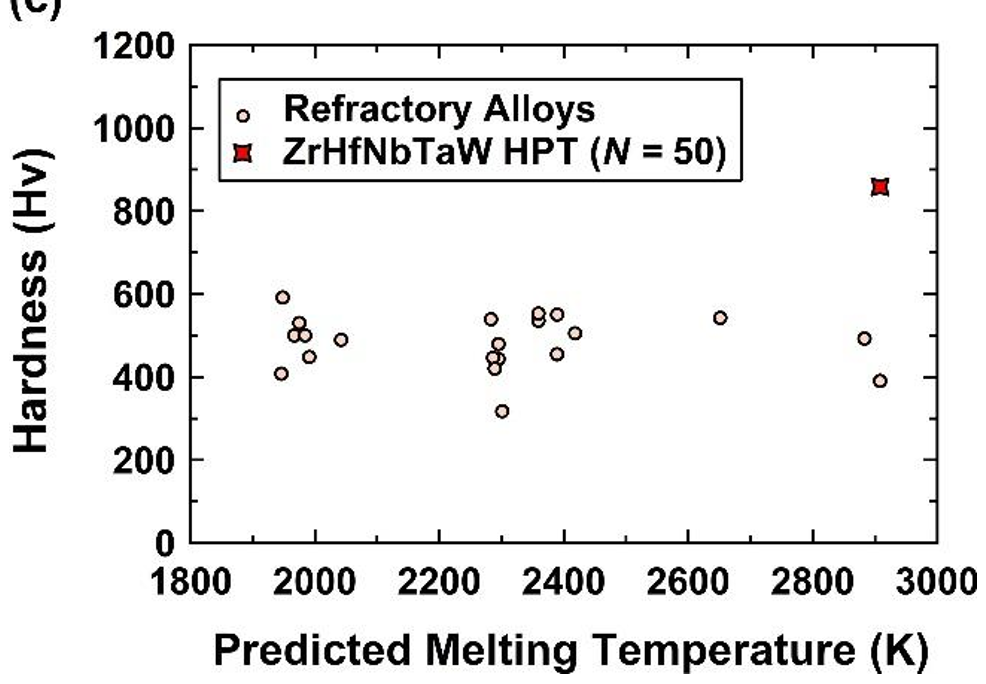
Figure 3: Comparison showing the superior hardness-melting point profile of the HPT-processed ZrHfNbTaW.
Critical Insight & Conclusion
Why does this work? The "Ultra-High Hardness" is a synergistic result of three factors:
- Solution Hardening: Driven by the massive atomic size difference of the 5 elements.
- Hall-Petch Hardening: The 12nm nanograins provide massive boundary resistance.
- Dislocation Hardening: The immobile dislocations act as additional internal barriers.
Takeaway: This paper demonstrates that HPT is not just a deformation tool, but a synthesis tool. It allows us to explore "thermodynamically difficult" single-phase regions of the HEA map. The next challenge for the field? Scaling this from 10mm laboratory discs to industrial-sized components.
Limitations: The study focuses on room-temperature hardness. While the DSC results suggest high thermal stability up to 873 K, the real test will be maintaining these 12nm nanograins under long-term service at 1500°C+.