
SAO: Rethinking Asynchronous RL for the Era of Agentic LLMs
Single-Rollout Asynchronous Optimization for Agentic Reinforcement Learning
This paper introduces Single-rollout Asynchronous Optimization (SAO), an asynchronous Reinforcement Learning (RL) framework designed for large language model (LLM) agents. SAO replaces traditional group-wise sampling with a single-rollout approach and achieves NEW SOTA on reasoning and coding benchmarks (e.g., reaching 97.3% on AIME2025) while maintaining high training stability.
TL;DR
The shift from static LLMs to autonomous agents requires Reinforcement Learning (RL) that is efficient, stable, and adaptable. While the industry has gravitated toward group-wise sampling methods like GRPO, these benchmarks-friendly methods suffer in real-world asynchronous environments. Single-rollout Asynchronous Optimization (SAO) breaks this bottleneck, enabling stable, high-throughput training that outperforms traditional methods in coding (SWE-Bench) and the most difficult math reasoning tasks (AIME).
Breaking the Idle: The Motivation for Asynchrony
Current RL pipelines (like those used for DeepSeek-R1) are typically synchronous: the system collects a batch of responses, computes rewards, and then updates the model. However, agentic tasks (like coding) have highly variable trajectory lengths. Short tasks finish quickly, while long tasks become "stragglers," causing massive GPU underutilization.
Asynchronous RL solves this by updating the model as soon as any rollout arrives. But there is a catch: Policy Lag. By the time a long trajectory finishes, the training model has already been updated several times, making the old rollout "off-policy." Traditional methods either ignore this (leading to collapse) or use complex tracking that slows down the system.
Methodology: Deep Dive into SAO
SAO introduces a suite of techniques to make single-rollout training as stable as batch-based methods.
1. Direct Double-Sided Importance Sampling (DIS)
To handle policy lag, the authors implement an aggressive clipping strategy. Instead of tracking multiple historical model versions, they use the log-probabilities directly from the rollout engine.
- The Innovation: A strict double-sided mask. If the probability ratio between the current policy and the rollout policy strays too far (outside ), the token is masked out entirely. This "hard gate" prevents extreme gradients from destabilizing the model.
2. Stabilizing the Value Model
Single-rollout RL relies heavily on a "Critic" (Value Model) to estimate advantages. To prevent the "blind leading the blind" (where a poor critic ruins the actor), SAO uses two tricks:
- Faster Value Updates: The critic is updated twice for every single actor update (), ensuring the value model adapts to the new policy distribution faster.
- Frozen-Attention Training: The authors discovered that updating the full value model is unstable. By freezing the Attention layers and only training the Mixture-of-Experts (MoE) projections, they regularized the critic effectively.
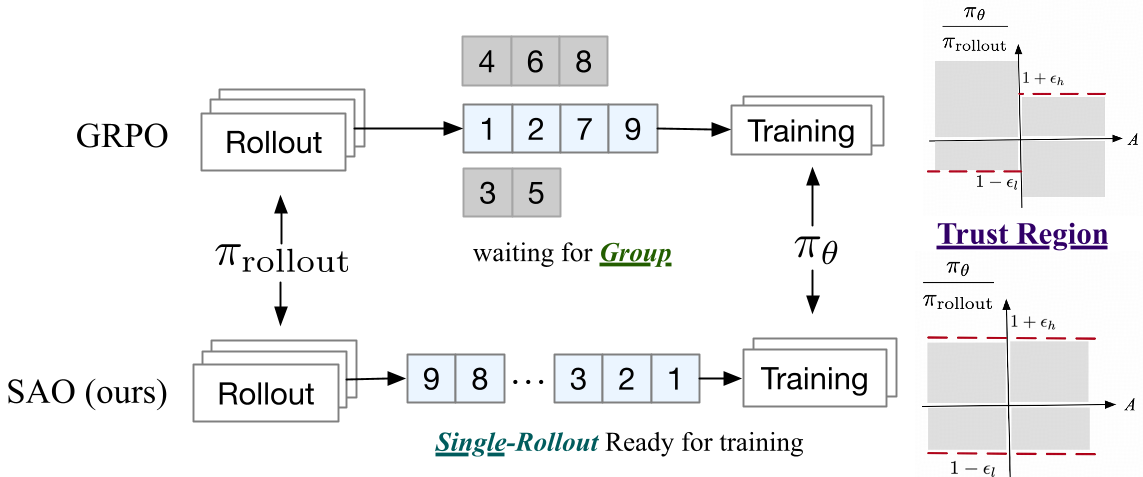 Figure 1: Comparison between SAO and GRPO. SAO processes individual trajectories immediately, while GRPO is blocked by the slowest sample in a group.
3. Skip-Observation GAE
In agentic tasks, models receive feedback (observations) from the environment. Standard Generalized Advantage Estimation (GAE) usually fails here because it tries to predict the value of environment-generated tokens. SAO's Skip-Observation GAE bridges the gap, calculating the advantage directly from one model action to the next, treating the environment feedback as a transparent transition.
Experimental Results: SOTA in Reasoning and Coding
The results are clear: SAO significantly boosts performance over the Qwen3-30B-A3B baseline and outclasses GRPO-based approaches.
- AIME2025: Achieved a staggering 97.3% accuracy.
- SWE-Bench Verified: Reached 29.8%, showing that asynchronous RL is highly effective for complex, multi-turn coding tasks.
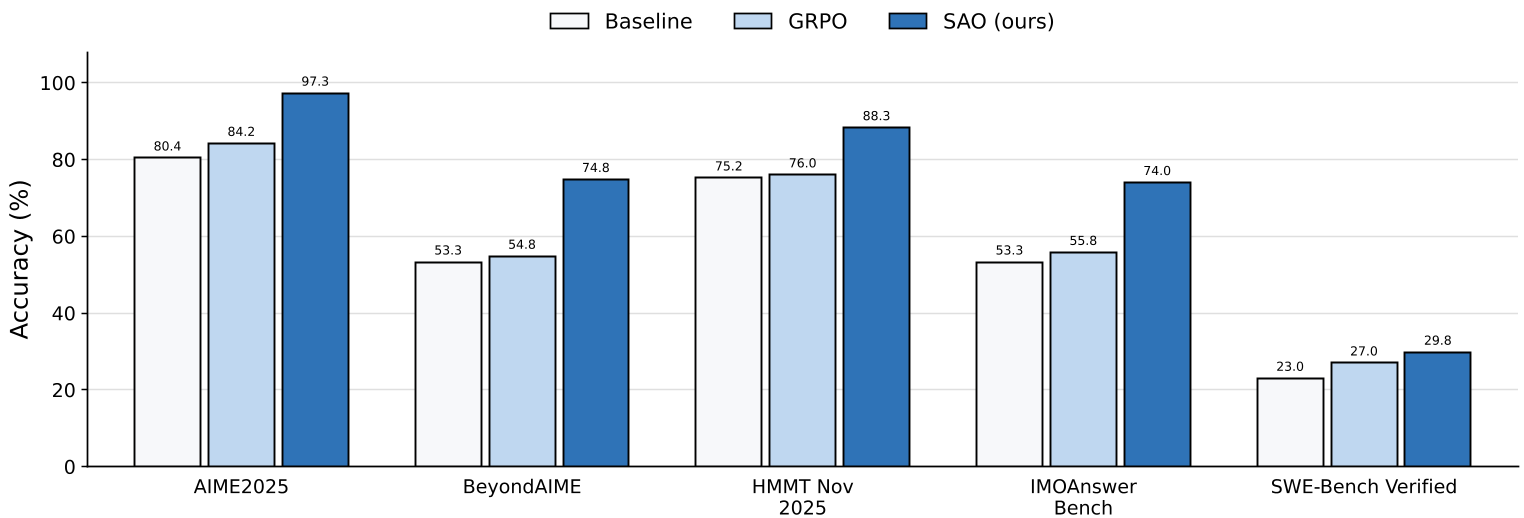 Figure 2: SAO (blue) consistently outperforms GRPO and SFT baselines across all major reasoning and coding benchmarks.
Critical Insights: Why Single-Rollout Matters
One of the most profound sections of the paper explores Online Learning. In a real-world scenario, you don't get groups of 8 similar prompts; you get one interaction at a time.
The authors simulated a "preference shift" (e.g., the user suddenly wants a "cute" tone instead of an "academic" one). SAO adapted almost instantly because its value-based critic could dynamically track the reward shift. Traditional group-based methods or running-mean baselines showed a significant "adaptation lag."
Conclusion & Future Outlook
SAO proves that we don't need to sacrifice stability for efficiency. By moving away from restrictive group-wise sampling and doubling down on robust value function modeling and token-level clipping, SAO provides a blueprint for training Online, Agentic LLMs.
As we move toward models that learn from real-time interaction (like GLM-5.2 mentioned in the paper), the principles of SAO—clipping off-policy drift and stabilizing the critic—will be foundational.
Limitations: The framework currently requires infrastructure capable of preserving token-level probabilities during rollouts, and its performance on smaller (7B) models or dense reward environments remains an area for further study.