
SIoTPredict: Deciphering the Social Evolution of Objects in the IoT
SIoTPredict: A Framework for Predicting Relationships in the Social Internet of Things
SIoTPredict is a first-of-its-kind link prediction framework for the Social Internet of Things (SIoT) that models technical objects as social entities. It utilizes a Bayesian nonparametric approach with edge-exchangeability to predict future relationships based on temporal and spatial co-occurrence, achieving significant gains over traditional Stochastic Blockmodels (SB).
TL;DR
SIoTPredict is a groundbreaking framework designed to predict future "social" relationships between IoT devices. By treating IoT objects as autonomous social agents that form links based on co-occurrence in time and space, the framework uses a Bayesian Nonparametric model to anticipate network growth. Unlike previous models, it excels at handling "new" devices that weren't present during the initial training phase.
Background: When Things Get Social
The Social Internet of Things (SIoT) isn't just a buzzword; it's a solution to the scalability bottleneck of centralized IoT service discovery. In SIoT, devices find services through "friends" and "friends-of-friends." However, these networks are highly dynamic. Objects move, join, and leave. To maintain a functional social structure, we need to predict which devices should be friends before they even interact.
The Core Motivation: The "New Node" Problem
Traditional link prediction often uses Vertex-Exchangeability (e.g., Stochastic Blockmodels), which assumes a fixed set of nodes. When a new sensor or mobile device enters the network, these models break. Furthermore, real-world IoT networks are sparse, while traditional models tend to predict dense, unrealistic connections. SIoTPredict addresses these by focusing on Edge-Exchangeability, identifying clusters of relationships rather than just nodes.
Methodology: From Raw GPS to Social Intelligence
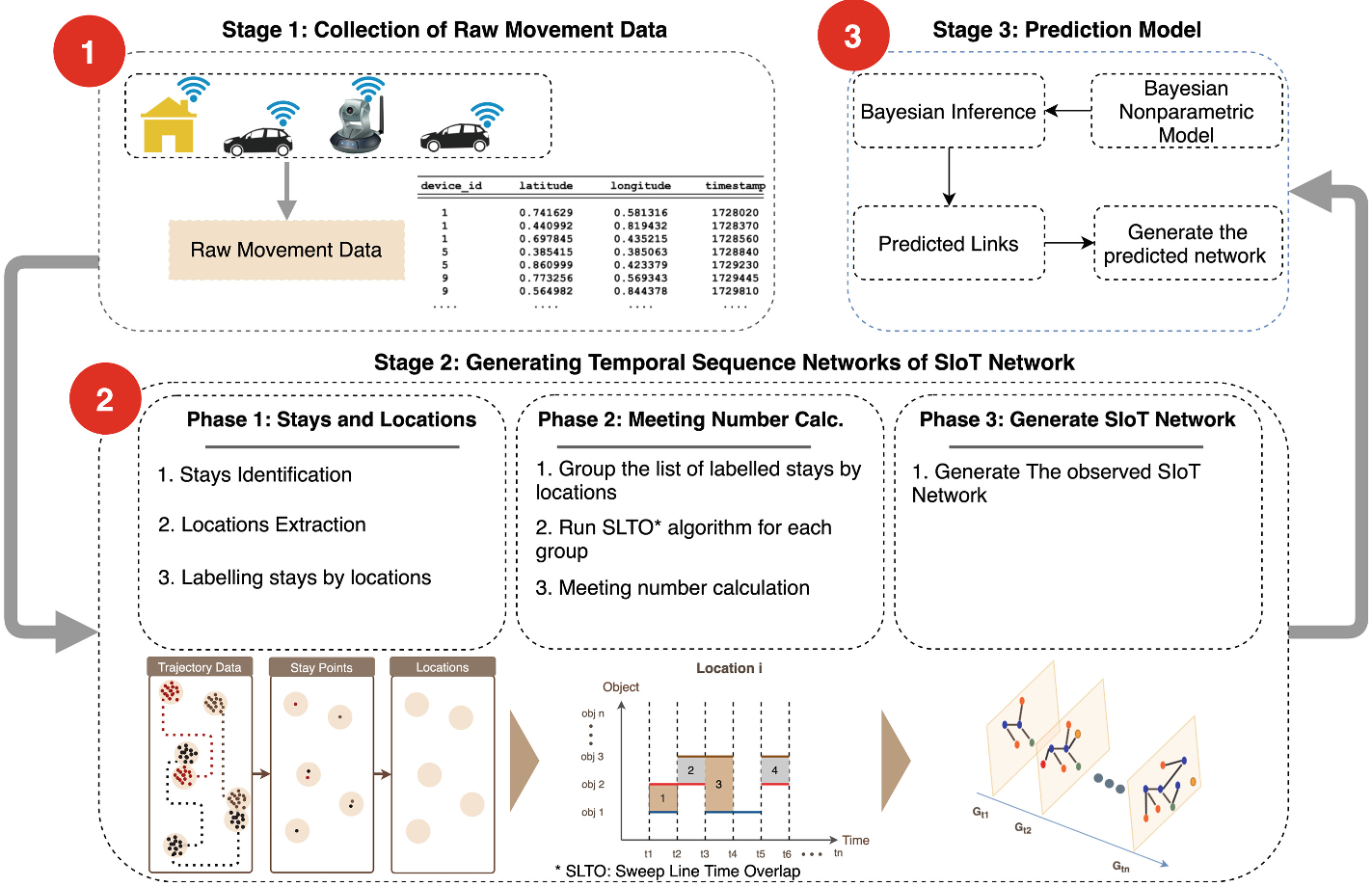
The SIoTPredict framework operates in three distinct stages:
1. Spatial-Temporal Mining
The framework first processes raw GPS trajectories to identify "stays"—periods where a device remains within a distance for a duration .
2. The Sweep Line Time Overlap (SLTO) Algorithm
To find when two objects "met," the authors developed the SLTO Algorithm. Inspired by geometry, it uses a virtual sweep-line to scan stay intervals. If two intervals overlap in the same location, a potential social link is recorded.
3. Bayesian Nonparametric Prediction
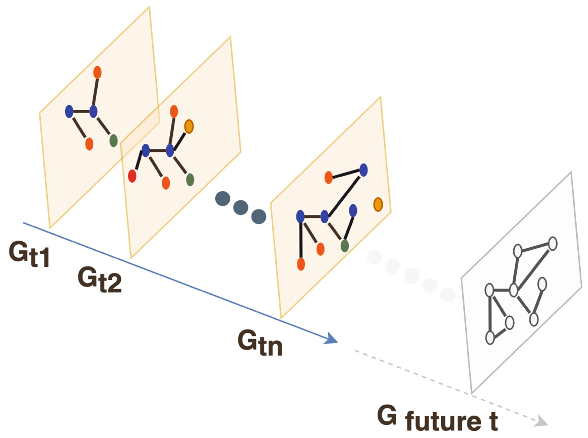
The heart of the prediction is a Dirichlet Process (DP) model. By using a stick-breaking construction (), the model can accommodate an infinite number of potential clusters. It calculates the probability of a link based on the interaction history, allowing the network to grow organically.
Experimental Battleground: Santander Smart City
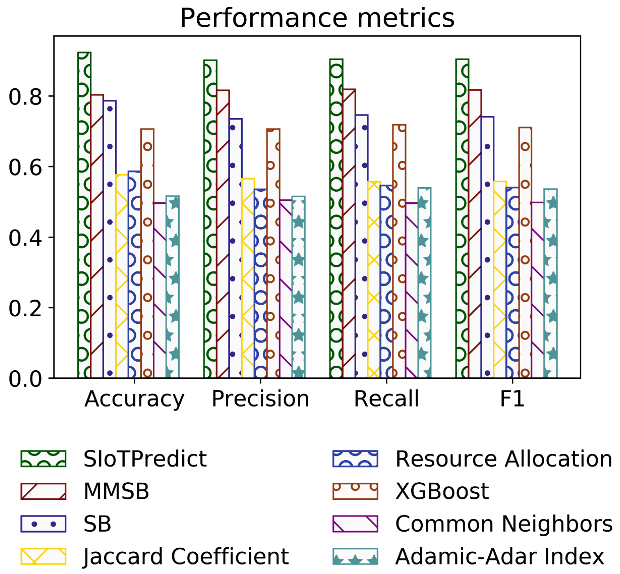
The framework was tested on the Santander dataset (16,216 objects). The authors compared SIoTPredict against MMSB and common heuristics like Adamic Adar and XGBoost.
Key Findings:
- Cold Start Advantage: When the test set contained new nodes (unseen in training), traditional methods collapsed. SIoTPredict maintained stable performance metrics (Precision/Recall).
- Superior ROC: SIoTPredict consistently stayed at the top of the ROC curve, proving that its probabilistic approach to edge clustering captures the true underlying "social" fabric of the city better than node-clustering.
Critical Insight & Conclusion
The genius of SIoTPredict lies in its transition from what the node is to how the edge behaves. By adopting a Bayesian Nonparametric approach, it solves the "dynamic membership" problem inherent in the IoT.
Limitations: Currently, the model relies heavily on geographic co-occurrence. Future iterations could incorporate semantic features (e.g., a "printer" and a "laptop" might form a Co-Work relationship even if they move together once).
Final Takeaway: SIoTPredict moves us closer to a truly autonomous "Web of Things" where devices self-organize into reliable social communities, optimizing service discovery without human intervention.