
UC-IC: Bridging Social Networks via SIP-based P2P Architectures
A SIP Based P2P Architecture for Social Networking Multimedia
This paper proposes UC-IC, a hybrid P2P and client-server architecture for social networking multimedia collaboration. By integrating Session Initiation Protocol (SIP) servers (registrar and proxy) as a decentralized signaling layer, the system achieves cross-domain interoperability and server load balancing for high-bandwidth media streams.
TL;DR
The paper introduces UC-IC, a hybrid architecture that blends the control of client-server systems with the scalability of Peer-to-Peer (P2P) networks. By leveraging the Session Initiation Protocol (SIP), the authors demonstrate how disparate social networks (like Facebook and private domains) can collaborate on real-time multimedia content while balancing server loads and maintaining user presence.
The Bottleneck of Centralized Social Media
In the era of Web 2.0, multimedia content (video, audio, and interactive workspaces) has become the dominant source of Internet traffic. Standard client-server models face a fundamental "scalability wall": as user numbers grow, the cost of network hardware and server maintenance scales exponentially.
While pure P2P networks (like BitTorrent or early Gnutella) solve the distribution problem, they lack the Hierarchical Organization and Centralized Control required for session management, user authentication, and persistent presence in social networking. The challenge lies in finding the "Golden Mean"—a hybrid system that is organized yet distributed.
Methodology: The SIP-Powered Hybrid Overlay
The authors propose using SIP (Session Initiation Protocol) not just for VoIP, but as the central axis for a collaborative cloud platform.
1. Dual-Role SIP Servers
Each UC-IC domain utilizes a SIP server that performs two logical roles:
- Registrar: Handles local user registration and maintains a location database.
- Proxy: Forwards requests to other domains and handles "forking" (sending requests to multiple users).
2. The SIP Trapezoid
By connecting local proxies, the system forms what is known as a SIP Trapezoid. This allows a client in Domain A to discover and collaborate with a client in Domain B without 's server needing to manage 's users. This effectively turns a cluster of servers into a P2P network of domains.
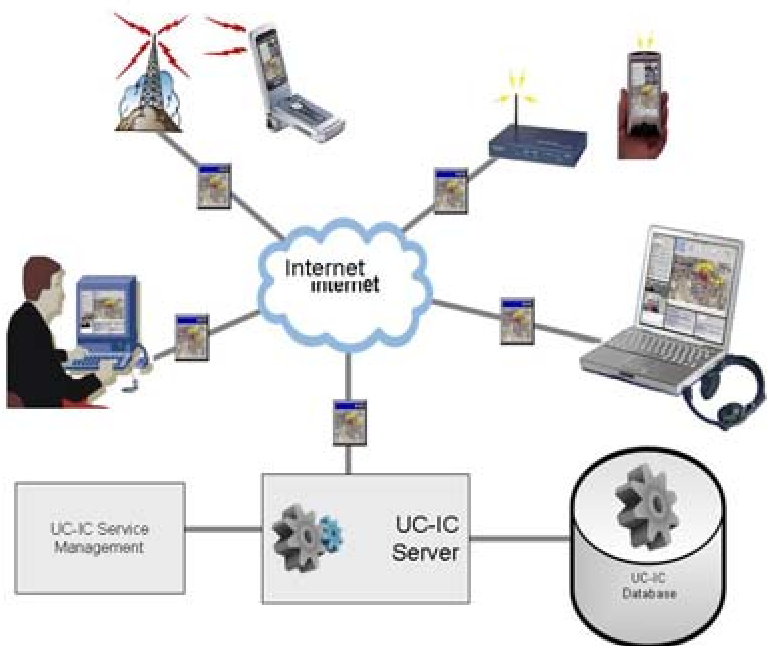 Figure 1: High-level view showing the interaction between the Ajax-based client and the Java-based UC-IC server.
3. Integrated Collaborative Workspace
Unlike simple file-sharing, UC-IC supports a "Portable Workspace" concept. Users can export specific application windows (via Ajax) to other users' browsers. The SIP layer handles the signaling (the "invitation" to collaborate), while the underlying P2P topology handles the data flow.
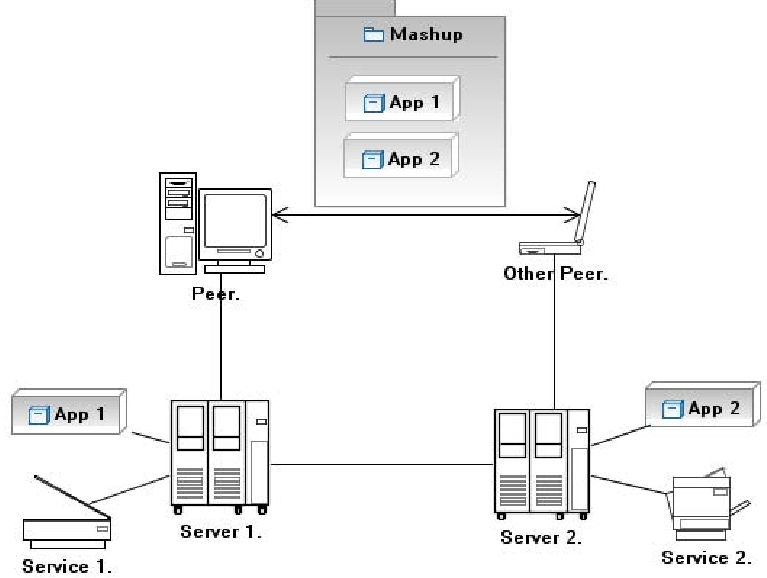 Figure 2: Signaling path between two UC-IC servers using SIP to establish a P2P session.
Experimental Results & Proof of Concept
The authors validated the system through two primary use cases:
- Cross-App Interoperability: Demonstrating Instant Messaging (IM) and collaboration between a standard VoIP client (eyeBeam) and the UC-IC platform.
- Watch Together (Facebook): A social application where Facebook users could participate in synchronized video conferencing. The system used a Flash Media Server as a proxy, controlled by the UC-IC SIP core.
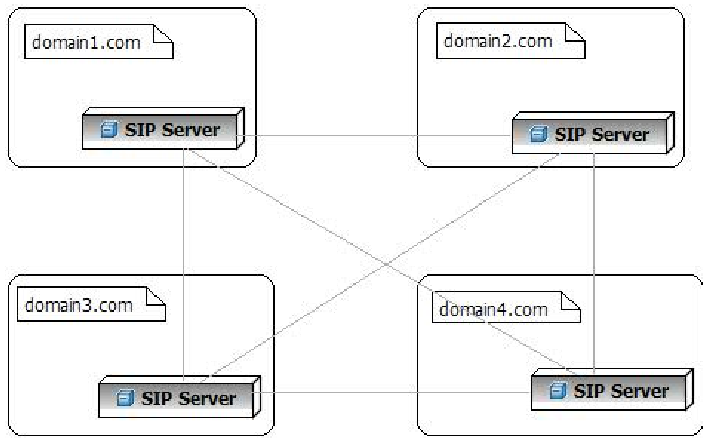 Figure 3: Inter-domain connectivity through SIP Proxies, enabling a global P2P social fabric.
The results indicates that this hybrid approach leads to significant load balancing. Instead of one central server handling all media streams, the traffic is distributed across the nodes involved in the P2P session, reducing the strain on the primary ICP (Internet Content Provider) infrastructure.
Critical Analysis & Future Outlook
Takeaways
The brilliance of this work lies in its use of existing standards. Rather than inventing a new P2P protocol, it repurposes SIP—a protocol already designed for session negotiation—to act as the glue between walled-garden social networks.
Limitations
- Security: The authors explicitly state that security issues (authentication between domains, data encryption) were not the focus of this paper, which is a significant hurdle for real-world deployment.
- NAT Traversal: While SIP is robust, P2P communication often struggles with NAT (Network Address Translation) and firewalls, a topic that requires further exploration in this hybrid context.
Future Perspectives
As we move toward "Edge Computing," the idea of "Server-to-Server connectivity on demand" will be crucial. This paper's approach of using decentralized signaling to bridge centralized silos remains highly relevant for modern federated social networks (like Mastodon or the Fediverse).
Conclusion
The UC-IC architecture proves that you don't have to choose between the reliability of a server and the scalability of P2P. By using SIP as a mediator, social networks can become more collaborative, distributed, and efficient.