
SIR-IM: Rethinking Rumor Dynamics through the Lens of Influence and Time
SIR-IM: SIR rumor spreading model with influence mechanism in social networks
The paper introduces SIR-IM, a novel rumor spreading model that enhances the traditional Susceptible-Infected-Removed (SIR) framework by incorporating an Influence Mechanism. Unlike static models, SIR-IM treats spreading probability as a dynamic variable dependent on the current number of spreaders and integrates a time-decay function for forgetting rates, achieving a more realistic simulation of social network dynamics.
TL;DR
The SIR-IM model transforms the static "epidemic" approach to rumors into a dynamic social framework. By making spreading probability a function of the current "viral" weight and adding a temporal decay to human memory (forgetting rate), this research provides a high-fidelity tool for predicting how quickly misinformation peaks on platforms like Weibo or Twitter.
Background: Why Rumors Aren't Just Viruses
For decades, mathematicians treated rumors like the flu (the SIR model). However, infectious diseases don't care about "social proof," but people do. If one person tells you a rumor, you might doubt it; if ten people do, you are significantly more likely to believe and spread it. This nonlinear influence is the missing link in traditional models that SIR-IM finally addresses.
Methodology: The Mechanics of Influence
The researchers break the population into Credulous (C), Spreader (S), and Stifler (R). The core innovation lies in three mathematical shifts:
- Dynamic Spreading Probability: Instead of a fixed , the model uses a growth function: . As the number of spreaders grows, the probability for a "Credulous" person to flip to a "Spreader" grows asymptotically toward 1.
- Individual Opinion Resistance: The model factors in a parameter . The stronger a person's pre-existing opinion, the less likely they are to be influenced by their neighbors, acting as a natural "human firewall."
- The Forgetting Curve: Human interest in a rumor fades. The model uses a time-dependent function to simulate how spreaders naturally move to a "Stifler" state (losing interest) regardless of external contact.
 Note: The flowchart illustrates the transition between Credulous, Spreader, and Stifler states governed by influence and time.
Experiments & Results: The Spreading Race
The authors tested SIR-IM against three major baselines: Standard SIR, SEIR (adding a 'hesitation' state), and trust-based models.
- Speed of Propagation: In SIR-IM, rumors reach their peak density much faster than in other models. It is approximately 48% faster than the standard SIR model. This suggests that real-world rumors have a much narrower window for intervention than previously thought.
- The Power of Immunity: Increasing the "immune rate" (those who refuse to believe rumors) had a more significant impact on lowering the peak value than simply increasing the "stifling rate" (those who stop spreading it later).
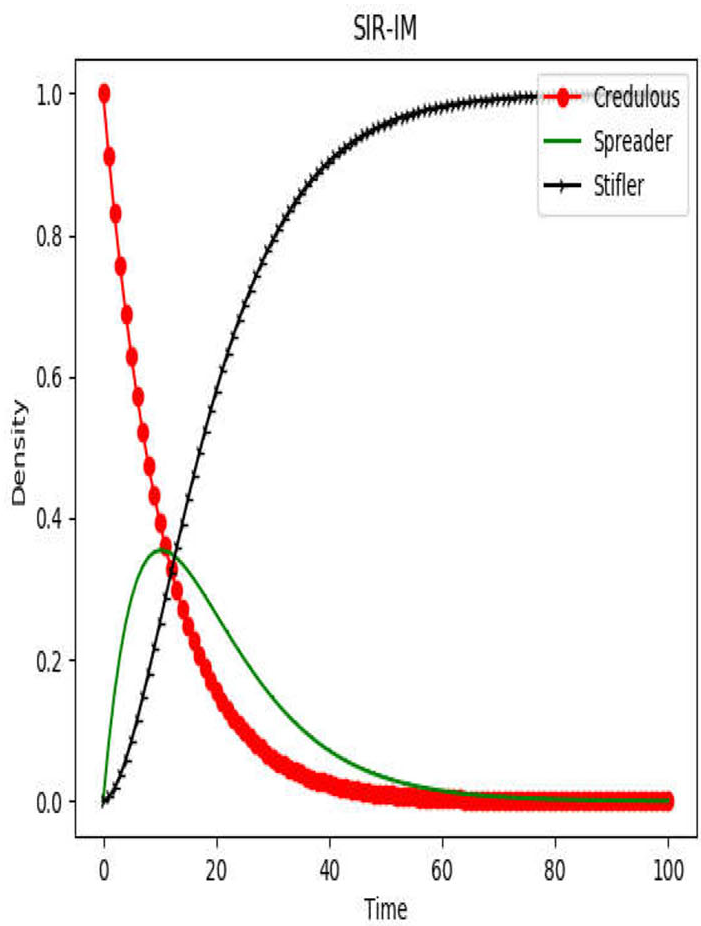 Experimental comparison showing the rapid ascent and lower peak of the SIR-IM model (d) compared to traditional models (a-c).
Critical Insight: Lessons for Social Platforms
The simulation results (Conclusion 2 and 5) offer a profound insight: Individual critical thinking (parameter P) is the greatest bottleneck for rumors. While most platforms focus on reporting rumors after they are viral, these findings suggest that the most effective way to control a rumor is to foster a "skeptical" population and intervene within the first few "time steps" before the cumulative influence of spreaders creates a belief cascade.
Conclusion & Limitations
SIR-IM successfully bridges the gap between biological spreading and social psychology. However, as the authors acknowledge, the current model assumes a homogeneous network where everyone has roughly the same number of connections. In reality, "Super-spreaders" or "Influencers" on heterogeneous networks would likely accelerate these dynamics even further. Future research will likely focus on how these influence mechanisms behave in the "echo chambers" of modern social algorithms.