
Beyond the Dashboard: The Deep "Situatedness" of Health Information Innovation
9 THE SITUATEDNESS OF WORK PRACTICES AND ORGANIZATIONAL CULTURE: Implications for Information Systems Innovation Uptake
This paper explores the "situatedness" of work practices and organizational culture in the context of Health Information Systems (HIS) innovation in Tanzania. Using Cultural Historical Activity Theory (CHAT) and ethnographic methods, it examines how local healthcare practices and systemic innovations mutually shape each other within the Health Information Systems Programme (HISP).
TL;DR
Deploying a Health Information System (HIS) in a developing nation isn't just a technical challenge; it's a cultural negotiation. This paper dives into the Tanzanian healthcare landscape to show why standardized tools often fail at the "last mile." By using Cultural Historical Activity Theory (CHAT), the research uncovers how health workers navigate the friction between saving lives and filling out spreadsheets, often inventing their own "shadow systems" to survive.
Contextual Positioning
Positioned at the intersection of Information Systems (IS) and Sociology, this work is a critical ethnographic evaluation of the Health Information Systems Programme (HISP). It resists the "techno-deterministic" view of innovation, arguing instead for a localized, "situated" understanding of how work actually happens on the ground.
The Friction: Clinical Reality vs. Administrative Demand
The core of the problem lies in Situated Action. Traditional IS design assumes that a user will follow a manual. In reality, a nurse in a Tanzanian clinic is managing a "crying child" and a "tired pregnant mother" simultaneously.
The author identifies three primary tensions:
- Primary vs. IS Work: The act of patient care (primary) is often interrupted by the heavy burden of data collection (secondary).
- Resource Scarcity: Lack of calculators and storage leads to tools being borrowed from schools or records being destroyed by pests.
- Institutional Conflict: Private clinics often manipulate data to avoid taxes, showing that "Information Systems" are never neutral—they are embedded in political and economic survival.
Methodology: CHAT and the Anatomy of a "Disturbance"
The researcher employs CHAT to decompose the healthcare activity system. When a standardized tool like the MTUHA (National HIS) fails to capture specific data, it creates a "disturbance."
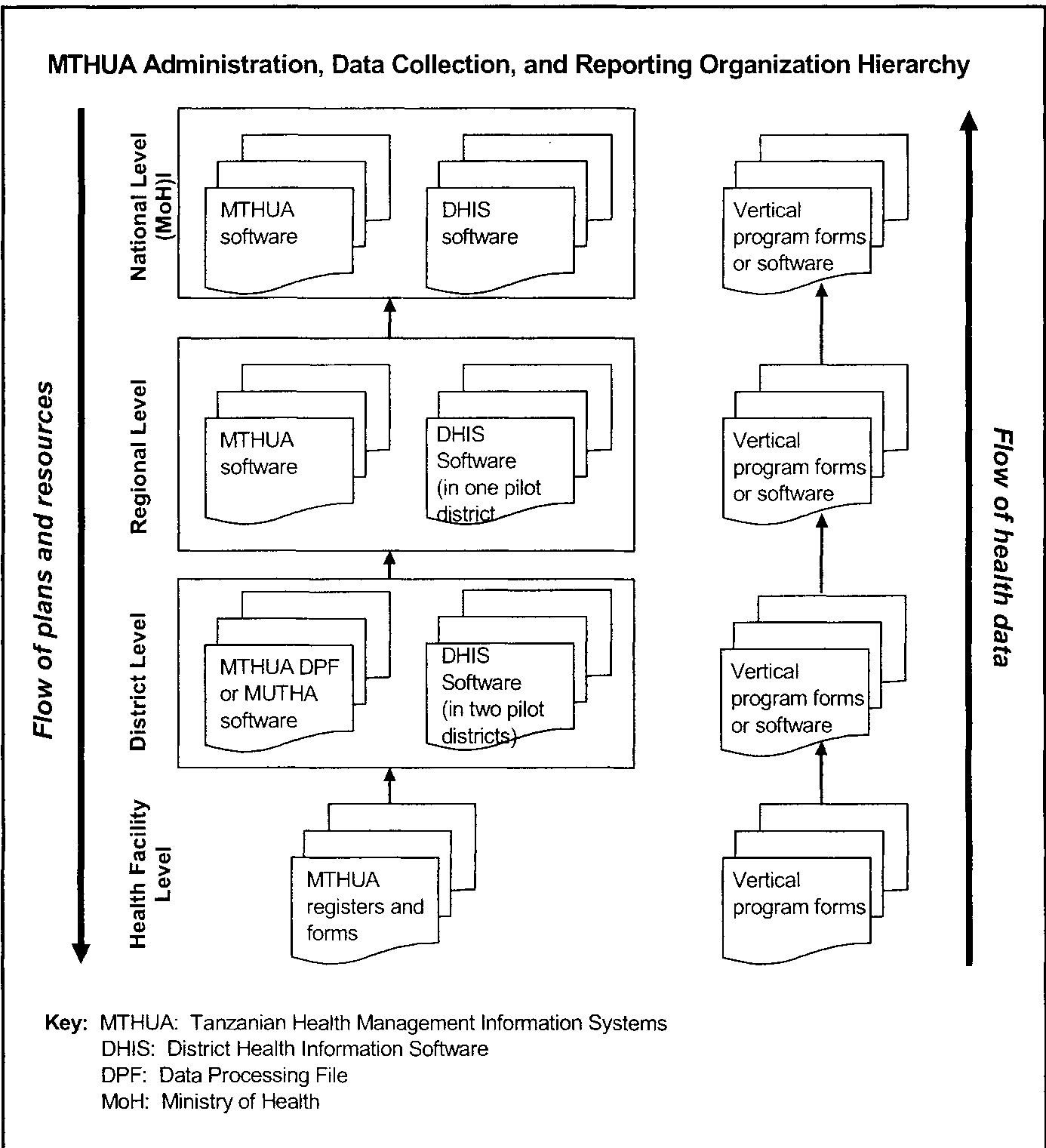
Figure 1: The hierarchical flow of data from health facilities to the National Ministry of Health.
Instead of stopping, workers perform Reflective Actions. They innovate "in the wild." For example, district officers created the "mkeka"—a massive, locally named spreadsheet (meaning "mat")—to manually calculate the top 10 diseases because the software couldn't provide quarterly snapshots. This is a classic example of mediated activity where the human agent alters the tool to reach the object.
Key Insights from the Field
- Imperfect Tools as Catalysts: When the MTUHA software was too rigid to be modified, it didn't just stop work; it forced health workers to develop "msapungufu ya MTUHA" (local gap-filling forms), adding to their workload.
- Shadow Division of Labor: Organizational charts rarely reflect reality. Data Officers (DIOs) often end up attending to patients or doing manual paperwork for the District Medical Officer, disrupting the intended IS workflow.
- Cultural "Holes": Innovation uptake is stalled not by "culture" as a monolithic block, but by the mismatch between "demands from above" and "needs from below."
Critical Analysis & Conclusion
This paper's greatest strength is its refusal to see organizational culture as a "barrier." Instead, it views culture as a dynamic process of learning and adaptation.
Limitations: While the ethnographic depth is high, the paper focuses heavily on the "Coast region" of Tanzania. The findings might vary in more urbanized or better-funded African contexts.
Future Outlook: The takeaway for modern IS designers is clear: Flexibility is a feature, not a bug. Systems must allow for local "situated" modifications (like the mkeka) to be integrated into the digital core, rather than forcing them into the shadows of manual paperwork. To innovate globally, we must design locally.