
SR-SSNOA: Elevating Situation-Awareness via Semantic Social Network Analysis
8295_A Situation-Aware Method Based on Ontology Analysis of the Semantic Social Network.
The paper introduces SR-SSNOA, a situation-aware recommendation method that combines ontology analysis with semantic social networks. By extending existing situation ontologies and employing a novel ranking algorithm, it improves the accuracy and relevance of personalized recommendations in complex social contexts.
TL;DR
The paper presents SR-SSNOA, a framework that treats situational knowledge as a social network. By moving beyond simple rule-based reasoning and adopting graph-based algorithms like GoalRank and CommunityRank, the authors demonstrate how to turn massive "How-to" datasets (like wikiHow) into a highly responsive situation-aware recommendation engine.
Context: Why "Context" Isn't Enough
In the world of pervasive computing, "Context-Awareness" (knowing where you are) has evolved into "Situation-Awareness" (knowing what you are trying to achieve). However, existing systems face a "definition bottleneck." A situation involves goals, actions, history, and environmental triggers. Most prior work uses brittle If-Then rules that fail when faced with the ambiguity and inherent imperfection of real-world data.
The authors' core insight is that situations aren't isolated bubbles; they have relevance and dependencies that mirror the structure of a social network.
Methodology: Mapping Situations as Social Graphs
The SR-SSNOA method follows a sophisticated pipeline to transform raw data into actionable recommendations:
1. Ontology Extension
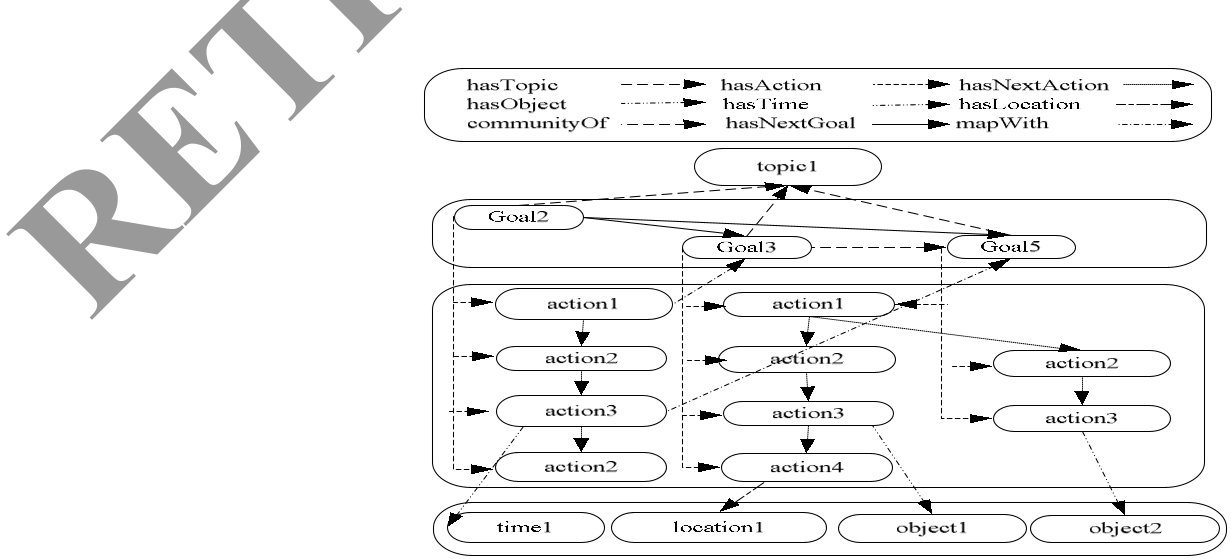
The authors extended the standard situation ontology by adding properties such as hasNextGoal (order relevance) and communityOf (grouping related objectives). This allows the system to understand that "Starting a car" is a precursor to "Driving on ice."
2. Graph Transformation
The ontology is converted into a directed graph ( mode). By treating "Goals" as nodes and "Relevance" as edges, the system can apply graph theory to determine which situations are objectively more "important" or "central" than others.
3. The Triple-Rank Scoring System
The final recommendation is determined by a synthesis of three scores:
- GoalRank: Inspired by Google's PageRank, it calculates the "Quality" of a situation based on its centrality in the ontology graph.
- GoalTIDF: A variation of TF-IDF that measures how well an input query (e.g., "car accident") matches the actions and ingredients of a goal.
- CommunityRank: Measures the social influence of a goal—how many other goals point to it as a necessary follow-up or a community representative.

Experiments: Real-World Scenarios
The authors tested the system using a dataset of over 31,000 goals crawled from wikiHow.
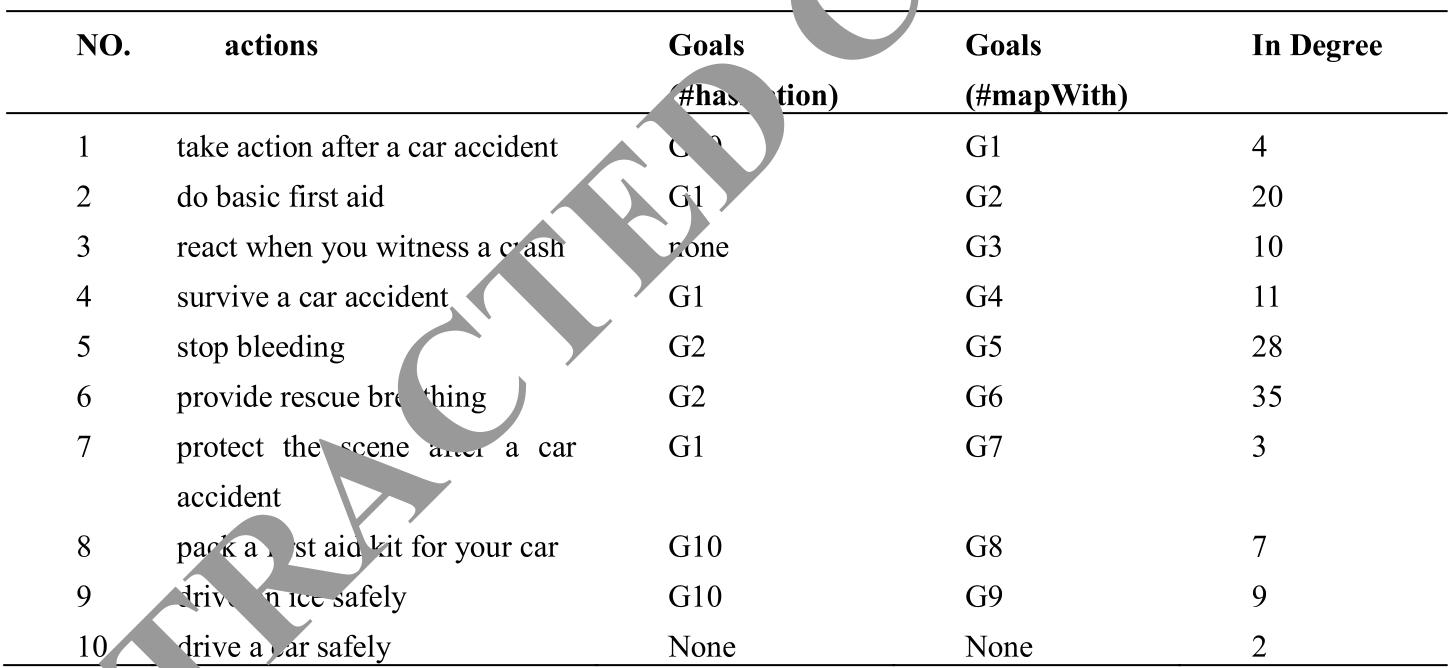
Consider the scenario: "You are driving on an icy road, a crash happens, and someone is hurt." Traditional keyword searches might just give you "How to drive a car." SR-SSNOA, however, ranks "How to take action after a car accident" and "How to do basic first aid" at the top because it understands the situational dependencies between a crash, injuries, and emergency response.
Quantitative Success
- Relevance Precision: Increased to 55% (a significant jump from baseline).
- Irrelevance Reduction: Dropped to only 3%.
- User Satisfaction: Evaluators found the SR-SSNOA recommendations more "unexpected yet relevant," highlighting its ability to suggest necessary steps a user might have overlooked.
Critical Insight: The Value of "Social" Situations
The brilliance of this work lies in treating knowledge relationships as social bonds. By applying community detection to ontologies, the system can "anticipate" a user's needs. If a user is in a "Car Accident" community, the system doesn't just look for matches; it looks for the influential nodes in that community (like First Aid) that are logically subsequent to the event.
Summary & Future Work
SR-SSNOA proves that semantic social networks are not just for modeling human interactions—they are powerful tools for modeling logical situations.
Limitations: The system heavily relies on the quality of the underlying ontology and the "keywords" extracted from the user's environment. Outlook: Future iterations could integrate real-time sensor data (IoT) more deeply, allowing the system to populate the "keywords" automatically, creating a truly hands-free situational assistant.