
SocialSitu: Revolutionizing User Intention Prediction in Multimedia Social Networks
A Situational Analytic Method for User Behavior Pattern in Multimedia Social Networks
This paper proposes "SocialSitu," an extension of Situ-analytics theory specifically for Multimedia Social Networks (MSNs), alongside an intention serialization algorithm based on an improved Generalized Sequential Pattern (GSP) method. The framework focuses on predicting user intentions by analyzing frequent behavior sequences linked to specific session targets.
TL;DR
In the hyper-dynamic world of Multimedia Social Networks (MSNs), users aren't just IDs—they are entities with shifting roles and groups. This paper introduces SocialSitu, a theoretical extension of situational analytics that integrates identity into behavior mining. By leveraging an improved Generalized Sequential Pattern (GSP) algorithm, the researchers can extract and predict user intentions (like playing or sharing) based on historical behavior sequences, proving that who you are in a group fundamentally changes how you navigate a platform.
Problem & Motivation: The Identity Gap
Most context-aware systems focus on the "Where" (Location) and "What" (Activity). However, in MSNs, the "Who" is multi-faceted. A user might be a "Moderator" in one group and a "Passive Viewer" in another. Current models often ignore how these Identity (ID) shifts influence the sequence of actions leading to a goal.
The authors argue that existing Situ-theory (designed for static software environments) lacks the "social" dimension. To provide truly personalized services, systems must understand the serialization of intentions—the specific chain of behaviors that signify a user's move from logging in to achieving a goal like "sharing a video."
Methodology: The SocialSitu Framework
The core contribution lies in the evolution of the situation tuple. While traditional models use a three-tuple {Desire, Action, Environment}, the authors propose SocialSitu(t) = {ID, d, A, E}.
1. The Extended Tuple
- ID: A combination of {Group, Role}, acknowledging that behavior is contextual to the user's social standing.
- Intention (I): Defined as a sequence of SocialSitu states from a starting point to a target achievement.
2. Intention Serialization Algorithm
To mine these sequences from messy, high-noise web logs, the authors adapt the GSP algorithm. The process involves:
- Data Transformation: Discreteizing continuous logs into SocialSitu intervals.
- Link & Pruning: Identifying frequent sub-sequences while discarding patterns that don't meet minimum support thresholds.
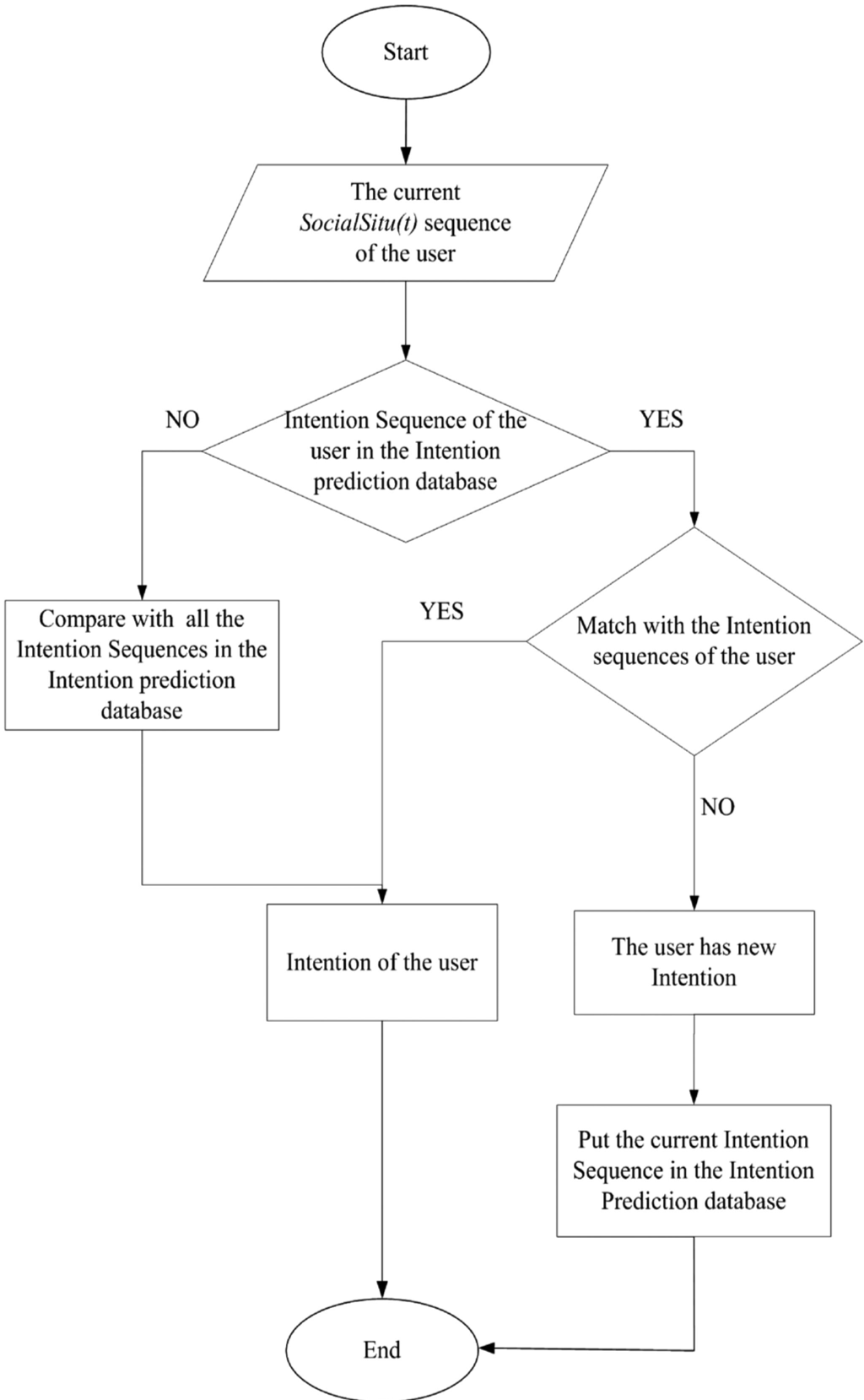 Fig 1: The conceptual flow of an intention sequence from the starting point to the achievement of a goal.
Experiments & Results: Identity Changes Everything
The researchers tested their framework on CyVOD, a multimedia social network prototype. They focused on two primary intentions: Playing and Sharing.
Key Findings:
- Role Impact: As shown in the comparison between User #161 as a "Common User" vs. a "VIP," the frequent behavior patterns changed. The VIP pattern showed a higher correlation with "Recommended Content," whereas the common user relied more on "Manual Search."
- Support vs. Confidence: The study found that a
Min_Supportof 20% to 40% provided the most stable intention sequences. Higher support (50%+) led to sequences that were too short to be predictive, while lower support introduced noise.
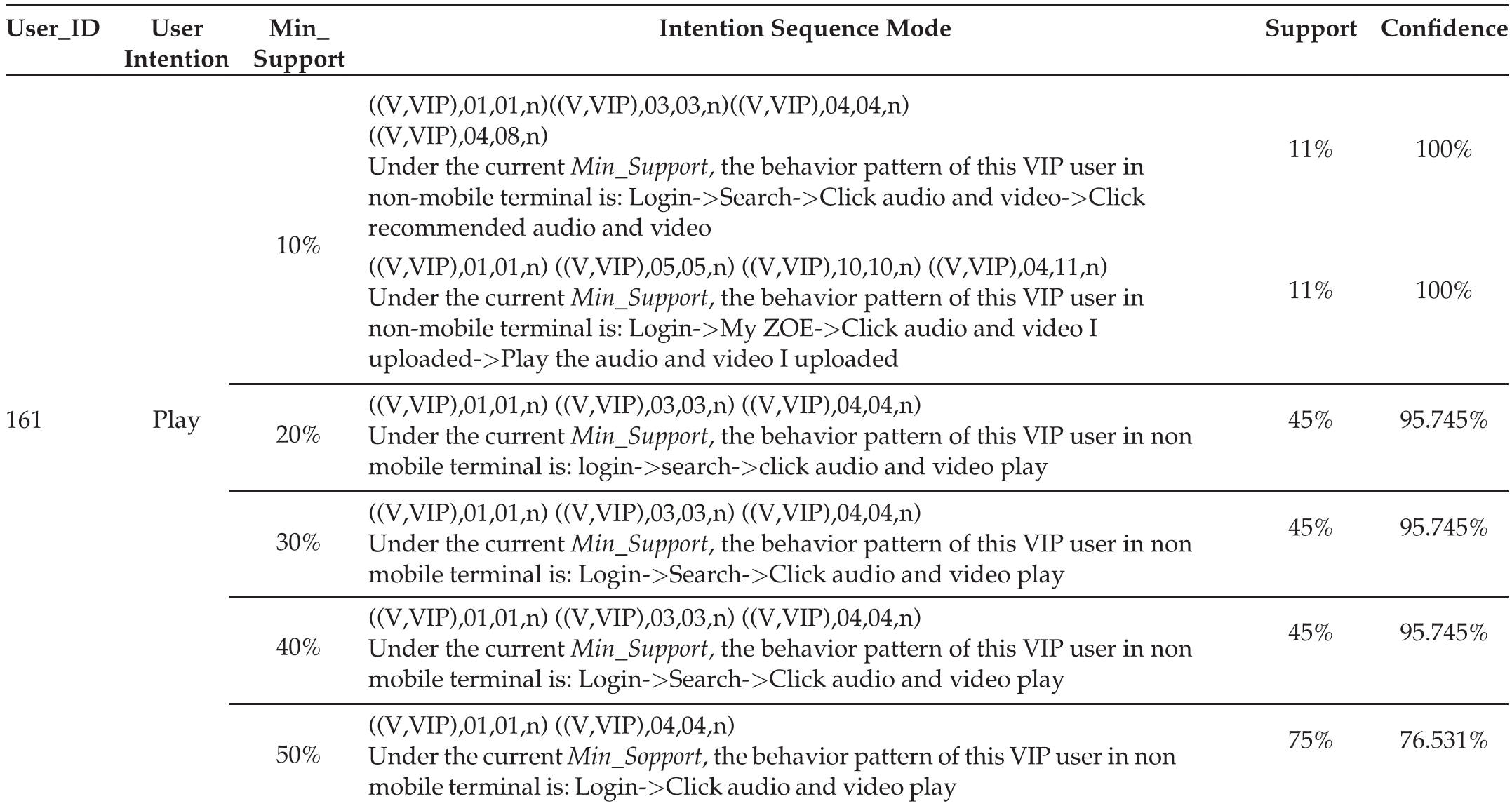 Table: Behavior pattern analysis for a VIP user showing the relationship between Min_Support and sequence accuracy.
Critical Analysis & Conclusion
This work provides a robust mathematical foundation for "Socially-sensed computing." By formalizing how identity constraints behavior, it moves beyond simple "next-item" recommendation toward "next-intention" prediction.
Limitations:
- The algorithm relies on historical session logs, which may struggle with the "Cold Start" problem for new users.
- The categorization of "Desire" (which is latent) from "Action" (which is observable) still requires predefined mapping tables, which might not scale to massive, diverse platforms.
Future Outlook: The logical next step is integrating this situational framework into Deep Sequential Models (like LSTMs or Transformers), where the SocialSitu tuple could serve as a multi-dimensional embedding to improve the accuracy of real-time service delivery in the "Social Media Ecosystem."