
[CVPR 2026] SkillClaw: Moving from Static Tools to Collective Intelligence in AI Agents
SkillClaw: Let Skills Evolve Collectively with Agentic Evolver
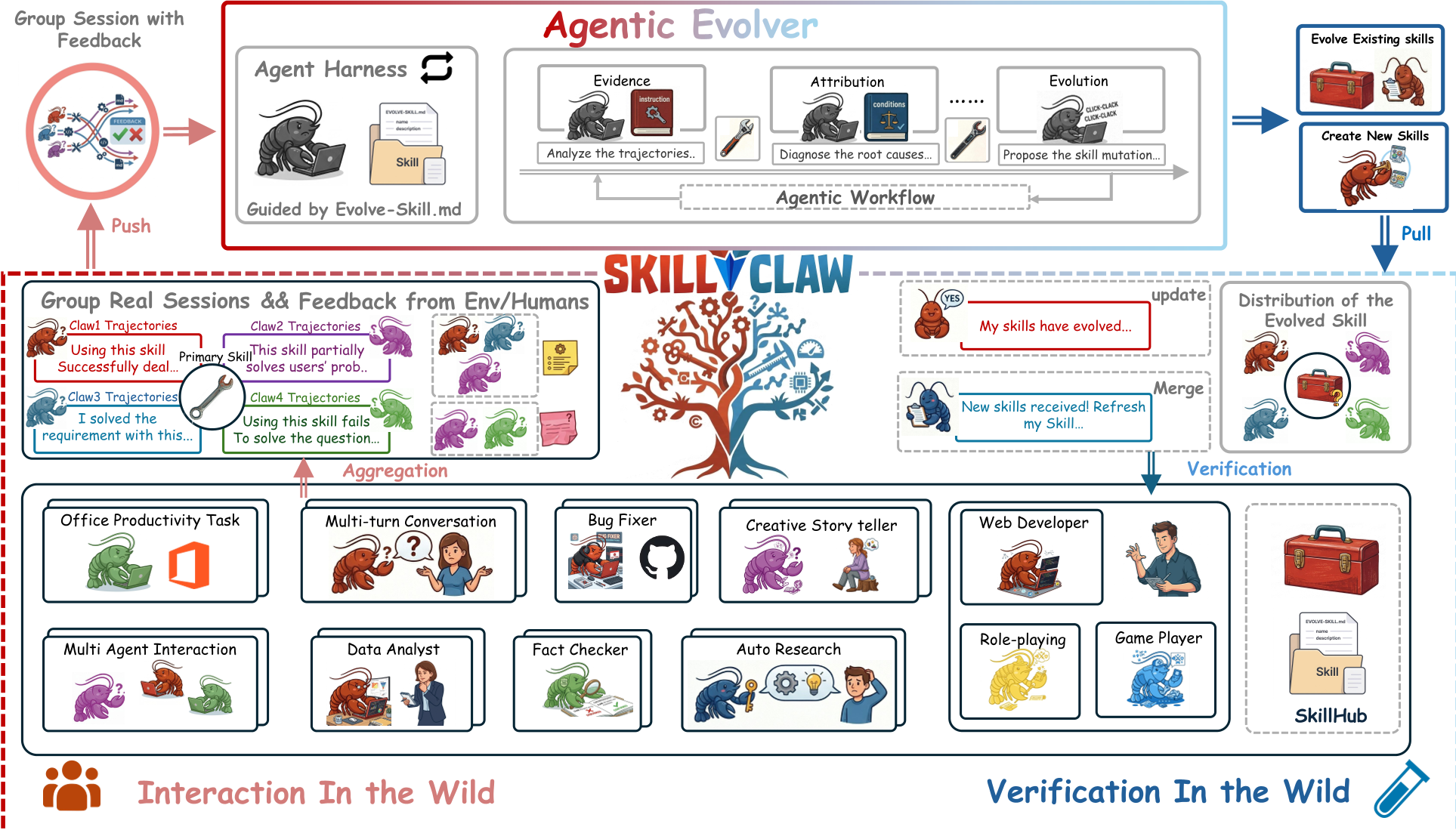
SkillClaw is an autonomous framework for the collective evolution of LLM agent skills in multi-user ecosystems. It utilizes an "Agentic Evolver" to aggregate interaction trajectories across different users, identify failure patterns, and continuously refine or expand a shared skill repository, achieving SOTA performance on WildClawBench with Qwen3-Max.
TL;DR
In the current AI landscape, agent "skills" are often treated like immutable software libraries—installed once and rarely updated. SkillClaw changes this by introducing a framework where agents learn from a community of users. By aggregating failure and success trajectories from diverse sessions, an autonomous Agentic Evolver rewrites and improves the agent's internal "manuals" (skills), leading to massive performance leaps (up to 88% in creative tasks) without any human coding.
Problem & Motivation: The "Siloed Experience" Trap
Today’s LLM agents (like OpenClaw or AutoGPT) are proficient but "forgetful." If User A finds a trick to fix a specific API port error in a Slack integration, User B—on the other side of the world—will still encounter the same error tomorrow.
The Pain Points:
- Static Skillsets: Skills remain frozen after deployment.
- Fragmented Learning: Improvements are confined to single sessions.
- Redundant Failures: Systems repeatedly rediscover the same failure modes across different users.
The authors' key insight is that heterogeneous experiences are complementary signals. A failure in one context is the "negative sample" needed to define the boundary of a robust skill.
Methodology: The Agentic Evolution Loop
SkillClaw operates on a "Day/Night" cycle reminiscent of human consolidation of memory.
1. From Trajectories to Shared Evidence
During the "Day," agents collect full execution traces (Prompt → Action → Feedback → Response). These aren't just chat logs; they include the raw tool errors and intermediate steps that usually stay hidden in the "black box" of the agent's reasoning.
2. The Agentic Evolver
Instead of using rigid, rule-based updates, SkillClaw uses a high-level LLM agent (the Evolver) to perform open-ended reasoning. It looks at a group of sessions for a specific skill and asks: "Why did these 5 users succeed while these 3 failed?"
The Evolver then chooses an action:
- Refine: Explicitly rewrite the procedural steps of a skill to avoid a documented failure.
- Create: If a new pattern emerges (e.g., a specific way to handle arXiv PDFs), spawn a new skill.
- Skip: If the evidence is too noisy.
3. Nighttime Validation
Before any updated skill is pushed to the global repository, it undergoes "Nighttime Validation." The system runs the old vs. the new skill in a Linux container. Only skills that demonstrate monotonic improvement (better success rates or stability) are synchronized back to the user-facing agents.
Experiments & Results: Real-World Gains
The framework was tested on WildClawBench, a grueling benchmark involving 60 complex, multi-modal tasks.
Key Performance Metrics:
- Search & Retrieval: Performance jumped from 22.7% to 34.5% (+52% relative gain) by evolving better file-existence checks and input validation.
- Creative Synthesis: Huge leap from 11.5% to 21.8% (+88% relative gain) as the agent learned to properly configure multimodal working directories.
- Procedural Consistency: In basic data extraction tasks, the success rate moved from 21.7% to nearly 70%.

Deep Insight: Why This Works
SkillClaw succeeds because it transforms implicit reasoning into explicit procedures.
In a notable case study on Slack Analysis, the original agent tried to "brute force" message retrieval, often hitting API limits or configuration errors. Through evolution, the skill was rewritten to:
- Scan previews first (filtering).
- Selectively retrieve (efficiency).
- Pre-configure ports (error prevention).
This mirrors how human Standard Operating Procedures (SOPs) evolve in organizations—learning from mistakes to make the process "fail-safe."
Critical Analysis & Conclusion
The Takeaway
SkillClaw proves that we don't necessarily need "smarter" base models to get better performance; we need better-structured institutional knowledge. By allowing agents to share their "homework," the system as a whole becomes more resilient than any individual instance.
Limitations
- Token Cost: The "Nighttime Validation" and evolutionary reasoning are computationally expensive.
- Cold Start: The system still requires an initial set of skills or enough failures to trigger the "Create" action.
- Environment Drift: If a tool's API changes globally, the system might take a few "Day" cycles to catch up through collective failure.
Future Outlook: As we move toward a world of "Agents in the Wild," frameworks like SkillClaw will be essential for ensuring that AI assistants don't just work—they get better every single day.