
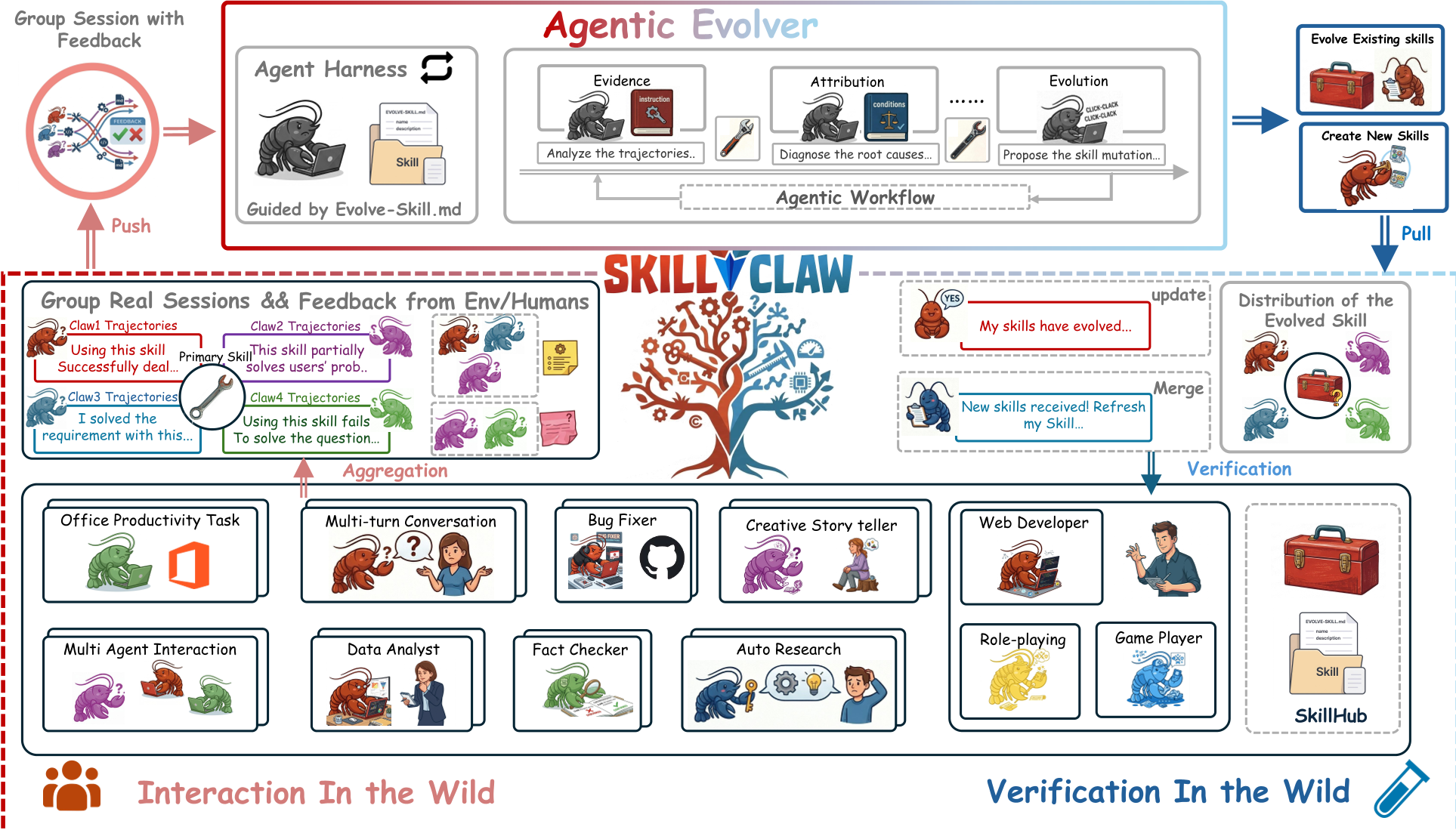
The paper introduces SkillClaw, an autonomous framework for the collective evolution of skills in multi-user LLM agent ecosystems. It aggregates interaction trajectories across distributed agents and uses an agentic evolver to continuously refine, create, and synchronize skills in a shared repository, achieving SOTA performance on the WildClawBench.
TL;DR
Current AI agents are "forgetful" — once a session ends, the lessons learned from a failure or a clever tool-use shortcut vanish. SkillClaw changes this by treating every user interaction as a signal for system-wide improvement. By aggregating trajectories from multiple users and using an Agentic Evolver to rewrite the shared "skillbook," SkillClaw enables agents to evolve collectively. In testing, this led to massive performance leaps, including an 88% relative gain in creative tasks.
The Motivation: The "Groundhog Day" Problem in Agents
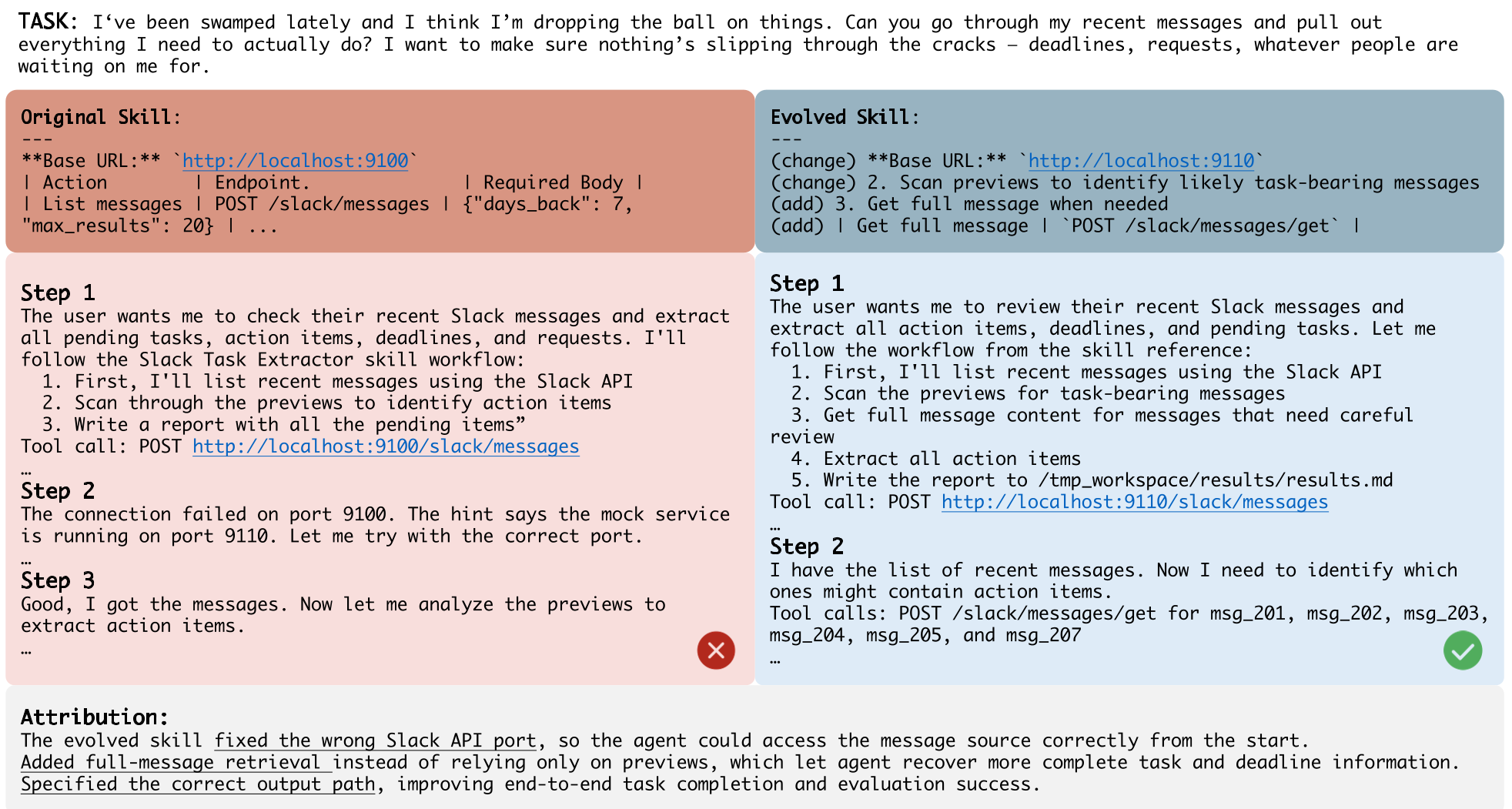
If two different users ask an agent to perform a complex Slack analysis, and the agent fails both times because of an obscure API port error, current systems require both users (or their agents) to troubleshoot the same error independently. This is a waste of "experience."
The authors identify that skills—the structured procedures agents use to handle tools—are currently treated as static artifacts. SkillClaw's core insight is that cross-user interactions provide a natural ablation study; by comparing why one user succeeded where another failed, the system can identify the exact "procedural bottleneck" and fix it for everyone.
Methodology: How Skills Evolve
SkillClaw operates in a continuous Day-Night loop:
- Daytime (Interaction & Collection): Agents interact with users, recording full "causal chains" (Prompt -> Action -> Error/Feedback -> Response).
- Nighttime (Evolution & Validation):
- Evidence Grouping: Trajectories are grouped by the skills they used.
- Agentic Evolver: A high-reasoning LLM acts as a "Skill Engineer." It analyzes failed vs. successful traces to see what guidance was missing.
- Actions: The evolver can Refine an existing skill (fixing a port number), Create a new one (identifying a new recurring workflow), or Skip if the evidence is noisy.
- Validation: Proposed skills are tested in idle environments. If they outperform the "best-so-far" version, they are merged.
- Synchronization: The new "Gold Standard" skills are pushed to all agents for the next day.

Experiments: SOTA Results on WildClawBench
The framework was tested on WildClawBench, a rigorous benchmark involving 15-50 step tasks in real Linux containers.
Key Performance Gains:
- Search & Retrieval (+52%): Evolution fixed low-level reliability issues (file path resolution) before moving to high-level strategy (multi-source planning).
- Social Interaction (+11%): The system quickly identified that "Meeting Summarization" was better handled as a structured workflow than a descriptive instruction.
- Creative Synthesis (+88%): Most gains came from fixing environment setup errors that previously blocked the agent from even starting the task.

Deep Insight: "Why this works"
Unlike simple memory-based agents that just "remember" past sessions, SkillClaw compresses experience. By turning thousands of raw logs into a few lines of "Skill Guidance," the agent avoids context-window bloat while gaining the "wisdom" of a thousand users.
A fascinating case study (Figure 2) shows the evolver turning a naive "grab all messages" Slack strategy into an "optimized preview-then-fetch" strategy. This wasn't programmed by humans—the agent discovered that the former often hit token limits or tool errors through trial and error across multiple users.
Conclusion & Critical Analysis
SkillClaw represents a shift from Individual Learning to Species-level Evolution for AI agents.
Limitations:
- The current validation step requires significant compute (running tasks in "nighttime" cycles).
- It assumes a degree of hardware/environment homogeneity across users for skills to be truly transferable.
Future Work: The authors suggest scaling the number of users to see if "emergent" skills appear that no single person could have designed. This work paves the way for a truly autonomous "Software-as-a-Service" where the software literally writes its own best practices as you use it.