
SKILLFLOW: Beyond Static Tools — How Autonomous Agents Evolve Through Lifelong Learning
SkillFlow:Benchmarking Lifelong Skill Discovery and Evolution for Autonomous Agents
SKILLFLOW is a novel benchmark designed to evaluate autonomous agents' ability to discover, evolve, and transfer skills across 166 tasks in 20 workflow families. Using a Domain-Agnostic Execution Flow (DAEF) framework, it measures lifelong learning as agents progress from zero knowledge to maintaining sophisticated skill libraries, identifying a significant performance gap even in top-tier models like Claude Opus 4.6 and Kimi K2.5.
TL;DR
Autonomous agents are moving past simple "plug-and-play" tool use. SKILLFLOW introduces a benchmark for Lifelong Skill Evolution, where agents must discover, repair, and transfer procedural skills across 20 distinct task families. The results are a wake-up call: while frontier models like Claude Opus 4.6 can successfully "self-evolve," many models suffer from "cognitive overload" and skill fragmentation, actually performing worse the more they "learn."
The Problem: The "Static Skill" Delusion
Most current benchmarks (like SWE-bench or SkillsBench) test if an agent can use a tool provided in the prompt. However, real-world autonomy requires more. If an agent fails a complex Excel task today, can it distill the "lesson learned" into a reusable script for tomorrow?
Prior work has focused on infrastructure, but SKILLFLOW identifies a core research void: the inability of agents to maintain a coherent library over time. Without a mechanism to patch errors, agents often fall into a "repetition trap," where a local mistake in Task 1 becomes an inherited flaw in Task 8.
Methodology: The DAEF Framework
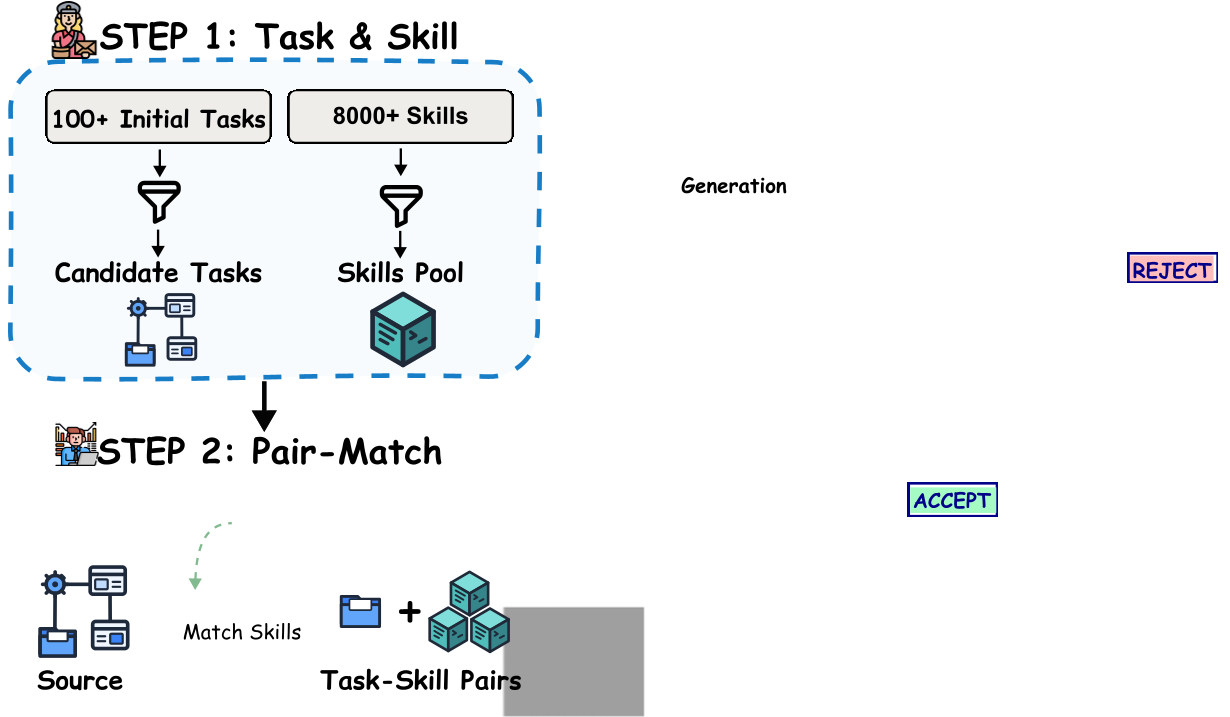
The backbone of SKILLFLOW is the Domain-Agnostic Execution Flow (DAEF). Instead of defining tasks by their surface details (e.g., "Analyze IBM's 2023 Revenue"), the authors define them by their operational topology:
Read Source -> Extract Fields -> Normalize -> Compute -> Compare -> Output
By grounding diverse tasks (Finance, Healthcare, Governance) in shared DAEFs, the benchmark creates a controlled environment for testing cross-domain skill transfer.
The Agentic Lifelong Learning Protocol
Unlike traditional evaluations, agents start with zero skills. They must:
- Attempt a task.
- Receive verifier feedback (rubrics).
- Generate a Skill Patch (Markdown files and Python scripts).
- Carry that updated library into the next, more difficult task in the family.
Experimental Insights: Growth vs. Utility
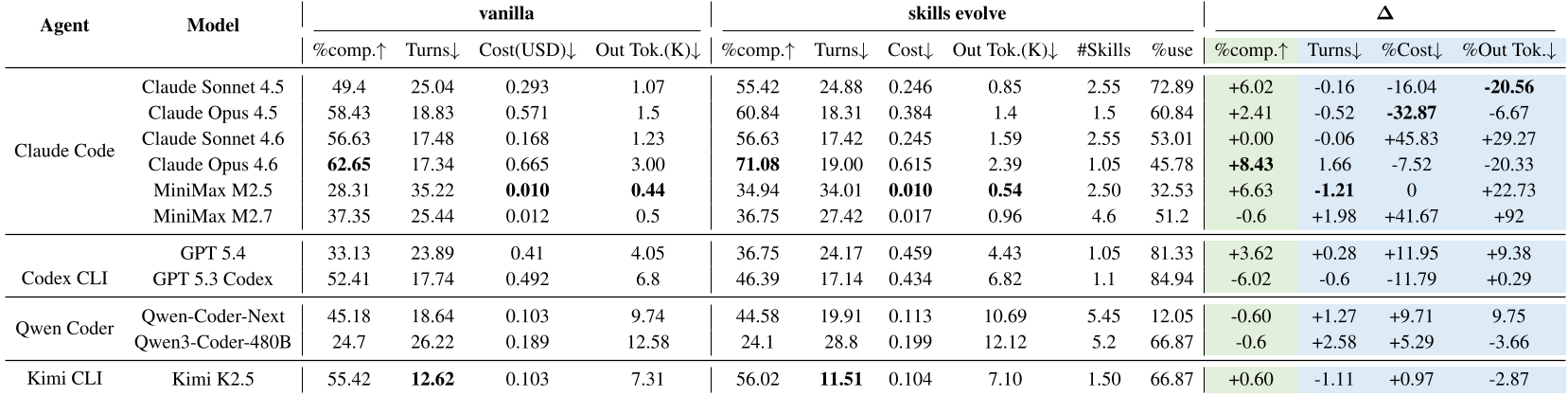
The experiments revealed a stark hierarchy in model capability. SKILLFLOW doesn't just measure if the task was completed; it measures the efficiency and utility of the generated skills.
Key Findings:
- Opus 4.6 Leads the Way: It was the only model to demonstrate stable library-level improvement, turning a 62% success rate into a 71% success rate by effectively repairing broken logic (e.g., handling Excel's XML cached values).
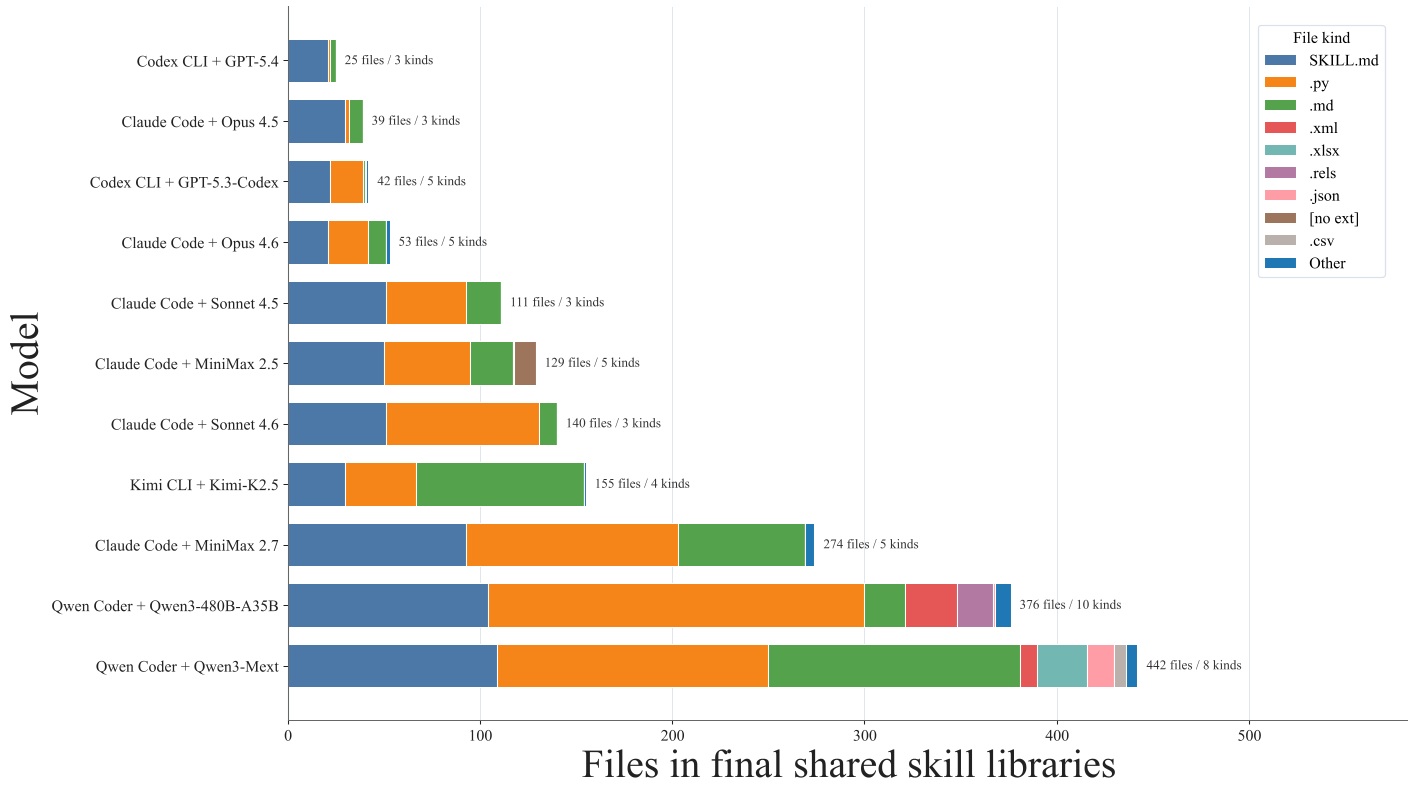
- The Skill Inflation Trap: Weaker models like Qwen-Coder-Next created too many skills. Instead of one powerful, generalizable resource, they created a fragmented mess of one-off notes, leading to higher token costs and lower success.
- The "Repair" Bottleneck: The fundamental gap between frontier and mid-tier models isn't writing code—it's recognizing when a skill is wrong and having the meta-cognitive ability to patch it.
Deep Dive: The Spreadsheet Failure Mode
One of the most revealing trajectories in the paper involves an Excel bedflow calculation. The agent discovered that standard Python libraries (openpyxl) write formulas but don't always compute values.
A "smart" agent realized this failure, wrote a Python script to patch the XLSX XML directly to inject cached values, and added this meta-knowledge to its SKILL.md. This is the essence of SKILLFLOW: turning a failure into a permanent capability.
Critical Analysis & Future Outlook
SKILLFLOW proves that "Learning to Learn" is the next frontier for autonomous agents.
Limitations: The current protocol reset libraries between families to avoid noise. Future research should investigate how agents manage massive, hundreds-of-skills libraries without specialized retrieval-augmented generation (RAG) failures.
Future Work: The transition from text-based skills to "executable neural procedures" is inevitable. SKILLFLOW's DAEF suggests that the future of agentic workflows lies in abstracting logic away from data, allowing agents to "study" their own execution traces to reach true SOTA performance.
Final Takeaway
Don't focus on giving your agent more tools. Focus on giving your agent the ability to audit and improve the tools it already has.