
The paper introduces SkillLearnBench, the first comprehensive benchmark designed to evaluate continual learning (CL) methods for LLM agent skill generation. It evaluates four CL strategies across 20 real-world, skill-dependent tasks using a three-level framework: skill quality, execution trajectory, and task outcome.
TL;DR
LLM agents are increasingly relying on "Skills"—structured Markdown documents containing workflows and domain knowledge—to solve complex tasks. But can they learn these skills on their own? SkillLearnBench is the first benchmark to prove that while agents can generate skills, they are still far from human-level expertise. The research reveals a crucial paradox: more powerful LLMs often create skills that are too rigid to be useful, and "self-reflection" without external feedback leads to performance decay.
The Problem: The Automation Gap in Agentic Workflows
We know that LLMs like Claude or GPT-4 perform better when given specific "manuals" (skills). However, in a dynamic world, we can't write a manual for every possible task. The goal is a generate-store-reuse cycle—a form of non-parametric Continual Learning.
Prior work has proposed various ways to automate this, but testing has been fragmented. Is a "Teacher" in the loop necessary? Does re-reading a failed attempt actually help? SkillLearnBench provides the first controlled arena to answer these questions across 20 verified tasks, from debugging code to planning travel.
Methodology: Four Ways to Learn
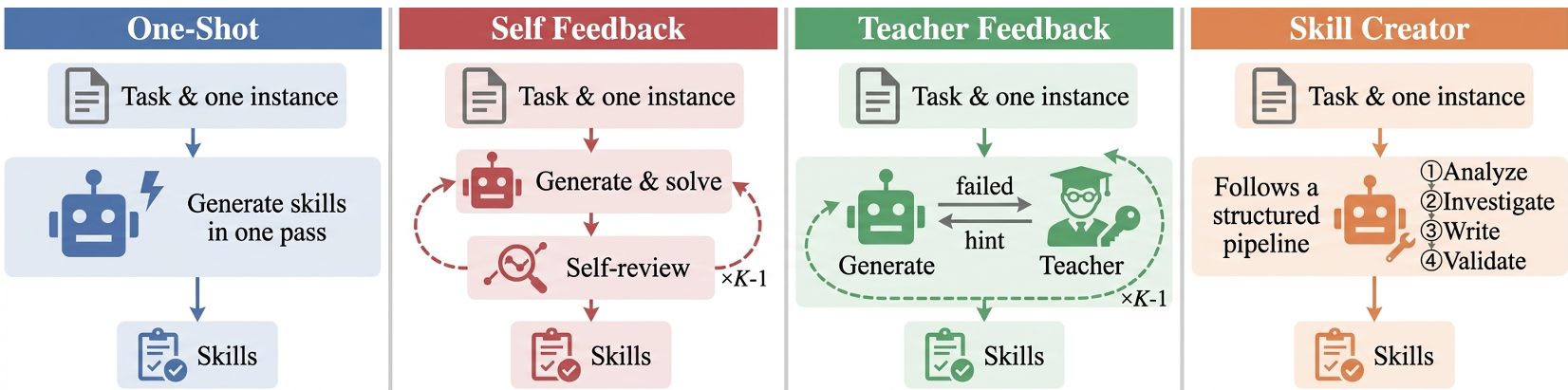
The researchers compared four distinct learning strategies to see which produces the most "reusable" skills:
- One-Shot: Direct generation from a task description.
- Self Feedback: The agent tries a task, fails, reflects, and rewrites the skill (internal loop).
- Teacher Feedback: An expert (with access to the ground truth) gives hints without revealing the answer (external loop).
- Skill Creator: A structured multi-stage pipeline designed by Anthropic to ensure professional formatting.
Key Insight 1: The Ceiling of Self-Correction
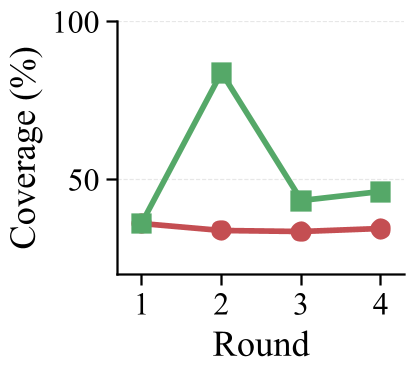
One of the most striking findings is the failure of "Self-Correction." In many AI papers, "Self-Reflect" is treated as a silver bullet. SkillLearnBench shows that Self-Feedback quickly leads to recursive drift. Without a fresh signal from the outside world (like a Teacher), the agent just reshuffles its existing (and potentially wrong) internal logic.
In contrast, Teacher Feedback was the only method where accuracy grew steadily across multiple rounds. External grounding is non-negotiable for genuine skill evolution.
Key Insight 2: The "Over-Optimization" Paradox
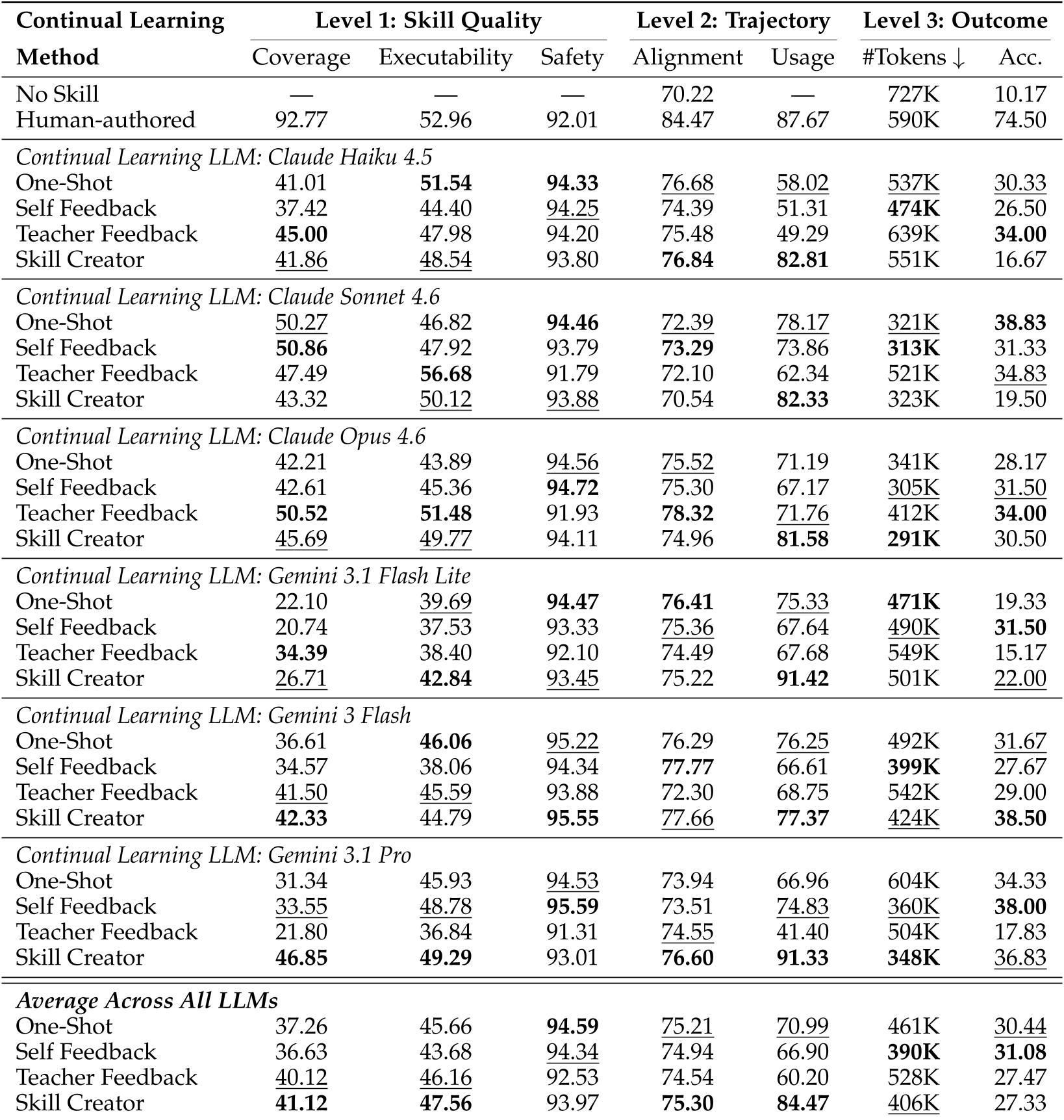
In traditional ML, bigger is usually better. In SkillLearnBench, Scaling to larger LLMs did not reliably produce better skills.
Why? The authors found that "Stronger" models like Claude Opus tend to hardcode parameters. For example, in a geophysics task, Opus might hardcode a specific coordinate system used in the training example. When the agent later tries a different instance, the skill is too rigid and causes a failure. "Mid-tier" models (like Claude Sonnet) actually produced more flexible, generalized skills that worked better across varied scenarios.
Key Insight 3: Adoption is Half the Battle
A skill is useless if the agent ignores it. The study measured "Skill Usage Rate" and found it surprisingly low for some methods. Even when a skill was high-quality (Level 1), the agent might ignore it during execution (Level 2), leading to a failed outcome (Level 3). This highlights that the next frontier isn't just writing better skills, but ensuring LLMs are trained to follow them faithfully.
Conclusion: The Road Ahead
SkillLearnBench sets a high bar. Current AI methods only close ~45% of the gap to human performance. To bridge the rest, we need:
- Better Grounding: Skills must be rooted in executable code, not just prose.
- Dynamic Flexibility: Distinguishing between a "rule" and a "hardcoded variable."
- External Signals: Moving away from pure self-reflection toward multi-agent feedback or environment-based reinforcement.
Takeaway: We are entering an era of "Procedural Memory" for AI. SkillLearnBench proves that learning the how is much harder than learning the what.