
SkillSmith: When LLMs Start Reasoning Over Their Own Weights
SkillSmith: Learning to Compose Parametric Skills and Textual Knowledge
SkillSmith is a novel augmented LLM architecture from Google DeepMind designed to bridge the gap between textual reasoning and weight-space adaptation by treating model weights as a native modality. It uses a coprocessor approach to ingest prefix-tuning weights and textual metadata, synthesizing new, instruction-steered prefix weights for target tasks.
TL;DR
Researchers from Google DeepMind have introduced SkillSmith, a system that allows Large Language Models (LLMs) to treat their own weights as a "modality" just like text. By training an augmented LLM to ingest both task descriptions and prefix-tuning weights, SkillSmith can synthesize new weights for novel tasks, outperforming traditional weight-merging (arithmetic) and text-based (In-Context Learning) methods.
The Silo Problem: Text vs. Parameters
In the current agentic landscape, "learning" happens in two separate silos:
- Textual Knowledge: Agents reflect on past mistakes and store strategies in natural language.
- Parametric Skills: Agents use Parameter-Efficient Fine-Tuning (PEFT), like LoRA or Prefix-Tuning, to bake specific behaviors into model weights.
The problem? These two worlds don't talk to each other. If an agent has weights for "English-to-Twi translation" and text notes on "Legal Analysis," it can't mathematically combine them to create a "Twi Legal Analyst" weight. Traditional merging (like LERP or Task Arithmetic) is too "dumb"—it averages numbers without understanding the logic of the task.
Methodology: The SkillSmith Architecture
SkillSmith bridges this gap by turning model weights into something an LLM can "read."
1. Model Weights as Input
The system uses Prefix-Tuning (KV-caches) as its parametric unit. These weights are projected into the LLM's latent space using an MLP (Multi-Layer Perceptron) adapter.
2. The Mixed-Modality Sequence
SkillSmith constructs a prompt that interleaves:
- Preamble: High-level instructions for the synthesis.
- Source Task Bundles: Textual metadata (descriptions/examples) paired with the corresponding adapted KV-cache weights.
- Generation Block: A series of placeholder tokens where the model "writes" the new KV-cache for the target task.
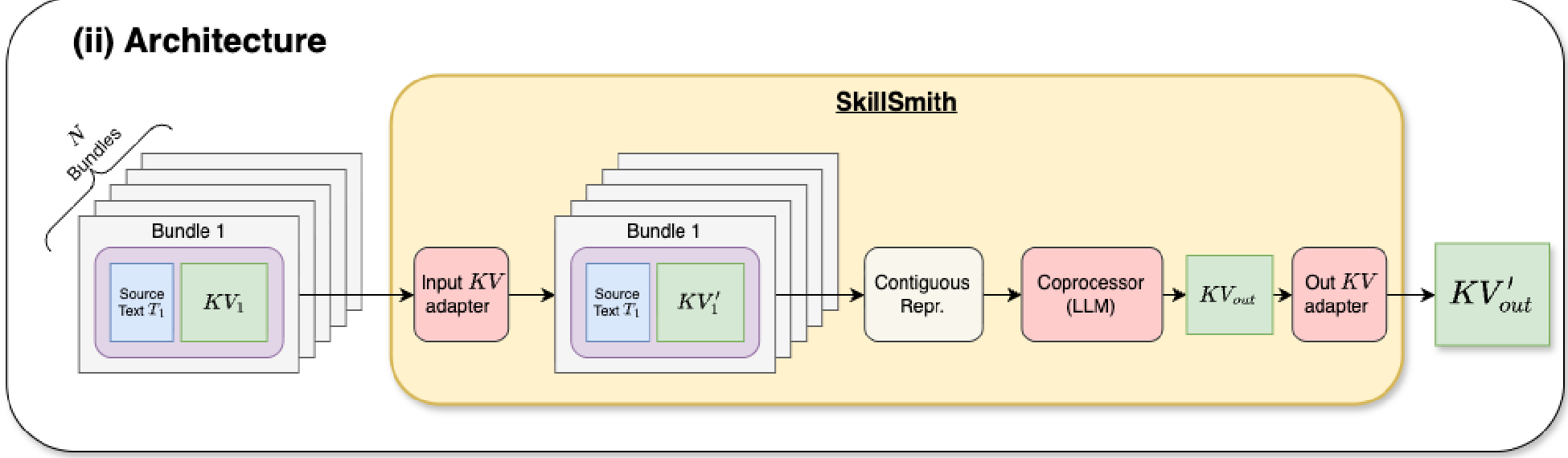 Figure 1: The SkillSmith pipeline (i) shows how source bundles are fed into the augmented LLM (ii) to generate target prefix weights.
Experiments: Superior Composition
The authors tested SkillSmith across three benchmarks: Composite-SNI (a new dataset with 21k synthetic composite tasks), Super-Natural Instructions (SNI), and MMLU-ProX.
Key Findings:
- Zero-Shot Power: SkillSmith generates weights that work immediately for new tasks, beating standard arithmetic merging techniques.
- Superior Initialization: When further fine-tuning is allowed, weights initialized by SkillSmith reach a much higher performance ceiling than those started from scratch or ICL examples.
- Robustness to Noise: Even when the "source tasks" were chosen by an imperfect retriever rather than ground truth, SkillSmith was able to extract relevant signals to build the target skill.
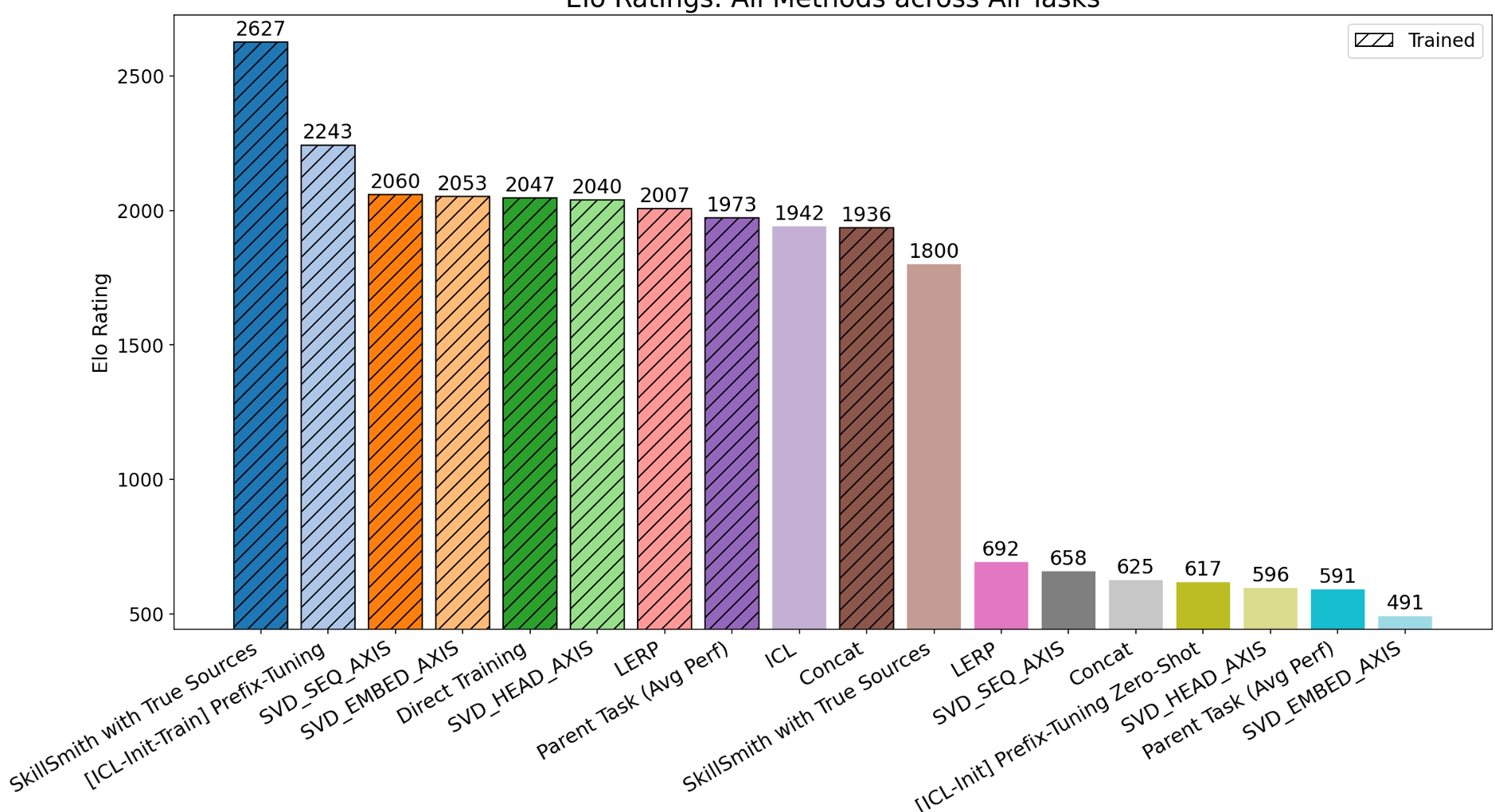 Figure 2: Elo ratings on the Composite-SNI dataset. SkillSmith (far right) shows a clear advantage in the fine-tuning regime.
Why It Matters: "Knowing" vs. "Doing"
The most profound insight from the SkillSmith paper is the collapse of the barrier between "knowing" (textual understanding) and "doing" (parametric execution).
An ablation study confirmed that SkillSmith isn't just succeeding because it has more text context; it is truly performing synergistic composition. When the researchers tried to simply give the text to a standard model (Direct Training), it couldn't match SkillSmith's performance. This proves that the LLM is actually "reasoning" over the weight-space modality.
Limitations and Future Outlook
While impressive, SkillSmith currently focuses on Prefix-Tuning. Expanding this to more complex PEFT methods like LoRA or even full model weights remains a frontier. Furthermore, the reliance on a secondary "coprocessor" model adds computational overhead.
However, SkillSmith provides a clear blueprint for the next generation of LLMs: models that don't just use weights to process data, but treat their own weights as data to be managed, merged, and evolved through natural language instructions.
Conclusion
SkillSmith is a step toward holistic agentic architectures. By treating parameter-space as a readable, synthesizable modality, we move closer to agents that can autonomously reconfigure their own "brains" to solve the next complex problem.