
SkyBoundary: Engineering the Path to Stardom in Social Networks
SkyBoundary: An Improved Approach to Member Promotion in Social Networks
The paper introduces SkyBoundary, a novel algorithm for the "Member Promotion" problem in social networks, which identifies non-skyline members that can become "stars" at the minimum cost. It leverages the Skyline Operator (multi-objective optimization) to measure importance and optimizes the search for promotion plans using geometric boundaries and cost-based pruning.
TL;DR
In the competitive landscape of Social Networks (SNs), "Member Promotion" is the task of identifying which non-influential users can become "stars" (Skyline members) with the minimum effort (edge addition cost). This paper presents SkyBoundary, an algorithm that uses geometric boundaries and heap-based cost sorting to turn an exponential search problem into a highly efficient optimization process, outperforming previous SOTA methods by orders of magnitude.
The "Star" Dilemma: Multi-Objective Importance
In any network—be it academic co-authorship or Twitter—importance is rarely one-dimensional. A "star" typically excels in multiple criteria, such as Authoritativeness (indegree) and Hub capability (outdegree).
The Skyline Operator is the standard tool for this: a member is in the "Skyline" if no other member beats them in all dimensions simultaneously. The problem? Transitioning a regular member into this elite group involves adding social ties (edges), each with a specific cost. Finding the cheapest path in a massive graph is a combinatorial nightmare.
Geometric Instinct: The Promotion Boundary
The authors' first major insight is visual. By mapping members onto a 2D Cartesian plane (Indegree vs. Outdegree), the Skyline forms a "staircase" boundary.
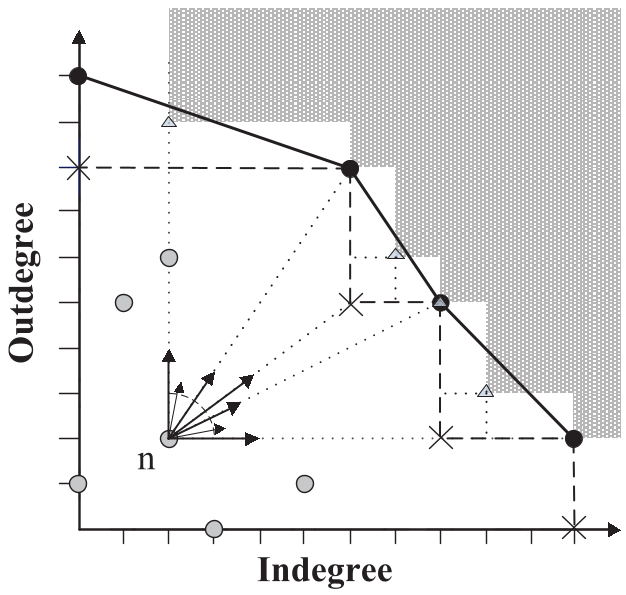
They define the Promotion Boundary () as a polyline connecting virtual promotion points and existing skyline points.
- The Logic: A member is successfully promoted only if their coordinates "cross" this boundary.
- The Benefit: This allows the algorithm to calculate the minimum number of incoming and outgoing edges required before even attempting to build a plan, pruning millions of "meaningless" edge combinations.
Algorithmic Core: SkyBoundary
The SkyBoundary algorithm integrates these geometric insights with a rigorous cost-based strategy.
1. Plan Limitation
For each candidate, the algorithm determines the lower bounds of required edges based on the distance to the Promotion Boundary.
2. Best-First Search with Min-Heaps
Instead of checking plans randomly, SkyBoundary uses a Min-Heap to verify plans in strictly ascending order of cost. Using two recursive rules (adding the cheapest available edge or replacing an edge with its next-cheapest successor), the algorithm ensures that the first successful promotion found is guaranteed to be the cheapest.

Experimental Proof: Efficiency and Success
The researchers tested SkyBoundary against the IDP (Improved Dominance Pruning) algorithm using the USAir flight network and synthetic Power-law datasets.
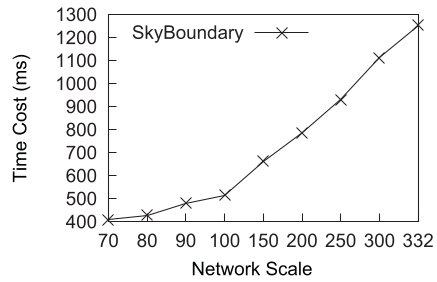
- Speed: As the network scale grows, the previous SOTA (IDP) costs become exponential and "intolerable." SkyBoundary remains efficient, often finding the solution after verifying fewer than 10 plans.
- Optimization: SkyBoundary consistently identifies promotion plans with significantly lower costs than random selection.
- Reliability: Unlike heuristic methods, SkyBoundary achieves a 100% success rate in promotion tasks because it respects the geometric reality of the Skyline.
Critical Insight & Future Outlook
The brilliance of SkyBoundary lies in its transition from Graph Theory to Geometry. By treating "influence" as a coordinate and "promotion" as a vector movement, the authors bypass the typical bottlenecks of graph traversal.
Limitations: Currently, the model is optimized for simple metrics like degrees. If we move to global metrics like Betweenness Centrality, adding an edge might change the coordinates of every node in the network, potentially breaking the static boundary assumption.
The Takeaway: SkyBoundary is a masterclass in using geometric pruning to solve combinatorial optimization, providing a roadmap for future applications in viral marketing and organizational restructuring within social platforms.