
Slack as the Nervous System: Coordinating Agile GSD in a Distributed World
15406_Slack me if you can! using enterprise social networking tools in virtual agile teams.
This paper investigates the role of Slack as an Enterprise Social Networking (ESN) tool in facilitating communication and coordination within Agile Global Software Development (GSD) teams. Through a case study of a distributed team across Norway and Poland, the research demonstrates how Slack supports mutual adjustment and transparency, effectively mapping its features to established coordination models.
TL;DR
Is Slack just a chat app, or is it a vital coordination engine? This paper dives into a real-world case study of a software company distributed between Norway and Poland to see how Slack (an Enterprise Social Networking tool) facilitates—and sometimes hinders—Agile development. The study finds that while Slack bridges geographical gaps through transparency and "mutual adjustment," it also creates new challenges like participation imbalances and language barriers.
Background: The Distance Dilemma
Global Software Development (GSD) is a double-edged sword: it offers access to global talent but introduces "distance" (temporal, geographical, and cultural). Agile relies heavily on face-to-face, informal communication. When your team is 1,000 miles away, how do you maintain that "pulse"?
The authors argue that Enterprise Social Networking (ESN) tools like Slack provide a "virtual water cooler" that traditional tools like Jira or Email cannot replicate.
Methodology: The Anatomy of a Chat Log
The researchers didn't just ask developers if they liked Slack; they looked at the data.
- Dataset: ~32,000 messages over 2.5 years.
- Coding: They categorized messages into Technical Information, Problem-focused Communication, Socializing, and Coordination.
- Theory: They used Van de Ven’s Coordination Framework to understand how Slack fits into Personal (1-on-1), Group (channels), and Impersonal (automated bots) coordination.
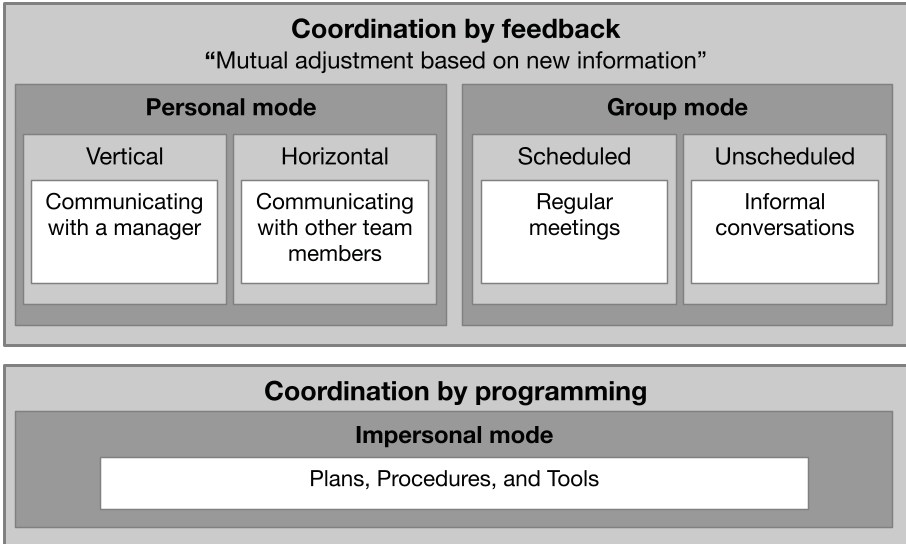 Figure 1: Simplified view of coordination modes used to analyze Slack interactions.
Key Insights: Why Slack Works (and Where it Fails)
1. Problem-Solving is the Primary Driver
Nearly 48% of all messages in the analyzed channels were "problem-focused." This suggests that Slack isn't just for "fun"; it is where the actual work of debugging and architectural alignment happens. In distributed teams, this "fast feedback" loop is critical for maintaining velocity.
2. The Participation Power Law
The study found a striking imbalance in participation. A small group of "super-communicators" (33% of users) accounted for nearly 72% of output. These were often Tech Leads or Senior Developers. While these individuals act as knowledge hubs, it raises the risk of "information gatekeeping" or burnout for those individuals.
 Figure 2: Analysis of user activity showing the concentration of communication among a few key members.
3. The Language Barrier
Even with Slack, "English as the working language" isn't a magic wand. The Polish developers reported feeling less confident contributing to public channels due to language proficiency, often resulting in them using Private DMs instead. This "Private DM" culture is dangerous because it hides knowledge from the rest of the team.
4. Coordination via "Affordances"
Slack's unique features, like Emojis, aren't just for fluff. The researchers found that emojis (used in 13% of messages) provided meta-level information—signaling agreement, frustration, or acknowledgment without cluttering the channel with text.
Strategic Recommendations for Managers
Based on the study, the authors proposed a set of "Slack Guidelines" adopted by the team:
- Public First: Favor public channels over DMs to increase transparency.
- Narrow Focus: Create specific channels (e.g.,
#feature-x,#bug-y) and archive them once finished to reduce noise. - Presence Awareness: Use dedicated channels to signal availability (e.g., "I'm running late" or "Working from home").
| Message Category | Frequency | Purpose |
|---|---|---|
| Problem-focused | 48% | Technical Q&A and solutions |
| Technical Information | 20% | Status updates on infrastructure |
| General Discussion | 15% | Logistic and general Qs |
| Emoji/Social | 16% | Team bonding and sentiment |
Critical Perspective & Conclusion
While Slack effectively supports the Mutual Adjustment needed for Agile, it is not a "fire and forget" solution. The study highlights that tools are only as good as the norms surrounding them. Without explicit rules, Slack can become a fragmented mess of private silos.
Future Work: The researchers suggest looking closer at the "Sentiment" of Slack messages to predict team burnout or project delays before they happen.
Senior Editor’s Note: This paper provides a much-needed empirical look at the "hidden labor" of communication in software teams. It moves the conversation from "Does Slack work?" to "How do we make Slack work for us?"