
Deciphering the Digital Exhaust: Large-Scale Fatigue Analysis via Social Media Selfies
Sleep-deprived fatigue pattern analysis using large-scale selfies from social media
This paper introduces a large-scale computational framework for predicting sleep-deprived fatigue by analyzing human facial cues in social media selfies. Leveraging deep learning (VGG16) and a dataset of nearly 1 million Instagram posts, the authors quantify fatigue patterns across diverse demographic groups (age, gender, ethnicity) and temporal cycles (weekdays).
TL;DR
Researchers from the University of Rochester have developed a data-driven pipeline to "read" fatigue from social media selfies. By analyzing nearly 1 million Instagram posts from over 10,000 users, they moved fatigue study from the controlled lab to the "wild" world of social media, uncovering how age, gender, and the day of the week intersect to influence our physiological appearance of exhaustion.
Problem & Motivation: The Scalability Gap in Fatigue Research
Fatigue is more than just feeling tired; it is a precursor to chronic health issues and a major safety risk. Historically, measuring fatigue required either subjective self-reporting (prone to bias) or clinical observation (expensive and small-scale).
The authors recognized a unique opportunity: millions of people post high-resolution "selfies" daily. These images are "honest" biological signals. By bridging clinical psychology (identifying facial cues) with computer vision, we can perform massive screening for sleep deprivation risks at a population level.
Methodology: From Pixels to Fatigue Scores
The method relies on a specialized pipeline that translates facial landmarks into a quantitative "Fatigue Rate."
1. Identifying the "Face of Tiredness"
Based on prior clinical research, the study focuses on eight specific correlates:
- Eyes: Hanging eyelids, red eyes, swollen eyes, glazed eyes, and dark circles.
- Skin & Mouth: Pale skin, wrinkles/lines, and droopy mouth corners.
2. The Model Architecture
The authors utilized Face++ for initial landmark detection and demographic estimation (Age, Race, Gender). For feature extraction, they employed a VGG16 network pre-trained on ImageNet.
- Region of Interest (RoI) Extraction: The system crops six specific areas (eyes, under-eyes, cheeks, mouth).
- Feature Fusion: These descriptors are concatenated and fed into an LSBoost (Least Squares Boosting) ensemble regressor.
- Optimization: Hyperparameters were tuned using Bayesian Optimization to minimize Root Mean Square Error (RMSE).
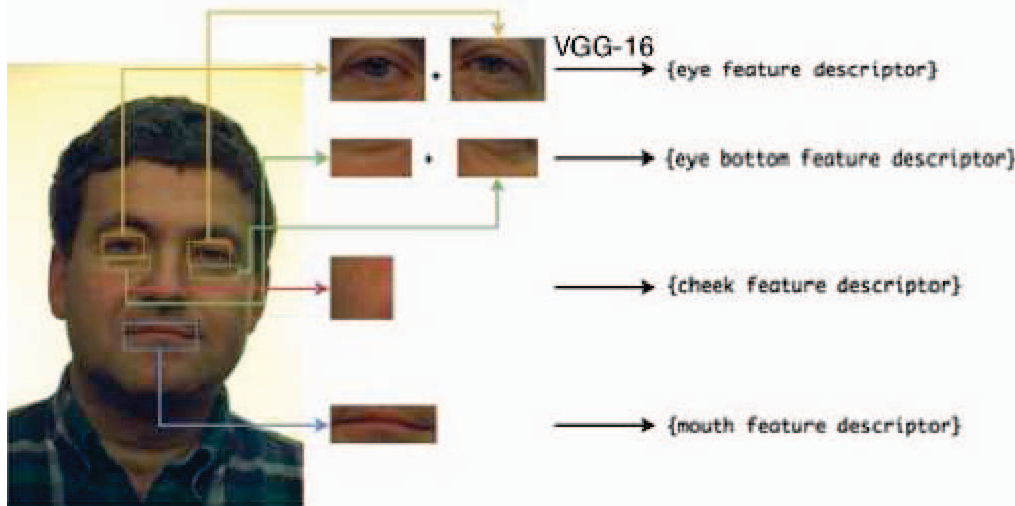 Figure: The feature extraction process, showing the segmentation of interest areas to isolate specific fatigue cues.
Experimental Results: Who is the Most Fatigued?
The researchers applied the model to 119,379 high-quality faces from Instagram. To validate the model, they compared photos tagged with #insomnia vs. #freshmorning, finding a statistically significant difference (p=0.0129) in predicted fatigue scores.
Key Demographic Insights:
- Age and the Weekend Effect: For those aged 30-40, fatigue peaks on Saturdays and Sundays. This suggests that "weekend recovery" may actually be a period of visible exhaustion for working adults.
- The Gender Gap: In the 30-50 age range, males appeared significantly more fatigued than females.
- The Friday Anomaly: Across several groups, Tuesdays often showed higher fatigue than Fridays, potentially reflecting the "mid-week slump" versus the anticipation of the weekend.
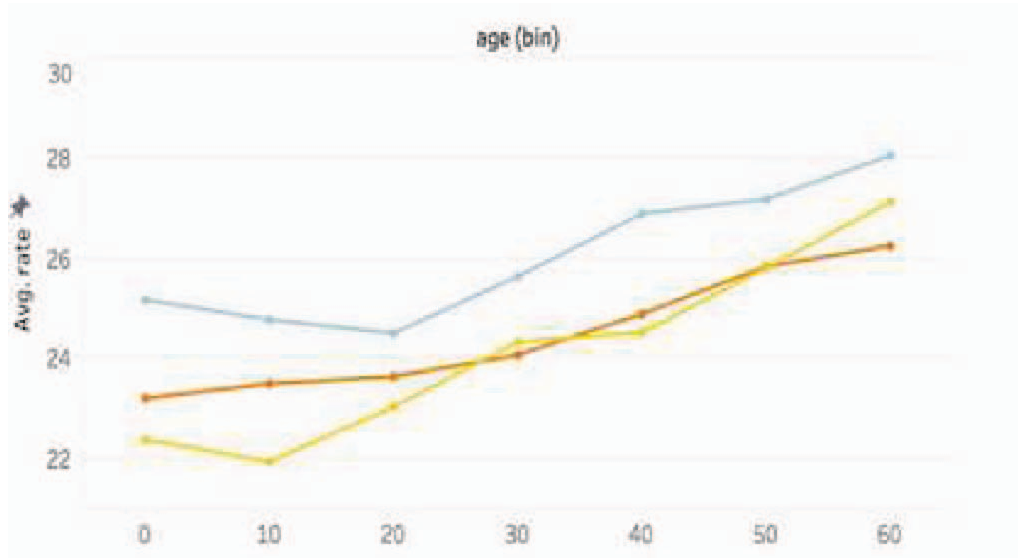 Figure: Comparison of fatigue trends across weekdays for different genders and age groups.
Critical Analysis & Future Outlook
Ethical and Technical Nuances
The paper honestly addresses several hurdles:
- The "Makeup" Bias: Cosmetics can mask pale skin and dark circles, potentially leading to underestimations of fatigue in certain demographics.
- Baselines: Some individuals naturally have "droopy" eyelids without being tired. Future work aims to establish a personalized baseline for each user to track relative changes.
- Selfie Selection Bias: People tend to post their "best" photos. The fact that fatigue is still detectable despite this "curation bias" suggests that the underlying biological signals are remarkably strong.
The Future of Computational Sociology
This research is a cornerstone for Digital Phenotyping. Instead of asking patients "How did you sleep?", public health officials could theoretically monitor the "facial fatigue" of a city to identify areas under high economic or social stress. As we integrate more sensors into our lives, our selfies might just become our most accessible health check-up.
Takeaway
This work proves that the intersection of deep learning and social media data isn't just for marketing—it’s a powerful tool for computational psychology, offering a mirror to the collective exhaustion of modern society.