
Slicing and Dicing MoE: The Case for Simpler, Massive Sparse Models
Slicing and Dicing: Configuring Optimal Mixtures of Experts
The paper presents a comprehensive study of over 2,000 pretraining runs to derive an optimal recipe for Mixture-of-Experts (MoE) architectures. It identifies that performance scales monotonically with total parameters, and the most critical design factors are expert count and granularity, while "flexible" options like shared experts or heterogeneous sizing provide negligible or negative benefits.
TL;DR
In the first systematic study of its kind involving over 2,000 pretraining runs, researchers from the University of Washington and NYU have found that the secret to high-performing Mixture-of-Experts (MoE) models isn't complexity—it's granularity and scale. While recent architectures have leaned into "generalist" experts and heterogeneous sizing, this data-driven post-mortem suggests that maximizing total expert count while keeping experts relatively coarse-grained is the real SOTA recipe.
Background Positioning
MoEs are the backbone of modern efficient LLMs (like Mixtral and DeepSeek). However, the design space is a mess of hyperparameters. This work serves as a "scientific cleanup," providing scaling laws for MoE configurations that debunk several recent architectural trends as being essentially "overhead with no profit."
Problem & Motivation: The Complexity Trap
Modern MoE design often involves "expert flexibility"—mixing different sizes of experts in one layer or keeping "generalist" experts active for every token. These innovations are often evaluated in isolation. The authors ask: Do we actually need this complexity, or is the performance gain simply a byproduct of having more parameters?
The researchers' intuition was that MoE performance is largely driven by total parameter capacity. If they could disentangled the "How" (architecture) from the "How Much" (parameter count), they could find the true source of MoE superiority.
Methodology: Disentangling Granularity
The core of the study lies in varying two specific variables:
- Expert Granularity (): The size of an expert compared to a standard dense FFN.
- Total Expert Count (): How many specialized sub-networks are available.
By holding the active parameters (FLOPs) fixed, they explored activation sparsity ratios up to 128x.
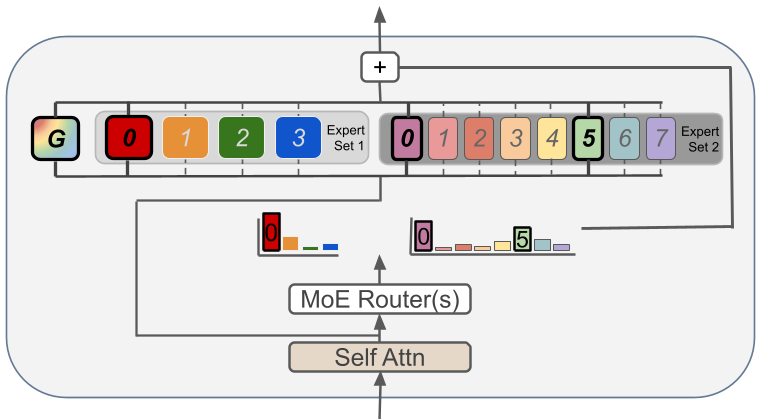 Figure 1: Comparison of homogeneous MoE vs. the complex heterogeneous and generalist configurations tested in the paper.
Key Insights: Flexibility vs. brute scale
1. Generalists are "Parasites"
Contrary to recent papers suggesting "shared experts" (like in DeepSeekMoE) are essential, this study found that they consistently degrade performance. Diverting parameters from specialized routed experts to a one-size-fits-all generalist reduces the model's ability to specialize without providing a "common knowledge" benefit that routed experts couldn't handle better.
2. Heterogeneity is unnecessary
Mixing experts of different sizes within a single layer (Set 1 vs Set 2 in Fig 1) performed no better than a well-tuned homogeneous setup. The model doesn't seem to benefit from having "small" and "large" experts available; it just wants more experts.
3. Dropless Routing Wins
Standard MoE routing often involve a "capacity factor" where some tokens are "dropped" (shipped to the next layer without FFN processing) if experts are overloaded. Dropless routing (ensuring every token gets processed) provided a small but consistent baseline improvement across all scales.
Experimental Proof: Scaling to 6.6B
The results show a clear monotonic trend: As long as you maintain a reasonable granularity (keeping experts at roughly 1/4 to 1/8 the size of a dense FFN), increasing the total number of experts always helps.
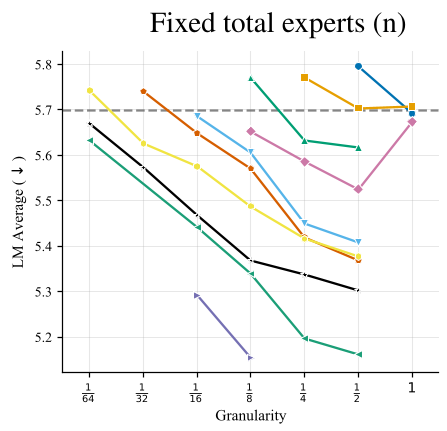 Figure 2: Scaling trends showing that performance leads to improvements purely based on parameter count, with optimal granularity (the "elbow" in the curves) remaining surprisingly stable across scales.
Takeaways & Critical Analysis
- The Simplified Recipe: Set your expert size () based on your active parameter budget (roughly ), then set the total count () to the maximum your memory allows.
- Load Balancing: Don't overthink it. While auxiliary losses are necessary, the model quality is robust over a wide range of loss weights.
- Limitations: The study focuses on model quality (Loss). In real-world production, very high expert counts () introduce communication overheads (All-to-All) that might offset the quality gains. Future work needs to bridge the gap between "Quality-Optimal" and "Throughput-Optimal."
Future Outlook
This paper serves as a "call to simplicity." As we push toward LLMs with trillions of parameters, the move toward massive, sparse, but homogeneous expert pools seems more promising than complex hand-crafted routing topologies. For researchers, it suggests that the "dark matter" of MoE—the inactive parameters—is far more important than we previously estimated.