
SlideAgent: Mastering the Hierarchy of Visual Document Understanding
SlideAgent: Hierarchical Agentic Framework for Multi-Page Visual Document Understanding
SlideAgent is a hierarchical agentic framework designed for multi-page visual document understanding (VDU), specifically targeting complex slide decks. It decomposes reasoning into global, page, and element levels, achieving SOTA performance with +7.9% and +9.8% accuracy gains over proprietary and open-source models, respectively.
TL;DR
Understanding a 100-page slide deck is a daunting task even for the most advanced Multimodal LLMs (MLLMs). SlideAgent addresses this by introducing a hierarchical, agentic approach that views documents through three lenses: the global theme, the individual page, and the fine-grained element (charts, icons, text blocks). This "divide and conquer" strategy delivers up to a 9.8% accuracy boost while slashing token costs by over 90%.
The "Holistic Bias" Problem
Most current MLLMs treat a document page as a single image. While this works for general descriptions, it fails spectacularly when a query demands precision. For example, a model might miscount segments in a cluttered pie chart when viewing the whole slide but succeed if it zooms in on that specific chart.
Existing systems also suffer from:
- Context Window Limits: You can't fit 50 high-res slides into a prompt.
- Metadata Dependency: Many tools break if the PDF doesn't have a clean underlying text layer (e.g., scanned or flattened documents).
- Spatial Blindness: Models struggle to "see" that a red arrow indicates a causal link between two specific text boxes.
Methodology: The Power of Three
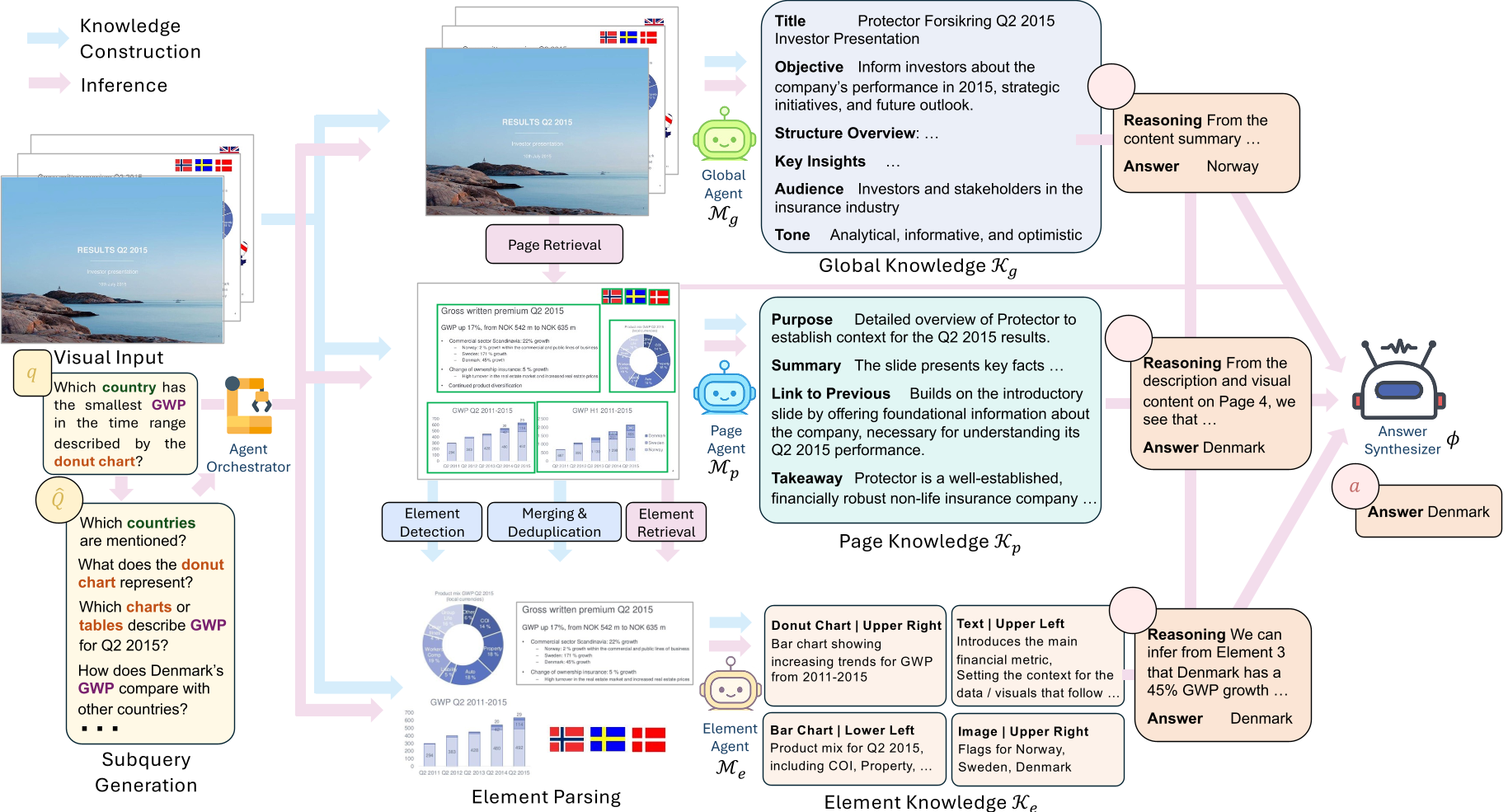
SlideAgent replaces the "single-shot" approach with a orchestrated team of specialized agents.
1. The Global Agent (The Strategist)
It scans the document to identify overarching themes, objectives, and narrative flow. It creates a "map" that helps the system decide which pages are relevant for a given query.
2. The Page Agent (The Contextualizer)
This agent processes pages sequentially. Crucially, it tracks cross-slide relationships, understanding how Slide 5 follows from the arguments made on Slide 4.
3. The Element Agent (The Specialist)
Using a metadata-free layout parsing pipeline, this agent breaks a slide down into its atomic parts:
- Text Blocks: Reconstructed using a graph-based merging algorithm to ensure semantic coherence.
- Visuals: Charts, logos, and icons are isolated and described.
Collaborative Inference
During the inference stage, an Agent Orchestrator classifies the user's query. Is it a "Global Understanding" question or a "Fact-based Direct Query"? This prevents computational waste by only activating the necessary agents.
If a query is complex, the Answer Synthesizer fuses reasoning from all three levels:
- Global: Filters the domain.
- Page: Locates the candidate slides.
- Element: Grounds the answer in visual evidence (e.g., "The revenue target is $5M as shown in the blue bar on the bottom-right chart").
Experimental Results: SOTA Performance
The researchers tested SlideAgent across diverse datasets, including SlideVQA, TechSlides, and FinSlides.
| Metric | GPT-4o (Base) | SlideAgent (GPT-4o) | Improvement |
|---|---|---|---|
| SlideVQA Overall | 77.0% | 84.9% | +7.9% |
| Numeric Reasoning | 72.1% | 80.4% | +8.3% |
| Multi-hop Reasoning | 67.4% | 77.2% | +9.8% |
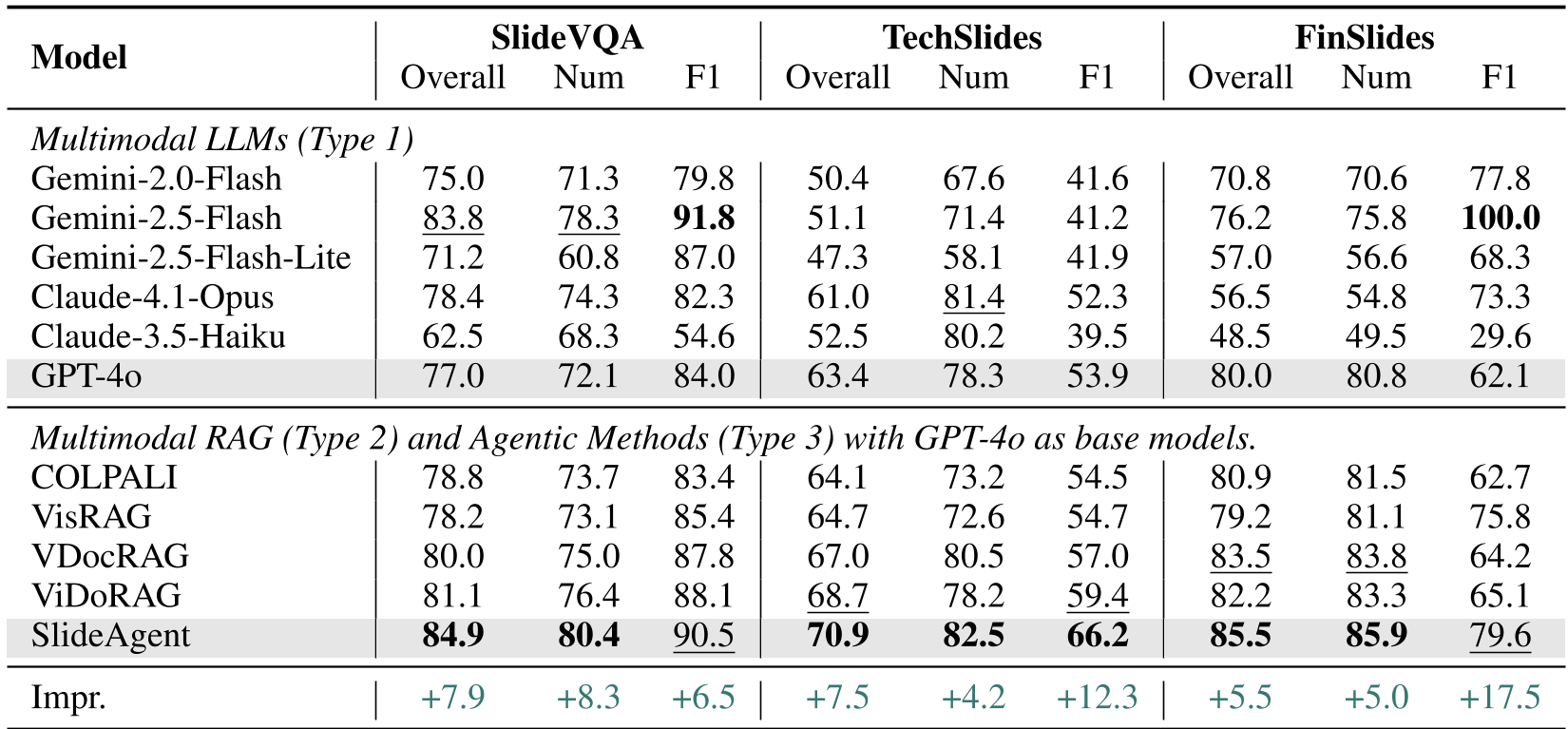
The ablation studies revealed that Page-level reasoning is the most critical component. Removing the Page Agent caused the steepest performance drop, highlighting that understanding the sequence of information is vital for document comprehension.
Critical Insight: Efficiency Meets Precision
One of the most impressive feats is that SlideAgent + BM25 (a simple keyword retriever) achieved 91% token reduction compared to raw model inputs while maintaining higher accuracy. This suggests that the "Secret Sauce" isn't just a bigger model, but a smarter way to cache and structure document knowledge.
Conclusion & Future Outlook
SlideAgent demonstrates that VDU is not just a vision problem or a language problem—it is a structural reasoning problem. By mimicking the human way of skim-reading (global), reading (page), and inspecting (element), SlideAgent provides a robust blueprint for the next generation of AI office assistants.
Future iterations will likely focus on:
- Inter-element relationship graphs: Explicitly modeling how a caption affects the interpretation of an adjacent figure.
- Multi-turn dialogues: Allowing users to "drill down" into document details through chat.
Disclaimer: This analysis is based on the SlideAgent paper (Jin et al., 2024/2025).