
Turning Noise into Signal: Mitigating Sloppiness in Crowd Scoring Tasks
Sloppiness mitigation in crowdsourcing: detecting and correcting bias for crowd scoring tasks
This paper introduces ITSC-TD, an iterative self-correcting truth discovery framework designed for crowd scoring (ordinal labeling) tasks. Unlike standard binary methods, it targets "sloppiness"—where workers provide labels that fluctuate around the truth—by specifically detecting and correcting biased workers to improve label aggregation.
TL;DR
In the world of crowdsourcing, we often discard inaccurate workers as "spammers." This paper argues that many inaccurate workers are actually "sloppy"—their errors follow a predictable bias. By introducing ITSC-TD (Iterative Self-Correcting Truth Discovery), the authors demonstrate that detecting and correcting these systematic biases can boost truth-discovery accuracy by up to 16% in complex ordinal scoring tasks.
The "Sloppiness" Problem: Beyond Binary Zeroes and Ones
Most research in crowdsourcing focuses on binary classification (Yes/No). However, real-world tasks—like grading an essay or rating a product—are scoring tasks with ordinal scales (e.g., 1 to 5).
The authors identify a specific class of "unreliable" worker: the Sloppy Worker. Unlike a spammer who provides random noise, a sloppy worker's judgments fluctuate around the truth. Specifically, Biased Sloppy Workers consistently shift their scores (e.g., always giving a "4" when the truth is "3"). Standard models like Majority Voting (MV) or Expectation Maximization (EM) treat these workers as low-quality, but this paper realizes they are actually high-information sources—if you can identify the shift.
Methodology: The ITSC-TD Framework
The core of the paper is a two-step iterative process that doesn't requires "Gold Truths" (expert-verified labels) to work.
1. Bias Detection and Correction
Using a vanilla Bayesian estimation, the model treats worker accuracy () and bias (, ) as distributions. It calculates a Bias Score (BS) derived from Information Gain.
- Insight: If a worker has a high Bias Score and a high error rate, the model identifies them as "Biased Sloppy."
- Correction: The model "de-biases" these workers by shifting their observed labels (e.g., subtracting 1 from all their scores) before the next phase.
2. Optimization-Based Truth Discovery
Once labels are corrected, the model uses an optimization framework to minimize the weighted deviation between the (now corrected) observations and the hidden true labels.
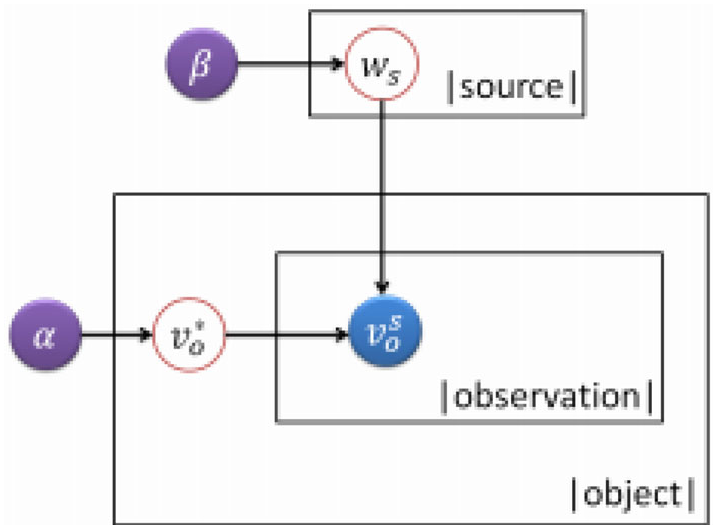 Figure 1: The general graphical model for crowdsourcing aggregation, showing the relationship between true labels (), observed labels (), and worker reliability ().
Experimental Proof: When Sloppiness Dominates
The authors tested ITSC-TD against heavyweights like GLAD and EM-DS (Dawid & Skene).
The "Knee Point" of Performance
The most striking discovery was that when the proportion of biased workers exceeds 50%, standard models' performance collapses. In contrast, ITSC-TD maintains high accuracy because it effectively "recruits" the biased workers into the reliable pool by correcting their scores.
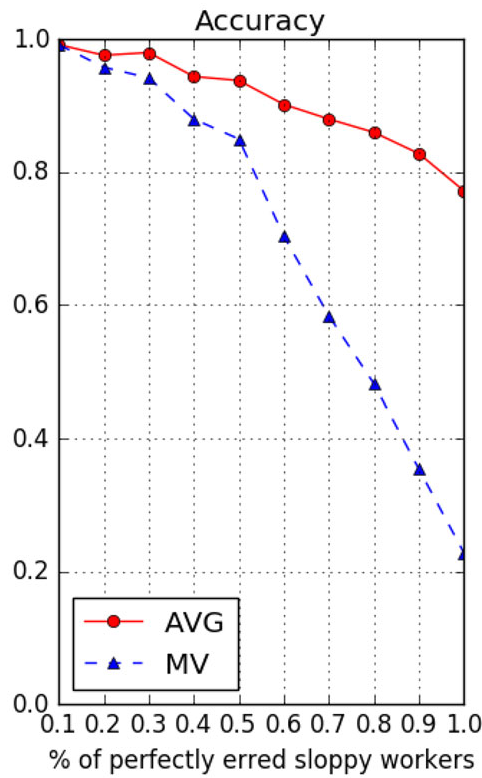 Figure 2: Influence of sloppy workers on consensus labels. As the proportion of perfectly erred workers increases, the gap between traditional methods and corrected models widens.
Real-World Validation
On real datasets like TREC (relevance judgments) and AC2 (adult content filtering), the model successfully identified dozens of biased workers. In the TREC dataset, it achieved a 2-8% improvement in accuracy over traditional EM-based methods, proving that "sloppiness" is a tangible factor in large-scale human labeling.
Critical Insight & Future Work
The fundamental takeaway is that accuracy is not the only metric for worker value. A worker who is 100% wrong but always "off by one" is just as valuable as a worker who is 100% right.
However, the paper acknowledges a limitation: it assumes the bias is constant across all items. Future extensions could investigate task-dependent bias, where a worker might be "generous" when grading difficult items but "strict" on easy ones. This work paves the way for more resilient human-in-the-loop systems that can extract truth from even the most "sloppy" crowds.
Summary of Gains (TREC Dataset):
- Accuracy: +2.0% - 8.0%
- F1 Measure: +4.0% - 9.0%